

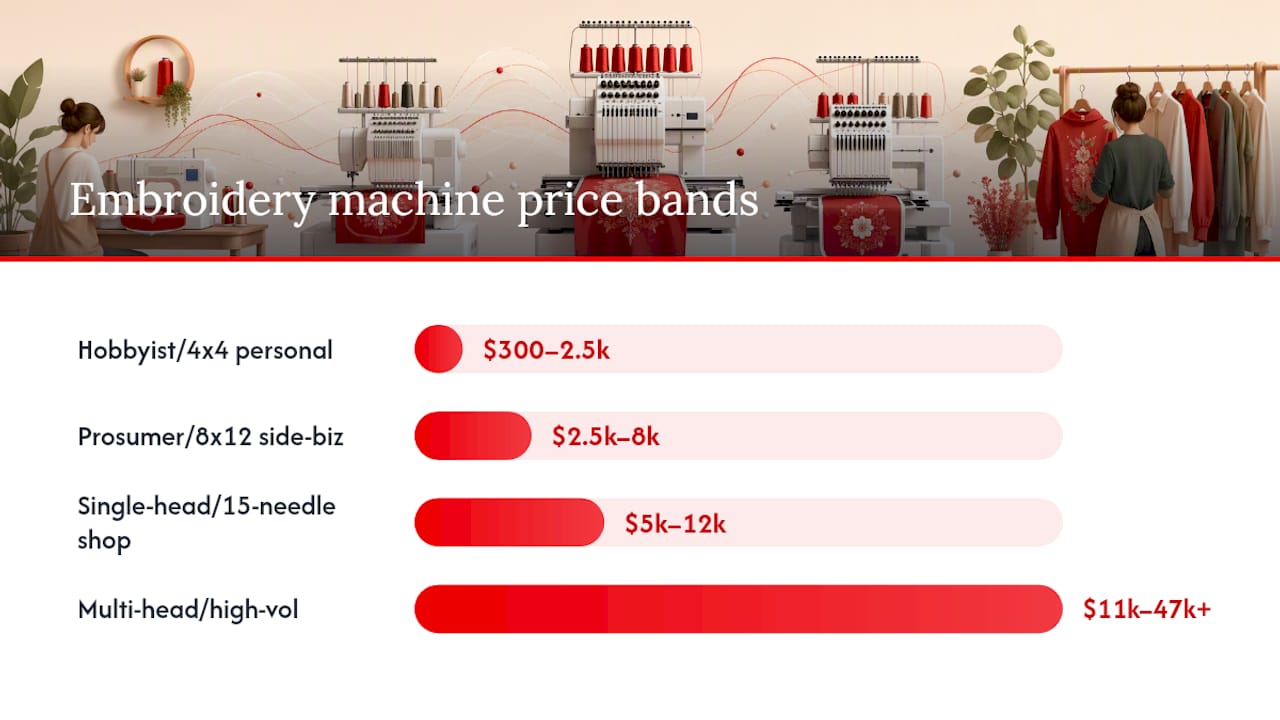
Embroidery machine cost in the US falls into three clear bands: hobbyist machines run roughly $300–$2,500, prosumer and semi-commercial models sit between $2,500–$8,000, and commercial or multi-head systems start around $8,000 and can exceed $25,000. The single most useful rule of thumb: if you plan to sell embroidered goods, target enough budget to get multi-needle reliability and the speed that makes production profitable. For personal or occasional use, staying under $1,500 is usually the right call.
Quick facts before you read further:
- Entry-level single-needle machines: $300–$1,200
- Prosumer multi-needle machines: $3,000–$8,000
- Single-head commercial units: $5,000–$12,000
- Multi-head industrial systems: $11,000–$47,000+
- Hidden fees to check: shipping, import duties (can add 10–30%), software licenses, and training
- Resale value holds best on commercial-grade machines from established brands
Most first-time buyers underestimate this by at least $300.*
Key Takeaways
Embroidery machine cost ranges from $300 for a basic home model to over $47,000 for a multi-head industrial system, and the right band depends entirely on your production volume and growth plan.
| Point | Details |
|---|---|
| Three clear price bands | Hobbyist: $300–$2,500; prosumer: $2,500–$8,000; commercial/multi-head: $8,000–$47,000+. |
| $3,000 is the business threshold | Buyers planning to sell should target at least $3,000 for multi-needle reliability and production-viable speed. |
| Budget 15–20% beyond sticker price | Launch essentials (hoops, software, stabilizer, thread) typically add $400–$800 to the real purchase cost. |
| Annual maintenance reserve | Plan for 5–10% of the machine’s purchase price per year in maintenance costs. |
| Sewingmachinesplus dealer advantage | Over 50 years as an authorized dealer, price-match guarantee, financing, and free shipping over $49 reduce total ownership cost. |
Table of Contents
- How much does an embroidery machine cost by use case?
- What actually drives the upfront price higher?
- What does it actually cost to own and run an embroidery machine?
- Accessories, software, and add-ons that buyers often miss
- Where you buy changes your total cost more than you might think
- A practical checklist before you commit to a purchase
- Why buying from an authorized dealer reduces your real cost
- What experienced dealers see buyers get wrong
- Sewingmachinesplus makes it easier to buy the right machine at the right price
- Sources
- FAQ
How much does an embroidery machine cost by use case?
Price bands only make sense when you match them to what you actually plan to do. A machine that is perfect for monogramming baby blankets on weekends is completely wrong for a shop filling 200-piece corporate orders. Here is how the tiers break down.
Hobbyist and home use: $300–$2,500
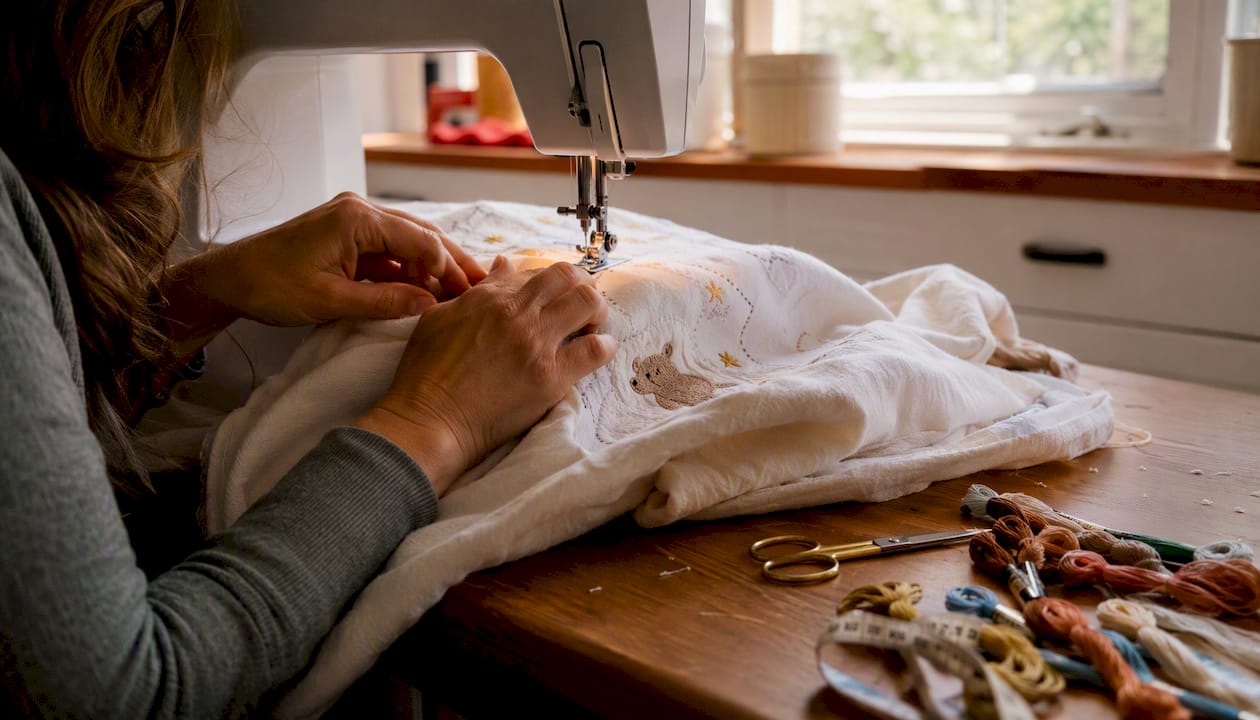
Entry-level machines suitable for beginners typically run $400–$1,200, with single-needle designs, smaller embroidery fields (4"x4" to 5"x7"), and built-in design libraries. They are fine for gifts, personal projects, and learning the craft. Machines toward the top of this range add larger hoops, more built-in designs, and USB connectivity.
Prosumer and semi-commercial: $2,500–$8,000
This is where the jump to multi-needle machines happens. Four-needle and six-needle models in this range let you run multiple thread colors without stopping to re-thread, which cuts production time dramatically. Speed climbs to 800–1,000 stitches per minute (SPM), and hoop sizes expand to 8"x12" or larger.
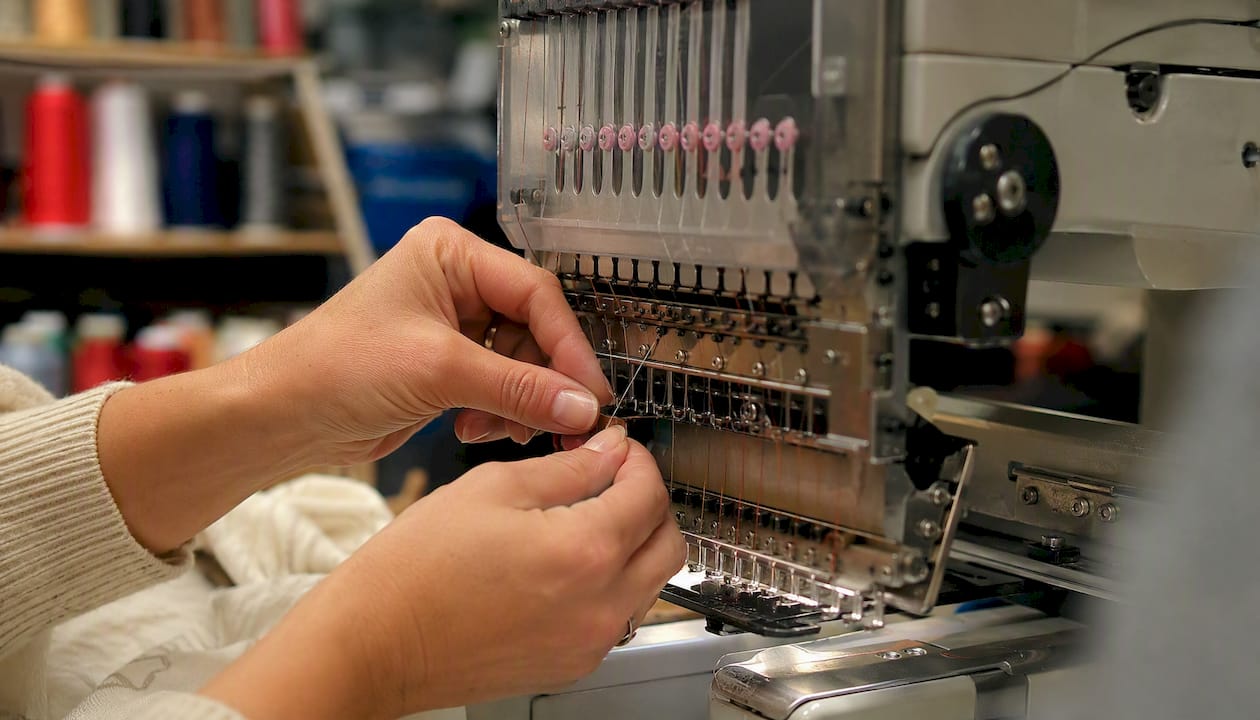
A practical threshold worth knowing is a budget level where buyers begin to obtain professional-grade reliability, improving potential return on investment for small production runs.
Single-head commercial: $5,000–$12,000
Commercial listings show single-head packages near $5,495, with 15-needle heads, speeds of 1,000–1,500 SPM, and frames built for all-day production. These machines handle caps, jackets, and flat goods without the workarounds that prosumer machines require. Expect a steel frame, servo motor, and a larger touchscreen for design management.
Multi-head and industrial: $11,000–$47,000+
Multi-head systems multiply output by running identical designs on several garments simultaneously. A two-head machine roughly doubles throughput; a six-head machine can fill large orders in a fraction of the time. Prices scale with head count, automation level, and brand support. Some industrial packages with advanced automation exceed $47,000.
| Band | Price Range | Typical Features | Best For |
|---|---|---|---|
| Hobbyist/home | $300–$2,500 | Single needle, 4"x4"–5"x7" hoop, built-in designs | Personal projects, gifts, learning |
| Prosumer | $2,500–$8,000 | 4–15 needles, 8"x12"+ hoop, 800–1,000 SPM | Side business, small production runs |
| Single-head commercial | $5,000–$12,000 | 15 needles, 1,000–1,500 SPM, steel frame, servo motor | Small shops, cap and jacket work |
| Multi-head industrial | $11,000–$47,000+ | Multiple heads, high automation, large field | High-volume production shops |
What actually drives the upfront price higher?
Two machines can sit in the same price band and differ by thousands of dollars. These are the specific features that move the needle on sticker price.
Needle count and head count are the biggest single drivers. Moving from a single-needle home machine to a 15-needle commercial head can triple the price, because multi-needle machines require more complex thread-path engineering, larger frames, and more robust motors.
Stitch speed (SPM) and motion systems matter for production buyers. Servo motors run quieter, faster, and more efficiently than stepper motors, and they add cost. A machine rated at 1,500 SPM with a servo system will cost more than a 600 SPM stepper-driven model, even with similar needle counts.
Hoop size and embroidery field directly affect price. A machine with a 14"x14" field costs more than one limited to 4"x4", because the frame, arm, and drive system must all scale up.
Automation features add up quickly:
- Auto thread trim: saves time per design but adds mechanical complexity
- Automatic color change: standard on commercial heads, rare on budget machines
- Cap frame attachments: specialty capability that raises both machine and accessory cost
- Touchscreen and onboard software: larger, higher-resolution screens with built-in digitizing tools push price up
Brand and dealer support are priced in. Machines from established brands with US-based service networks carry a premium over no-name imports, but that premium often pays back through lower downtime and available parts.
New vs. refurbished is a real lever.
What does it actually cost to own and run an embroidery machine?
The sticker price is only the beginning. Thread, stabilizer, and needles cost cents to a few dollars per piece, but annual maintenance reserves typically run about 5–10% of the machine’s initial value. On a $5,000 commercial machine, that is $250–$500 per year just for upkeep.
Recurring consumables to budget for:
- Thread: a quality 80-color thread assortment runs $30–$80; per-piece thread cost is typically a few cents
- Stabilizer (cut-away, tear-away, water-soluble): $15–$40 per roll; per-piece cost varies by design complexity
- Bobbins: $5–$15 for a 10-pack; replace regularly for consistent tension
- Needles: $5–$15 per pack of 10; change every 8–10 hours of run time
- Specialty adhesive (temporary fabric spray): $10–$20 per can for hooping delicate items
Sample per-piece cost calculation:
Suppose you buy a $5,000 single-head commercial machine with a 5-year useful life and run 2,000 pieces per year. Machine depreciation alone works out to $0.50 per piece. Add $0.10 for thread, $0.15 for stabilizer, $0.05 for needle wear, and $0.25 for maintenance reserve, and your hard cost per piece is roughly $1.05 before labor and electricity. At a typical retail price of $8–$15 per embroidered item, the margin is strong once volume is consistent.
Pro Tip: Track your actual consumable use for the first 90 days. Most buyers overestimate thread cost and underestimate stabilizer use, especially on dense designs.
Labor is the largest variable. At home, your time is the cost. In a shop, factor in operator wages, setup time per design, and re-hooping time for multi-piece orders. Electricity is minor for single-head machines but worth noting for multi-head setups running 8+ hours daily.
Accessories, software, and add-ons that buyers often miss
These costs rarely appear in the headline price, but they are real and they add up fast.
Digitizing and design software is the most commonly underestimated line item. Professional digitizing suites can run several hundred to a few thousand dollars for a full license. Entry-level options with basic auto-digitizing start lower, but serious production work needs a proper tool. A product like Singer Quantum Futura embroidery software is a practical starting point for buyers who want design flexibility without a full commercial suite.
Hoops and frames are not always included. A standard hoop set for a commercial machine can cost $100–$400 depending on sizes. Cap frames for hat embroidery are a separate purchase, often $150–$400.
Other add-ons to budget for:
- Magnetic hoops: $50–$150 each; faster hooping, less distortion on stretchy fabrics
- Thread stand or rack: $30–$100 for multi-spool setups
- Machine stand or table: $100–$300 if not included
- Specialty feet (embroidery/darning): $10–$30 each, such as a Singer embroidery foot
- Starter needle pack: $10–$20
- Embroidery scissors: $15–$40 for a quality pair like Gingher double-curved scissors
A realistic “launch essentials” budget for a new commercial buyer: $400–$800 on top of the machine price, covering hoops, software, a thread starter kit, stabilizer, and basic accessories.
Where you buy changes your total cost more than you might think
Buying channel is a real cost driver, not just a convenience preference.
Authorized dealers provide setup assistance, training, warranty handling, and access to local service technicians. When a commercial machine goes down mid-order, having a dealer who can dispatch a technician or ship a part overnight is worth real money. Dealers often bundle training, spare parts, and accessories into the purchase price, and asking for a bundled quote can save hundreds versus buying components separately.
Brand-direct purchases offer factory pricing and direct warranty support but may lack the hands-on setup and local service that dealers provide.
Marketplace purchases (large online platforms) offer competitive pricing and wide selection, but warranty handling typically falls to the buyer, and service support is limited to what the individual seller provides. For hobbyist machines, the risk is manageable. For a $10,000 commercial system, the absence of dealer-level support is a meaningful financial exposure.
Overseas and import listings deserve special caution. Hidden import costs can add 10–30% or more to the purchase price once shipping, customs duties, and freight are included. A machine listed at $4,000 from an overseas supplier can land at $5,000–$5,200 after duties, and warranty service may require shipping the machine internationally.
Financing and price-match options change the monthly math significantly. A $5,000 machine financed over 24 months at a typical dealer rate works out to roughly $220–$240 per month, which many small businesses can cover with just a few dozen orders. Always ask whether the dealer offers a price-match guarantee before you commit.
Trust signals to verify before purchase:
- Confirmed authorized dealer status for the brand you are buying
- Written warranty with clear terms (parts, labor, duration)
- Local or regional service network access
- Clear return and exchange policy
A practical checklist before you commit to a purchase
Work through these steps before signing anything.
- Define your volume. How many pieces per week do you realistically expect to produce in year one? Under 50 per week points to prosumer; over 200 points to single-head commercial or multi-head.
- Map your design complexity. Simple text and logos need fewer needles. Photorealistic or densely detailed designs need a machine with high SPM and precise tension control.
- Set your total budget, not just the machine price. Add 15–20% for launch essentials (hoops, software, stabilizer, thread).
- Confirm your growth plan. If you expect to double volume in 18 months, buy one level above your current need rather than upgrading in two years at full cost.
- Get a bundled quote. Ask the dealer to price machine + training + starter accessories as a package.
Exact questions to ask the seller:
- What is the warranty duration, and does it cover both parts and labor?
- Is training included, and is it in-person or remote?
- Which accessories and hoops ship with the machine?
- What is the typical parts lead time for this model?
- Is there a local service technician, or does the machine need to be shipped for repair?
- Does the price include all import, freight, and setup costs?
Red flags that signal a risky purchase:
- No written warranty or warranty limited to 90 days
- No local service network for commercial machines
- Seller cannot confirm authorized dealer status
- Missing documentation (user manual, software license, calibration records)
- Price significantly below market with no explanation
Why buying from an authorized dealer reduces your real cost
The purchase price is only one number. Downtime, repair bills, and the cost of bad training decisions add up faster than most buyers expect.
Authorized dealers reduce ownership risk through bundled setup, training, price-match guarantees, financing options, and local service access. When you buy from a dealer with a verified service network, you are not just buying a machine. You are buying the support infrastructure that keeps it running.
Sewingmachinesplus has operated as an authorized dealer for over 50 years and carries more than 175,000 positive customer reviews. The site offers a price-match guarantee, financing options, and free shipping on orders over $49. For buyers comparing total cost of ownership, those terms directly reduce the gap between the sticker price and what you actually spend in year one.
Concrete dealer advantages:
- Bundled accessories and setup reduce the “launch essentials” gap
- Training shortens the learning curve and reduces costly setup errors
- Price-match guarantee means you are not leaving money on the table
- Financing spreads cost across months, improving cash flow for new businesses
- Authorized service access cuts repair turnaround time versus marketplace purchases
A buyer who saves $300 on a marketplace purchase but spends $600 on a repair that a dealer would have covered under warranty has not saved anything.
What experienced dealers see buyers get wrong
Most buyers focus on needle count and miss the question that matters more: does this machine match my realistic order volume for the next 18 months?
A hobbyist machine pushed into small-business production wears out faster, produces inconsistent results under load, and costs more in repairs than the upgrade would have. The opposite mistake is just as common: a new embroiderer buying a $12,000 commercial system before they have a single paying customer, then struggling to cover the monthly payment.
The right machine is the one that fits your current volume with a little room to grow, bought from a seller who will still be there when you need a part or a technician.
Pro Tip: Before you buy, run a simple break-even calculation: divide the total machine cost (including accessories and software) by your expected profit per piece. That number tells you exactly how many orders you need to recover the investment. If it takes more than 18 months at realistic volume, consider the next tier down.
Sewingmachinesplus makes it easier to buy the right machine at the right price
Picking the right machine at the right price is straightforward when you have the right support. Sewingmachinesplus offers personalized consultations that match your production goals to the correct price band, so you are not guessing between a $3,000 prosumer and a $7,000 commercial unit. With a price-match guarantee, financing options, free shipping on orders over $49, and over 50 years as an authorized dealer, the total cost of buying here is lower than it looks at first glance.
Whether you are buying your first embroidery machine or upgrading to a multi-needle commercial system, the team at Sewingmachinesplus can walk you through the options, bundle the accessories you actually need, and connect you with financing that fits your cash flow. Browse machines and start a consultation at Sewingmachinesplus to get a real price and a real plan before you commit.
Sources
The price ranges and cost guidance in this article draw from the following US-focused sources:
- Understanding Embroidery Machine Cost: A Complete Guide
- How Much Does An Embroidery Machine Actually Cost? 2026 Real-World Pricing & Guide - News - Yunfu Equipment
- Computer Embroidery Machine Cost: A Complete Buyer’s Guide for Every Budget – MagneticHoop
- Embroidery Machine Price: A 2026 Buyer’s Cost Guide | Dirt Cheap Headwear
- Embroidery Machine Rates: Comprehensive Cost Breakdown and Buying Guide
FAQ
How much does a decent embroidery machine cost?
A capable home machine for regular personal use typically runs $400–$1,200. For small-business production, expect to spend $3,000 or more to get multi-needle reliability and the speed needed to fill orders profitably.
Is owning an embroidery machine profitable?
Yes, for buyers who match machine capacity to realistic order volume. A $5,000 commercial machine producing 2,000 pieces per year can recover its cost in under two years at typical retail pricing, once consumables and maintenance are factored in.
What is the best embroidery machine for the money?
The best value depends on your use case. For hobbyists, machines in the $400–$1,200 range offer strong feature-to-price ratios. For small production shops, multi-needle prosumer machines in the $3,000–$5,000 range deliver the reliability and speed that make orders profitable. Sewingmachinesplus carries options across all bands with a price-match guarantee.
