

Most U.S. small businesses can finance new or used commercial embroidery machines, and you can start with a one-page application or vendor pre-approval today. The fastest routes are application-only equipment lenders (approvals often within a few days), vendor partner financing through Sewingmachinesplus, or a short-term lease that gets you producing immediately. SBA loan programs are also available for established businesses that want the lowest possible rate and can handle a longer approval window.
Here is what to do right now:
- Get a machine quote or invoice. Lenders need a specific equipment cost to structure your financing.
- Request a one-page pre-approval. Application-only lenders can respond in hours without requiring full financial statements.
- Contact Sewingmachinesplus for vendor financing options, a tailored monthly payment estimate, or to start an application directly.
- Note your tax position. Section 179 of the U.S. tax code lets many businesses deduct the full cost of financed equipment in the year it is placed in service — a real cash-flow advantage worth discussing with your accountant before you sign.
Table of Contents
- What embroidery machine financing options are available to you?
- How does the financing process work, step by step?
- Who qualifies, and what do lenders check?
- What are the typical costs, terms, and monthly payments?
- How does financing affect your taxes and accounting?
- How do you choose the right lender and financing product?
- Why specialty equipment lenders often outperform general bank loans
- Key Takeaways
- The financing path most shops overlook
- Useful sources and further reading
What embroidery machine financing options are available to you?
Not every financing product fits every shop. Here is a plain-language breakdown of what you will actually encounter, and who each option suits best.
Vendor financing and 0% promotional offers. Sewingmachinesplus and select machine manufacturers offer direct financing, sometimes with 0% promotional periods. These are worth taking when the promotional window covers your expected payoff timeline — but always calculate the total cost if you carry a balance past the promo period, because deferred-interest structures can be expensive.
Equipment loans. A lender advances the full purchase price; you repay principal plus interest over a fixed term. You own the machine outright from day one, which matters for Section 179 deductions and long-term asset value. Equipment loans work well for established shops that want ownership and predictable payments.
Operating leases. You pay to use the machine for a set period, then return or upgrade it. Monthly payments are typically lower than loan payments on the same equipment, and the lease expense runs through your income statement rather than your balance sheet. Best for shops that want to upgrade to newer multi-head machines every few years.
Capital leases and lease-to-own. Structured like a loan in accounting terms, with a nominal buyout at the end (often $1). Beacon Funding and similar specialty lenders offer lease-to-own programs covering both new and used equipment, with terms from 24 to 84 months and approvals within 24 hours.
SBA 7(a) loans and microloans. Competitive rates and long terms, but approval takes weeks to months and documentation requirements are substantial. Best reserved for larger purchases or when you need the absolute lowest APR and your business financials are strong.
Business credit cards. Useful for smaller accessories or software, not a practical tool for a $30,000+ commercial machine. Interest rates are high and credit limits rarely cover full equipment costs.
BNPL and merchant financing (Affirm, Acima Leasing). Point-of-sale installment options like Affirm and lease-to-own programs like Acima Leasing can work for lower-ticket machines or accessories. Acima Leasing, in particular, is designed for customers who want flexible payment structures without a traditional credit approval process.
- Established shops — with strong revenue can access SBA rates or negotiate better APRs from specialty lenders.
- Used-machine buyers — should confirm upfront that the lender accepts used equipment — Beacon Funding explicitly does, and specialty lenders often include warranties and accessories in the financed package.
Pro Tip: Before accepting a 0% vendor offer, ask for the full deferred-interest terms in writing. If the balance is not paid in full before the promotional period ends, many programs retroactively charge interest from day one.
How does the financing process work, step by step?
The path from “I need a machine” to “the machine is running in my shop” is more straightforward than most business owners expect. Here is the sequence.
- Get a written quote or invoice. Contact Sewingmachinesplus or pull a specific product page. Lenders need an itemized cost — machine, shipping, installation, software — to structure your financing amount.
- Choose your financing type. Equipment loan, lease-to-own, or vendor financing. Your choice affects ownership, tax treatment, and monthly payment.
- Submit a pre-application. Application-only programs up to $75K–$250K require only a one-page form, a government-issued ID, and recent bank statements. No tax returns, no full financial package.
- Receive a credit decision. Application-only lenders typically respond in 24–48 hours. Traditional banks and SBA lenders take weeks to months.
- Review and sign the agreement. Read the amortization schedule, confirm the total cost of financing, and check for early payoff penalties before signing.
- Funding and delivery scheduling. Once documents are signed, funds are typically released within one to a few business days. Coordinate delivery with Sewingmachinesplus so installation and training align with your funding date.
Minimum documents for most application-only approvals:
- Completed one-page application
- Government-issued photo ID
- Business bank statements (typically 3 months)
- Equipment quote or invoice
- EIN or business license
For amounts above the application-only threshold, lenders may also request two years of business tax returns and a profit-and-loss statement.
A note on rolling in soft costs. Shipping, installation, initial software, and training can often be included in the financed amount. Rolling these in preserves your working capital and means production starts sooner — without a separate out-of-pocket expense at delivery.
Who qualifies, and what do lenders check?
Lenders underwrite embroidery equipment financing on a handful of core factors. Knowing them lets you assess your readiness before you apply.
- Credit score. Most specialty equipment lenders want a personal FICO score of 600 or above for standard programs; stronger scores (680+) unlock better rates. Some lease-to-own programs work with lower scores.
- Time in business. Many lenders prefer at least 1–2 years of operating history, but startup programs exist — often at slightly higher rates or with a larger down payment.
- Annual revenue. Lenders want to see that monthly payments are serviceable against your cash flow. There is no universal threshold, but demonstrating consistent, recurring revenue strengthens any application.
- Application-only thresholds. Up to $75K–$250K, many lenders approve based solely on credit profile and bank statements — no financial statements required. This is the sweet spot for most single-head or multi-head commercial embroidery machine purchases.
- Collateral. Equipment financing typically uses the machine itself as collateral, which avoids the blanket liens on all business assets that traditional bank loans often require.
Documents to have ready:
- One-page application
- Government-issued ID
- 3 months of business bank statements
- Equipment invoice or quote
- EIN or business license
- Tax returns and P&L (for amounts above the application-only threshold)
Pro Tip: Group your bank statements to highlight months with strong, recurring revenue — contract embroidery orders, wholesale accounts, or seasonal spikes. Lenders read bank statements for patterns, not just averages.
What are the typical costs, terms, and monthly payments?
Understanding the numbers before you apply puts you in a much stronger negotiating position.
Loan and lease amounts typically start near $10,000 and can reach $500,000 or more for multi-head commercial setups. Crestmont Capital advertises customized programs from $10,000 to $2 million. Most single-shop purchases fall within a moderate price range.
Term lengths run 24–84 months. Shorter terms mean higher monthly payments but less total interest paid. Longer terms reduce monthly cash outflow but increase total financing cost.
Rate bands vary by lender type:
- Banks and SBA: lowest APRs for qualified borrowers, but slower and more documentation-intensive
- Specialty equipment lenders: Crestmont Capital advertises rates starting at 3.25% for qualified borrowers; Genesis Commercial Capital advertises rates as low as 4.5%
- Vendor/captive promos: 0% for a limited period, then standard rates
- Factor-rate products (some BNPL/merchant lenders): expressed as a multiplier (e.g., 1.25x), not an APR — always convert to APR to compare fairly
Example monthly payment. A $40,000 machine financed over 60 months at a 9% APR produces a monthly payment of roughly $830. At 12% APR over the same term, that rises to approximately $890. Rolling in $3,000 in shipping and installation brings the financed amount to $43,000 — adding about $25–$30 per month at the same rates.
| Feature | Typical Range |
|---|---|
| Loan/lease amount | $10,000 – $500,000+ |
| Term length | 24 – 84 months |
| Approval time (application-only) | 24 – 48 hours |
| Approval time (bank/SBA) | Weeks to months |
| Used equipment accepted | Yes (specialty lenders) |
| Down payment | 0% – varies depending on credit and lender |
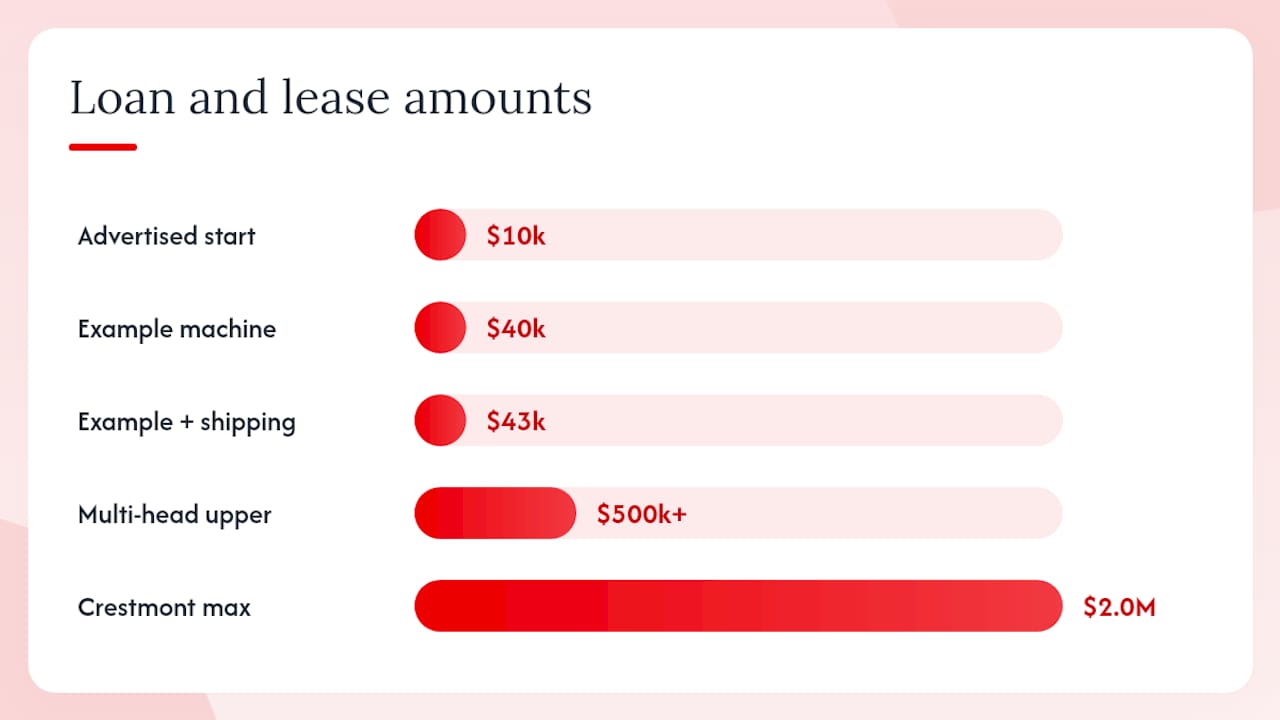
Down payments, origination fees (typically 1%–3% of the financed amount), and any prepayment penalties all affect your true cost. Always ask for a written total-cost-of-financing figure before signing.
How does financing affect your taxes and accounting?
The tax and accounting treatment of your financing choice can be as valuable as the rate itself.
- Section 179. Under current U.S. tax law, you can deduct the full purchase price of qualifying equipment placed in service during the tax year — even if you financed it. You do not need to pay cash to claim the deduction. Consult your accountant to confirm your machine qualifies and that your business has sufficient taxable income to absorb the deduction.
- Bonus depreciation. Available alongside or instead of Section 179 for qualifying property, allowing accelerated first-year write-offs. Rules change periodically, so verify the current percentage with a tax professional.
- Loan accounting. An equipment loan appears on your balance sheet as both an asset (the machine) and a liability (the loan). Interest is typically deductible as a business expense.
- Operating lease accounting. Lease payments run through your income statement as an operating expense. The machine does not appear as an asset, which keeps your balance sheet lighter.
- Capital lease / lease-to-own accounting. Treated like a purchase: the machine is an asset, the obligation is a liability, and you can typically claim depreciation and Section 179.
- Rolling in soft costs. Shipping, installation, and training rolled into the financed amount increase your depreciable basis, which can increase your Section 179 or depreciation deduction.
Pro Tip: Talk to your accountant before choosing your term length. A shorter term increases your annual payment, which may reduce your taxable income more aggressively in the current year — a meaningful advantage if you are having a strong revenue year.
This section is general information, not tax or legal advice. Confirm current rules and your specific eligibility with a qualified tax professional.
How do you choose the right lender and financing product?
The right financing product depends on three things: how fast you need the machine, whether you want to own it long-term, and what your cash flow looks like month to month. Here is a decision framework.
Match term to useful life. A commercial embroidery machine with a 10-year useful life can reasonably support a 60–84 month term. Financing a machine over 84 months when you expect to upgrade in four years means paying for an asset you no longer own.
Choose application-only for speed. If you have a production deadline or a large order incoming, application-only programs get you funded in 24–48 hours without a full financial package.
Choose lease-to-own if upgrades matter. Lease-to-own structures let you build equity and buy out at the end, while keeping monthly payments lower than a straight loan.
Choose a loan for long-term ownership. If you plan to run the machine for its full useful life and want to maximize Section 179, a loan is cleaner.
Ten questions to ask every lender before signing:
- What is the APR (not just the factor rate or monthly payment)?
- Are there origination, documentation, or closing fees?
- What down payment is required?
- Is there an early payoff penalty, and how is it calculated?
- What are the buyout terms at lease end?
- Do you finance used equipment, and are there age or condition restrictions?
- Can payments be structured seasonally or with a 90-day deferred start?
- How long does funding take after signing?
- What documentation is required for my loan amount?
- How is this financing classified for tax purposes?
Red flags to watch for:
- Vague or undisclosed fees not itemized in the agreement
- Blanket liens on all business assets rather than just the financed equipment
- Buyout language that is difficult to exercise or requires additional negotiation
- Factor-rate pricing presented without an equivalent APR
Pro Tip: Always request a written amortization schedule and a final total-cost-of-financing figure. If a lender resists providing either, that is a signal to keep shopping.
Why specialty equipment lenders often outperform general bank loans
General bank loans are not designed with embroidery shops in mind. Specialty equipment lenders are, and the structural differences show up in ways that directly affect your cash flow and approval odds.
Equipment financing from specialty lenders typically uses the machine itself as collateral, which means no blanket lien on your inventory, receivables, or other business assets. Traditional bank loans frequently require exactly that, along with restrictive covenants that limit how you can operate your business while the loan is outstanding.
Speed is the other major advantage. Application-only programs up to $250,000 from lenders like Genesis Commercial Capital can approve and fund in 24–48 hours, with flexible pay structures including 90-day deferred starts and seasonal payment schedules. That kind of structure lets you align your first payment with your first revenue from the new machine. Crestmont Capital and Beacon Funding offer similar flexibility, and checking BBB accreditation for any lender you are considering is a straightforward way to verify reputation before you commit.
SBA loans still make sense in one specific scenario: an established business with strong financials that wants the absolute lowest APR and is not in a hurry. The documentation burden and multi-week approval window are real costs, but the rate savings over a large, long-term loan can be substantial.
Pro Tip: If your purchase is above the application-only threshold and you have two or more years of clean financials, get quotes from both a specialty equipment lender and your current bank. The rate difference will tell you whether the SBA route is worth the extra time.
Key Takeaways
Financing a commercial embroidery machine is straightforward when you match the right product to your shop’s credit profile, cash flow, and ownership goals.
| Point | Details |
|---|---|
| Application-only approvals are fast | Specialty lenders approve up to $75K–$250K in 24–48 hours with a one-page application and bank statements. |
| Roll in soft costs | Shipping, installation, and software can be included in the financed amount, preserving working capital from day one. |
| Section 179 applies to financed equipment | You can deduct the full purchase price in the year placed in service even when financing — confirm eligibility with your accountant. |
| Compare APR, not just monthly payment | Always request a written total-cost-of-financing figure and amortization schedule before signing any agreement. |
| Sewingmachinesplus offers vendor financing | Contact Sewingmachinesplus for a tailored monthly payment estimate, pre-approval help, and financing options on commercial embroidery machines. |
The financing path most shops overlook
Most of the conversation around embroidery machine financing focuses on rates and approval odds. What gets less attention is the timing advantage — and how much it actually costs a small shop to wait.
A commercial embroidery machine sitting on a quote while you gather bank statements and chase a traditional lender is not a neutral position. Every week without the machine is a week you are turning down orders, subcontracting work at a margin hit, or simply leaving revenue on the table. Application-only programs exist precisely because the equipment finance industry recognized this. The machine is the collateral. Your credit profile and cash flow are the underwriting. The rest is paperwork that can be completed in an afternoon.
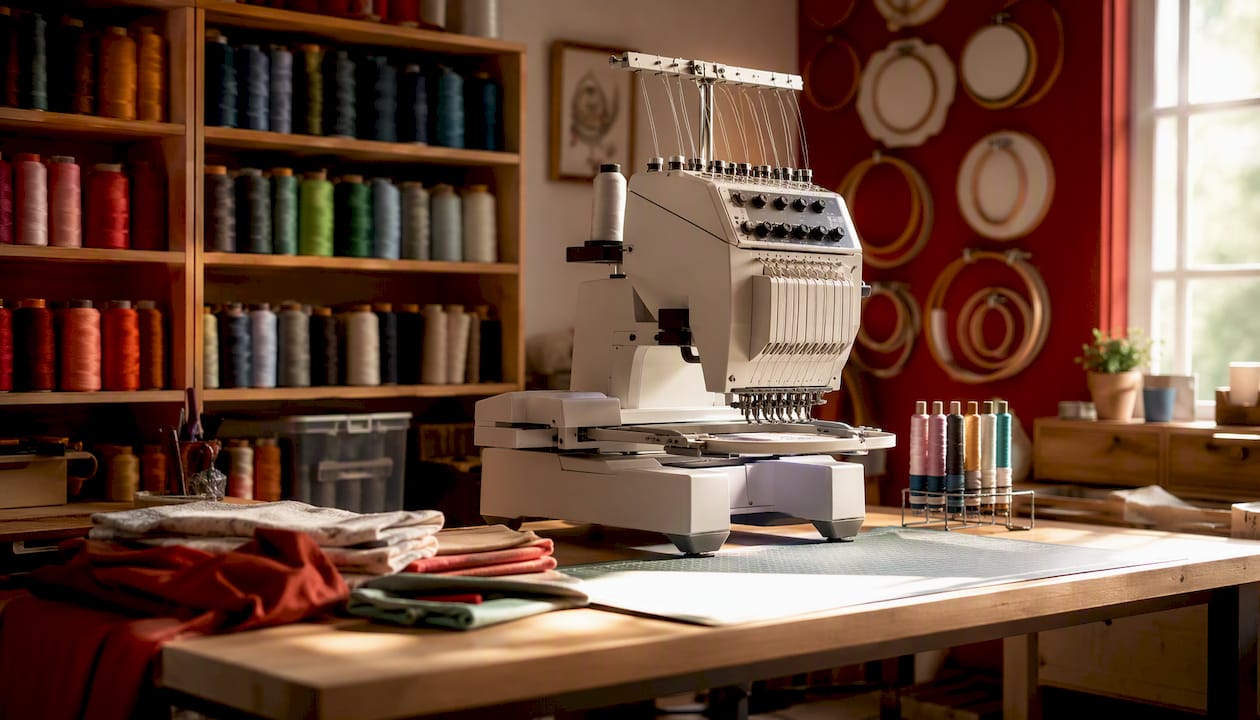
The other thing shops underestimate is the value of working with a vendor who understands the financing side. When you buy through Sewingmachinesplus, you are not navigating the financing process alone. The ability to roll accessories, embroidery software, and shipping into a single financed package means your machine arrives ready to run, not waiting on a separate software purchase or an installation invoice you did not budget for.
The shops that grow fastest are not always the ones with the best credit. They are the ones that move quickly, preserve cash, and put revenue-producing equipment to work before the competition does.
Useful sources and further reading
The following sources were used in preparing this article and are worth bookmarking for your own research:
- Embroidery Machine Financing: The Complete Guide for Business Owners
- Embroidery Equipment Financing & Leasing - Crestmont Capital
- Embroidery Equipment Financing & Leasing | Beacon Funding
- Embroidery Machine Financing – GeNESIS Commercial Capital
- sba.gov
- Home - AFP Gammill
- bbb.org
For tax decisions — Section 179 eligibility, depreciation strategy, and accounting classification — consult a qualified CPA or tax advisor. For financing help specific to your machine purchase, contact Sewingmachinesplus directly.
