

For most quilters, a midweight steam iron with a precision tip handles everyday piecing and block pressing well. For detailed applique and foundation paper piecing, a pointed-tip iron or mini iron gives you the control you need in tight spots. If you press long yardage regularly, a steam station is worth the investment. And for retreats or classes, a cordless or mini iron travels without the hassle.
Here are the one-line picks by use-case:
- Precision piecing and applique: Oliso TG1600 Pro+ (a high wattage of one thousand eight hundred watts, touch auto-lift, precision tip)
- Workhorse/yardage pressing: Rowenta DW9280 Steamforce (high steam output, stainless soleplate, precision tip)
- Cordless/retreat: Panasonic NI-WL600 (1,700W, a ceramic soleplate with double tips to allow movement in multiple directions, retractable cord, anti-calc)
- Budget/backup: BLACK+DECKER Vitessa IR2050 or Hamilton Beach Steam Iron 14210
- Mini/precision detail: Oliso M2 or M3 Pro mini iron
Missouri Star Quilt Co. names the Oliso TG1600 Pro+ as its best overall pick, citing the iTouch auto-lift, a high wattage of one thousand eight hundred watts power, and an extended auto-shutoff duration suitable for long quilting sessions as the features that make it stand out for quilters. Sewingmachinesplus carries a curated range of pressing tools and accessories, backed by over 175,000 positive customer reviews and a price match guarantee.
Key Takeaways
The Oliso TG1600 Pro+ is the best all-around iron for most quilters, but matching your iron to your specific workflow, whether precision piecing, yardage pressing, or retreat travel, delivers better results than any single universal pick.
| Point | Details |
|---|---|
| Match iron to workflow | Precision pieces need a pointed tip and auto-lift; yardage quilters need high sustained steam. |
| Oliso TG1600 Pro+ leads | Missouri Star names it best overall for its iTouch auto-lift, a high wattage of one thousand eight hundred watts, and 30-min shutoff. |
| Two-iron setup works best | A full-size workhorse plus a mini iron covers every quilting task more effectively than one compromise model. |
| Maintenance prevents failures | Empty the tank after every session and run a self-clean monthly to prevent spitting and soleplate buildup. |
| Sewingmachinesplus for buying | Sewingmachinesplus offers free shipping over $49, price match, and expert consultations for quilters choosing an iron. |
Table of Contents
- How do the top irons for quilting compare at a glance?
- Why do quilters need a different iron than everyone else?
- How do you choose the right iron for your quilting workflow?
- When does a mini or cordless iron make sense for quilting?
- Steam stations vs. traditional irons: which one fits your quilting setup?
- How do you clean your iron and handle fusible residue?
- Where can you buy a quilting iron in the U.S., and what should you expect to pay?
- Mini irons vs. full-size irons: why quilters often use both
- What do most quilters actually use, and what does Missouri Star recommend?
- An honest perspective on picking the right quilting iron
- Sewingmachinesplus has the irons and expertise to match your quilting workflow
- Sources
- FAQ
How do the top irons for quilting compare at a glance?
The picks below cover the five main quilter use-cases. Each model is chosen for how it performs in real quilting workflows, not just general household ironing.
| Use-case | Model | Steam output | Wattage | Soleplate | Tip precision | Weight | Safety features | Tank / anti-calc | Price band |
|---|---|---|---|---|---|---|---|---|---|
| Best for precision | Oliso TG1600 Pro+ | High burst + continuous | a high wattage of one thousand eight hundred watts | Stainless | Excellent | Medium | iTouch auto-lift, 30-min shutoff | Medium tank, anti-calc | Mid–High |
| Best workhorse | Rowenta DW9280 Steamforce | Very high, many holes | a wattage around one thousand seven hundred and fifty watts | Stainless microsteam | Excellent | Medium-heavy | Auto-off | Medium tank, anti-calc | Mid–High |
| Best cordless | Panasonic NI-WL600 | Good continuous | 1,700W | Wide ceramic, double-tip | Good | Medium | Extended idle auto-off | a medium-sized removable water tank with anti-calc features | Mid |
| Best budget | BLACK+DECKER Vitessa IR2050 | Moderate | a moderate wattage iron | Nonstick | Moderate | Light | Auto-off | Small tank | Low |
| Best mini | Oliso M2/M3 Pro | Light-moderate | a low-to-mid-range wattage for mini irons | Ceramic/nonstick | Excellent | Very light | Auto-off | Small tank | Low–Mid |
Pro Tip: Raw burst steam numbers look impressive on the box, but predictable continuous steam recovery and anti-drip behavior matter more for quilting. Frequent pick-up and put-down motions expose seams to spitting and water staining, so prioritize consistent output over peak burst claims.
Why do quilters need a different iron than everyone else?
A household iron is designed for shirts and trousers. Quilting asks for something more specific, and the gap shows up fast once you start chain-piecing or pressing fusible web.
Here is what quilting actually demands from an iron:
- Precision tip: Seam allowances in quilting can be as narrow as a quarter inch. A pointed tip lets you press directly into seam intersections without disturbing adjacent fabric.
- Predictable steam: Bias-cut pieces stretch when hit with an uneven steam burst. You need steam you can control, not a random surge that distorts your work.
- Rapid heat recovery: Chain piecing means pressing dozens of small units in quick succession. An iron that drops temperature between presses slows you down noticeably.
- Anti-drip and anti-calc: Fusible web and batting are unforgiving. Water spots from a spitting iron can leave permanent marks, and mineral buildup clogs steam holes over time.
- Auto-lift or long auto-off: Setting the iron down between short presses is constant in quilting. Auto-lift (as on the Oliso TG1600) raises the iron on small legs the moment you let go, protecting your fabric and your pressing surface. A 30-minute auto-off is far more practical than a 10-minute shutoff during chain-piecing sessions.
- Weight and ergonomics: A heavy iron tires your wrist during long sessions. A very light iron can lack the pressing force needed for thick seam intersections. Most quilters land on a medium-weight iron as the best balance.
IroningLab’s hands-on review confirms that steam output, auto-lift safety, and soleplate glide are the attributes that separate quilting-grade irons from general-purpose models.
Use-case examples:
- Foundation paper piecing (FPP): Needs a sharp tip, dry or light steam, and precise placement. A mini iron or a pointed full-size iron works best.
- Applique: Benefits from a precision tip and the ability to switch between dry and steam quickly.
- Pressing yardage: Needs high, sustained steam output and a wide soleplate for coverage.
- Fusible web: Requires dry heat and a clean, nonstick soleplate. Steam can cause fusible adhesive to migrate.
Pro Tip: For FPP and fusible work, switch to dry heat. Steam stretches paper and can activate fusible adhesive unevenly. Use a dry, hot iron and a pressing cloth for the cleanest results.
How do you choose the right iron for your quilting workflow?
Start with four quick questions before looking at specs:
- How often do you press? Daily production quilters need durability and anti-calc systems. Occasional quilters can work with a mid-range model.
- Do you press long yardage? If yes, sustained steam output and a wide soleplate matter more than tip precision.
- Do you attend retreats or classes? Portability, a retractable cord, and a heatproof case become priorities.
- Do you use fusible products regularly? Anti-drip behavior and a nonstick or ceramic soleplate are non-negotiable.
Prioritized feature checklist
- Steam capacity and recovery: Look for consistent continuous steam, not just a high burst number. Recovery time between presses matters for chain piecing.
- Wattage: Higher-wattage irons heat faster and recover temperature more quickly, which helps when pressing repeatedly. Note that very high-wattage models can strain older household circuits.
- Soleplate material: Ceramic and titanium-infused coatings resist fusible residue and glide smoothly. Stainless steel is durable and easy to clean. Avoid cheap nonstick coatings that scratch and drag.
- Tip precision: A narrow, well-defined tip lets you press into seam intersections accurately.
- Weight and ergonomics: Hold the iron before buying if possible. A comfortable grip reduces fatigue during long sessions.
- Cord length vs. cordless: A 6–8 foot cord gives you freedom of movement at a pressing table. Cordless models like the Panasonic NI-WL600 add mobility but require a base station and have brief recharge pauses.
- Auto-lift and auto-off: Auto-lift protects fabric between presses. A 30-minute auto-off is the practical minimum for quilting sessions.
- Tank capacity and anti-calc: Larger tanks mean fewer refills during long sessions. Anti-calc capsules or self-clean cycles extend iron lifespan when you use tap water.
- Maintenance needs: Some irons require distilled water only. Others handle tap water with anti-calc systems. Know which you are buying.
Questions to ask before you buy
- Does the iron spit or drip at lower temperatures? (Check user reviews specifically for this.)
- What is the real continuous steam output, not just the burst figure?
- How long does heat recovery take between presses?
- What is the warranty length, and are replacement parts available?
Red flags to watch for
- Spitting or dripping at medium heat settings
- Unstable temperature that fluctuates between presses
- A soleplate finish that drags on cotton or catches on seams
- An auto-off that triggers in under 10 minutes, interrupting chain-piecing sessions
Maintenance checklist
- Weekly (active quilters): Empty the tank after each session. Wipe the soleplate with a damp cloth while still warm.
- Monthly: Run a self-clean or steam-flush cycle to clear mineral deposits from steam holes.
- Quarterly: De-scale fully if you use tap water. Replace anti-calc cartridges per the manufacturer’s schedule.
The Hobby Guru’s 2026 guide maps models to quilter frequency, recommending the Reliable Velocity for frequent yardage pressing and the BLACK+DECKER Vitessa for balanced everyday use, which aligns with this workflow-based approach.
When does a mini or cordless iron make sense for quilting?
Mini irons and cordless models fill specific gaps in a quilting setup. They are not replacements for a full-size iron, but for the right tasks, they are genuinely better tools.
What mini irons do well
- Applique and FPP, where a full-size iron is too wide to maneuver
- Pressing small blocks and units without disturbing surrounding pieces
- Travel and retreat use, where packing space is limited
- Classroom settings where multiple irons share limited outlet space
Their real limits
- Not suited for pressing long yardage or large quilt tops
- Lower wattage means slower heat recovery for high-volume sessions
- Small tanks require frequent refilling
Cordless benefits and caveats
Cordless irons like the Panasonic NI-WL600 give you full freedom of movement at the pressing table, which is genuinely useful when you are rotating large quilt blocks. The a ceramic soleplate with double tips to allow movement in multiple directions, works from either direction, so you do not need to reposition the iron as often. The trade-off is the base station: the iron needs brief pauses on the base to maintain temperature during extended sessions, and the 160 mL removable tank needs refilling more often than a full-size model.
Stitch Obsessed’s buying guide recommends the Panasonic cordless and the Oliso M3 Pro mini as travel and retreat companions, noting their portability and precision-tip advantages.
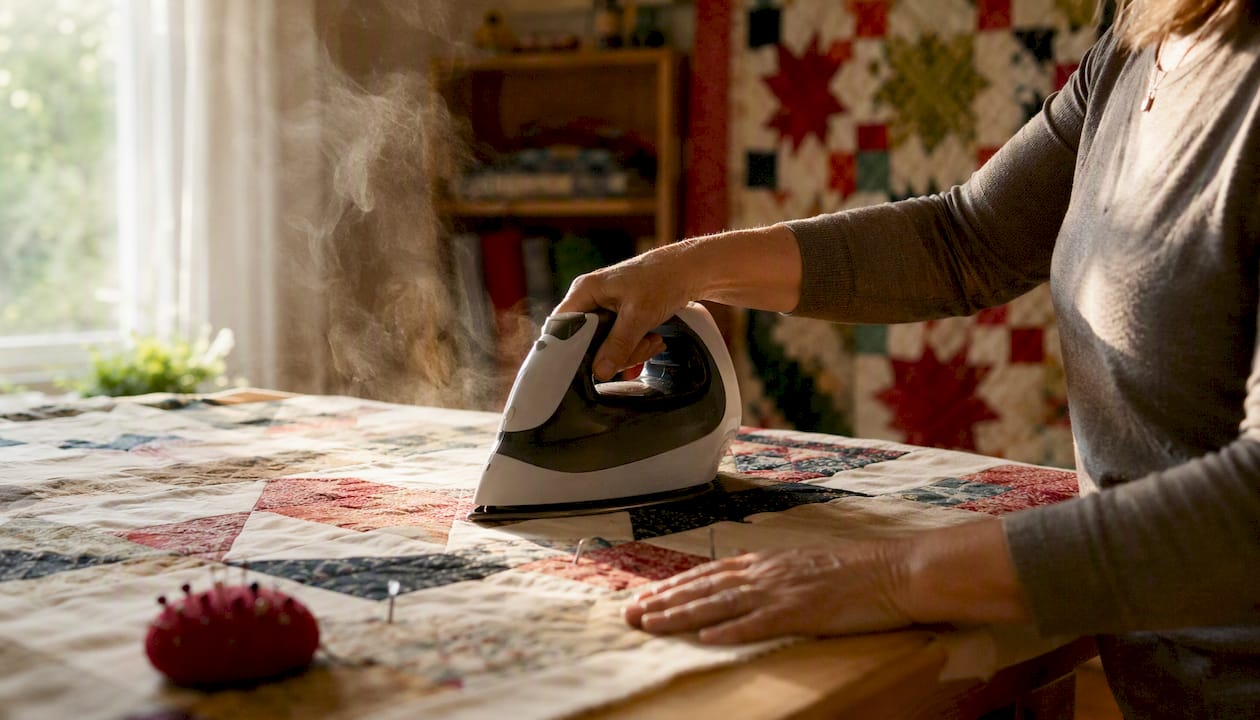
Pro Tip: When packing a mini iron for a retreat, use a heatproof carrying case and look for a model with a retractable cord. You can pack the iron while it is still slightly warm, which saves time at the end of a class. A compact sewing kit alongside your mini iron keeps your retreat bag organized.
Mini vs. full-size: quick comparison
- Mini iron: Best for applique, FPP, small units, travel. Not for yardage.
- Full-size iron: Best for blocks, yardage, seam pressing, general use. Less precise in tight spots.
- Best setup for most quilters: One full-size workhorse plus a mini for detail work, as Missouri Star recommends for quilters who want one tool for every task.
Steam stations vs. traditional irons: which one fits your quilting setup?
A steam generator or ironing station is a different category of tool. It is worth understanding when the upgrade makes sense and when a traditional iron is the smarter call.
Steam stations: pros and cons
Pros:
- Continuous, high-volume steam output without waiting for recovery
- Large external water tank means far fewer refills during long sessions
- Consistent temperature across extended pressing sessions
- Models like the Reliable Velocity 200IR are built for production-level yardage work
Cons:
- Significantly higher cost than a traditional iron
- Larger footprint; not practical for small sewing rooms or travel
- Heavier iron head, which can cause fatigue over time
- Setup and storage take more space and time
Traditional irons: pros and cons
Pros:
- Lighter, more mobile, and easier to store
- Lower price point across all quality tiers
- Simpler maintenance and widely available replacement parts
- Sufficient for most quilting tasks outside of heavy production work
Cons:
- Steam recovery pauses during high-volume pressing
- Smaller tanks require more frequent refilling
- Burst steam can be inconsistent on budget models
Which workflow justifies a steam station?
If you press multiple quilt tops per week, run a long arm quilting business, or regularly work with heavy fabrics like denim or canvas, a steam station pays for itself in time and consistency. For everyday piecing, applique, and occasional yardage work, a quality traditional iron handles the load well. A popular pairing among production quilters is a steam station for yardage and a mini iron for detail work, keeping both tools in their ideal roles.
How do you clean your iron and handle fusible residue?
Fusible web is one of the most common iron-killers in a quilting room. A few minutes of preventive care saves you from a ruined soleplate.
Cleaning fusible residue: step by step
- Heat the iron to a medium setting (not full heat, which can bake residue further into the soleplate).
- Use a heat-safe soleplate cleaner or a dedicated iron cleaning stick on the warm soleplate.
- Wipe with a damp cloth or a folded piece of scrap cotton. Repeat until the residue lifts.
- For stubborn spots, a wooden or silicone scraper (never metal) removes buildup without scratching ceramic or stainless surfaces.
- After cleaning, run the iron over a scrap piece of fabric to pick up any remaining cleaner residue before pressing your quilt.
Maintenance schedule for regular quilters
| Frequency | Task |
|---|---|
| After every session | Empty the water tank; wipe the soleplate while warm |
| Weekly | Check steam holes for mineral buildup; wipe with damp cloth |
| Monthly | Run self-clean or steam-flush cycle; inspect soleplate for scratches |
| Quarterly | Full de-scale with manufacturer-approved solution; replace anti-calc cartridge if applicable |
Common problems and quick fixes
- Spitting or dripping: Usually caused by mineral buildup or using the iron before it reaches full temperature. Run a self-clean cycle and always let the iron fully heat before pressing.
- Water stains on fabric: Empty the tank fully between sessions and use distilled water if your tap water is hard.
- Sticky soleplate: Fusible residue. Follow the cleaning steps above. A pressing cloth during fusible work prevents most buildup.
- Dragging on fabric: A scratched or worn soleplate coating. Ceramic and stainless surfaces last longer than basic nonstick coatings.
Pro Tip: Always use a pressing cloth or a Teflon pressing sheet when working with fusible web. This single habit prevents the vast majority of soleplate contamination and keeps your iron performing like new far longer.
Where can you buy a quilting iron in the U.S., and what should you expect to pay?
Price bands give you a realistic frame for what each tier delivers.
- Budget (under $60): Models like the Hamilton Beach Steam Iron 14210 and BLACK+DECKER Vitessa IR2050 work well for occasional quilters or as class and retreat backups. Expect moderate steam consistency and basic anti-drip features.
- Mid-range ($60–$150): The Panasonic NI-WL600 and PurSteam Professional 1800W sit here. You get better soleplate coatings, more reliable anti-calc systems, and improved steam recovery.
- Pro ($150–$300): The Oliso TG1600 Pro+ and Rowenta DW9280 Steamforce occupy this tier. These are the irons that frequent quilters and production sewers rely on for durability, precision, and consistent steam.
- Steam stations ($200 and up): The Reliable Velocity 200IR and similar models. Built for heavy yardage and production work. The investment makes sense if you press multiple quilt tops weekly.
As The Hobby Guru notes, frequent quilters benefit from the higher steam stability, anti-calc systems, and better warranties that come with mid-range and pro models, while budget options serve occasional quilters and backup roles well.
Where to buy
- Sewingmachinesplus.com: Carries irons, pressing tools, and quilting accessories with free shipping on orders over $49, a price match guarantee, and expert consultations. Their team can help you match an iron to your specific workflow.
- Specialty quilt shops: Good for hands-on demos and local support, though selection is often limited.
- General retailers: Wide availability, but limited quilting-specific guidance and shorter return windows on pressing tools.
When buying online, check the warranty length (look for at least one year), confirm the return policy covers defective steam systems, and ask whether the retailer carries replacement anti-calc cartridges or accessories for the model you choose.
Mini irons vs. full-size irons: why quilters often use both
The case for a mini iron is not about replacing your full-size model. It is about having the right tool for tasks where a standard iron is simply too large to be useful.
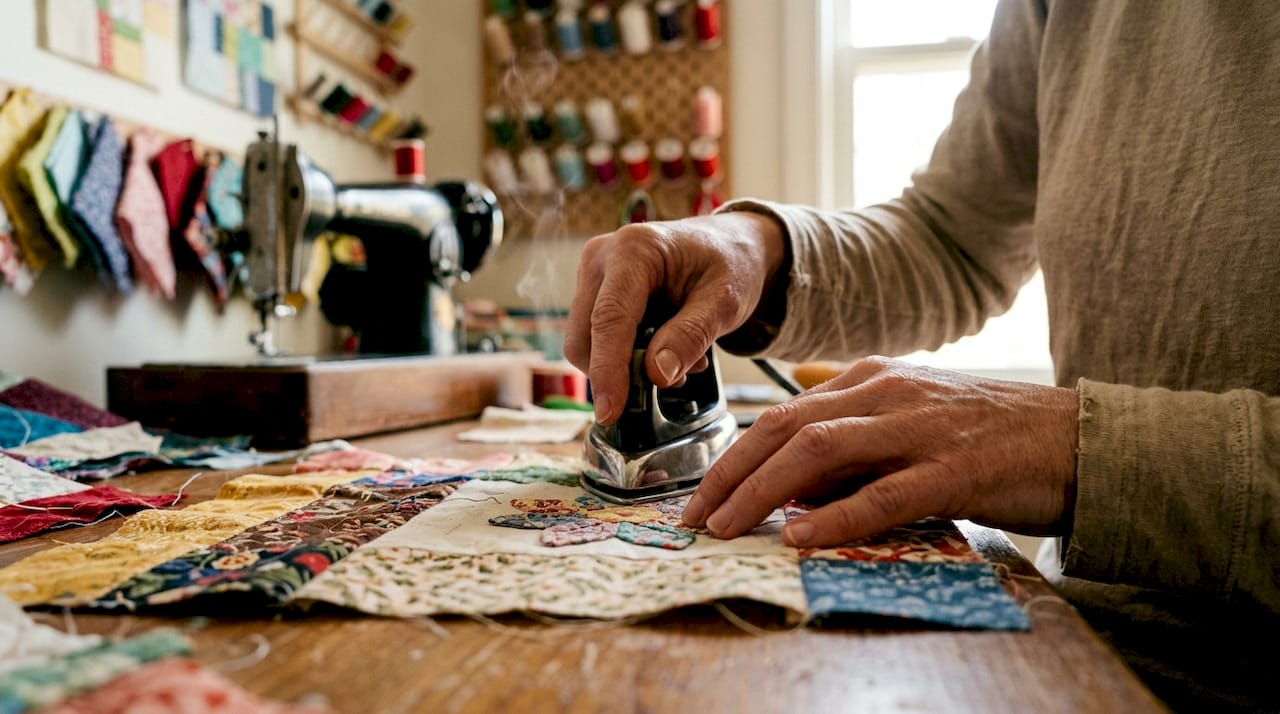
A full-size iron covers ground efficiently. Pressing a 12-inch block, setting seams across a long strip, or steaming yardage flat all benefit from a wide soleplate and high wattage. But when you are pressing the seam on a one-inch flying geese unit, or nudging a tiny applique piece into position, that same wide soleplate becomes an obstacle.
Mini irons like the Oliso M2 and M3 Pro are purpose-built for precision. Their small footprint and pointed tips reach into corners and seam intersections that a full-size iron cannot touch without disturbing adjacent pieces. The Singer SteamCraft and similar compact models offer a middle ground between full-size and true mini, useful for quilters who want one iron that handles most tasks without a full two-iron setup.
The two-iron approach is common among experienced quilters for a practical reason: each tool does its job better than any single compromise iron could. Your full-size iron handles yardage and block pressing; your mini handles applique, FPP, and retreat work. The total cost of a good full-size iron plus a quality mini is often less than a single high-end steam station, and the flexibility is greater.
What do most quilters actually use, and what does Missouri Star recommend?
Most quilters gravitate toward a mid-range to pro-level full-size steam iron for everyday work, with the Oliso TG1600 Pro+ consistently appearing at the top of community recommendations. Its iTouch auto-lift system is the feature quilters mention most: the iron rises on small legs the moment you release the handle, protecting your fabric and your pressing mat without any conscious effort on your part.
Missouri Star Quilt Co., one of the most widely followed quilting communities in the U.S., names the Oliso TG1600 Pro+ as its best overall iron for quilters. The reasons are practical: a high wattage of one thousand eight hundred watts for fast heat recovery, the iTouch auto-lift for hands-free safety, and an extended auto-shutoff duration suitable for long quilting sessions without constant resetting.
For quilters who want a smaller iron, the Oliso M3 Pro mini and the Panasonic NI-WL600 cordless are the most frequently cited options in community forums and review roundups. The Rowenta DW9280 Steamforce is the go-to recommendation for quilters who prioritize maximum steam output and soleplate precision over auto-lift convenience.
Steam matters in quilting because it relaxes fabric fibers, sets seams flat, and helps bias edges lie true without stretching. Dry heat alone can press a seam, but steam does it faster and with less pressure, which reduces the risk of distorting pieced units. That said, dry heat is the right choice for fusible web and paper piecing, where steam causes problems.
An honest perspective on picking the right quilting iron
The most common mistake quilters make when buying an iron is optimizing for the wrong feature. High burst steam numbers look compelling on a spec sheet, but they tell you almost nothing about how an iron performs during chain piecing, where you are picking it up and setting it down dozens of times per hour. What actually matters in that workflow is how quickly the iron recovers temperature between presses and whether it drips when you pick it up at a lower heat setting.
The Oliso TG1600 Pro+ earns its reputation not because it has the highest steam output on the market, but because its auto-lift system removes a genuine friction point from the quilting workflow. You stop thinking about the iron between presses. That cognitive offload, small as it sounds, adds up over a four-hour session.
The two-iron approach is underrated. Many quilters resist buying a mini iron because it feels like a redundant purchase. In practice, a good mini iron changes how you approach applique and FPP entirely. The precision you gain in tight spots is not replicable with a full-size iron, no matter how pointed its tip is.
Budget irons are not always the wrong choice. For a beginner building a first quilting setup, a Hamilton Beach or BLACK+DECKER model gets the job done while you figure out which features matter most to your workflow. Upgrading later, once you know what you actually need, is a smarter path than overspending on a steam station before you have pressed a single quilt top.
Sewingmachinesplus has the irons and expertise to match your quilting workflow
Choosing between a precision iron, a cordless model, and a steam station is easier when you have someone to talk it through with. Sewingmachinesplus carries a full range of quilting and pressing tools from the brands quilters trust, including Oliso, Rowenta, Panasonic, and more, all available with free shipping on orders over $49 and a price match guarantee.
If you are not sure which iron fits your workflow, the Sewingmachinesplus expert team offers personalized consultations to help you match the right model to your pressing habits, budget, and studio setup. Financing options are available for larger purchases, and every order is backed by the retailer’s customer service team. Browse the full selection and start a consultation at Sewingmachinesplus today.
Sources
The recommendations in this article draw on the following sources, used for model specifications, community preference data, and steam versus dry pressing guidance:
- Best Iron for Quilting in 2026: Top 5 Picks for Every Budget
- Best Iron for Quilting and Sewing 2023 Review
- Best Steam Irons for Quilting in 2026
- How to Choose the Best Quilting Iron
FAQ
What iron do most quilters use?
The Oliso TG1600 Pro+ is the most widely recommended iron among quilters, praised for its iTouch auto-lift, a high wattage of one thousand eight hundred watts power, and an extended auto-shutoff duration suitable for long quilting sessions. Rowenta’s Steamforce models are a close second for quilters who prioritize maximum steam output.
What iron does Missouri Star Quilt Co. recommend?
Missouri Star Quilt Co. names the Oliso TG1600 Pro+ as its best overall iron for quilters, citing the iTouch auto-lift, a high wattage of one thousand eight hundred watts wattage, and 30-minute shutoff as the features that make it stand out for quilting workflows.
Why do quilters use mini irons?
Mini irons reach into tight seam intersections and small applique pieces that a full-size iron cannot maneuver around without disturbing adjacent fabric. They are also the practical choice for retreats and classes where packing space is limited.
What is the best small iron for quilting?
The Oliso M3 Pro mini and the Panasonic NI-WL600 cordless are the most frequently cited small irons for quilting. The Oliso M3 Pro excels at precision detail work; the Panasonic NI-WL600 adds cordless mobility with a ceramic soleplate with double tips to allow movement in multiple directions, suited for both applique and general pressing.
Why do quilters use steam when pressing?
Steam relaxes fabric fibers and sets seams flat faster and with less pressure than dry heat alone, reducing the risk of distorting pieced units. Dry heat is preferred for fusible web and foundation paper piecing, where steam can cause adhesive migration or paper warping.
