

If you make bed-size quilts regularly and have a dedicated corner of a room to spare, a floor longarm or sit-down frame is usually the right pick. If you’re quilting lap-size projects in a shared living space, start with a tabletop or portable frame. Either way, measure your room and check your machine’s weight and throat clearance before you spend a dime.
TL;DR:
- Quilters making large or frequent bed quilts should choose floor or longarm frames to ensure even tension and minimal puckering on quilts over 60 inches wide.
- Measure your room’s length, width, doorway, and ceiling height carefully, leaving at least 2 to 3 feet of clearance on one long side of the frame for comfortable quilting.
- Confirm your machine’s mounting plate and weight limits before purchasing a frame, especially if you plan to upgrade to a heavier or industrial machine later.
- Budget from $500 for basic tabletop frames up to over $2,000 for professional longarm systems, and factor in additional costs like adapters, extension rails, or shipping.
- Buying from an authorized dealer with personalized support reduces risks of compatibility issues and ensures proper setup and ongoing assistance.
Table of Contents
- Quilt Frame Buying Guide: Frame Types and Who They Suit
- How Do Quilt Frame Sizes Match Your Room and Quilts?
- How Do You Measure Your Space Before Buying a Quilt Frame?
- Will Your Sewing Machine Actually Fit the Frame?
- Which Quilt Frame Features Actually Matter?
- What Should You Budget for a Quilt Frame?
- What Does Setting Up and Maintaining a Quilt Frame Involve?
- Why Buy Your Quilt Frame From an Authorized Dealer?
- What Are Some Recommended Frame and Machine Pairings?
- Where Should You Buy a Quilt Frame?
- What Warranty and Support Should You Expect?
- What Accessories Improve the Quilting Experience?
- A Space-First Way to Choose
- Get Expert Help Choosing and Mounting Your Quilt Frame
- Where to Verify Your Measurements and Specs
- Sources
- FAQ
Quilt Frame Buying Guide: Frame Types and Who They Suit
Every frame style trades something for something else. Portability costs you stability. Stability costs you floor space. Once you know which tradeoff you can live with, half your shopping decision is already made.
Tabletop and portable frames clip onto a table or stand on short legs and fold flat for storage. They’re built for quilters working on lap quilts, baby quilts, and table runners in a spare bedroom or dining room that pulls double duty. You can pack one into a closet between sessions, which matters if you don’t have a sewing room to call your own. The tradeoff: tension control is only as good as the surface you clamp it to, and most tabletop setups struggle once a quilt top pushes past 45 to 50 inches wide.
Sit-down frames hold the quilt stationary on a fixed frame while you move the sewing machine across it, seated at a table height that stays put. These suit quilters who make twin and full-size quilts a few times a month and have a permanent spot, even a modest one, to leave the frame set up. You get better tension than a tabletop rig without needing a full room, but you lose the fold-and-stash convenience.
Floor and stand frames raise the quilt on adjustable legs so you stand and walk the machine along rails, or roll the quilt through with the frame stationary. This is the workhorse setup for quilters making queen and king quilts on a regular basis. Because the quilt is fully supported at height, tension stays even across the whole surface, which is exactly what large quilts need. Comparisons between frames and flat-table setups consistently show frames producing less puckering on quilts over about 60 inches wide, which is right where a tabletop rig starts to strain.
Longarm frames pair a dedicated longarm machine with a frame that spans 8 to 14 feet, letting the machine glide over a mounted quilt rather than the other way around. This is the choice for frequent large-quilt work or a small quilting business taking in customer tops. It’s also the biggest commitment in floor space, machine cost, and learning curve.
A simple decision rule: multiply your typical project size by how often you quilt, then measure what’s left over after furniture. Occasional lap quilts in a shared room point to tabletop. Regular bed quilts with a spare corner point to sit-down or floor. Frequent large quilts or paid work point to longarm, assuming the room supports it.
- Tabletop/portable: best for occasional lap quilts, tight storage, budget under $500.
- Sit-down: best for regular twin/full quilts, small dedicated spot, moderate budget.
- Floor/stand: best for frequent bed-size quilts, a permanent setup area.
- Longarm: best for frequent large quilts, business use, and a room built around the frame.
How Do Quilt Frame Sizes Match Your Room and Quilts?
Frame length isn’t a random spec. It’s tied directly to the largest quilt you plan to make and the room you have to make it in. Getting this match wrong is the single most common reason quilters end up returning a frame or wedging it into a hallway.
An 8-foot frame handles lap quilts and smaller bed quilts comfortably. A 10-foot frame is the sweet spot for most twin and full quilts, and 12 foot or longer frames are built for queen and king projects. Going longer than you need doesn’t help your stitching. It just eats floor space you could have used for a cutting table or storage.
Room size recommendations scale with frame length, but they’re not identical numbers. Quilting frames generally need 8 to 12 feet of length and 6 to 10 feet of width, with a 10 by 8 foot room working well for a mid-size setup. That width figure includes walking clearance, not just the frame’s footprint.
Ceiling height rarely disqualifies a frame outright, since most floor and longarm models top out around 5 to 6 feet at full extension. It matters more if you’re mounting a frame with an elevated take-up roller or plan to stand on a step stool to reach the back rail. Standard 8 foot ceilings work for nearly every consumer frame on the market.
If your room falls short of these numbers, foldable tabletop frames and frames designed to collapse for storage are worth prioritizing over fixed floor models. Some floor and longarm frames also mount on casters, which lets you slide the whole rig against a wall between sessions instead of dedicating permanent square footage to it, a strategy longarm manufacturers frequently recommend for smaller homes.
How Do You Measure Your Space Before Buying a Quilt Frame?
A tape measure and ten minutes will save you from the worst quilt frame buying mistake: ordering something that physically can’t get into the room you planned for it.
- Measure your doorway and hallway width. Frames ship partially assembled, but rails and end brackets still need to pass through every doorway between your entryway and the quilting room.
- Measure the room’s length and width, wall to wall. Subtract for furniture you’re keeping, not just the empty floor area.
- Measure ceiling height if you’re considering a frame with an elevated roller system or plan to quilt standing on any kind of platform.
- Mark the frame’s footprint on the floor with tape or string, using the dimensions from the manufacturer’s spec sheet, then walk the space as if you were quilting.
- Test the exit path. Stand where the frame’s longest dimension would sit and confirm you could still carry it, or its boxed parts, back out the door if you needed to return it.
- Run the numbers through a space calculator built for this purpose, which will flag clearance problems before you commit. A long arm frame space calculator can estimate minimum room space and walking clearance in a couple of minutes.
Budget 2 to 3 feet of walking clearance on at least one long side of the frame for normal use, plus a bit more if your machine carriage travels the full rail length during quilting. You don’t need clearance on all four sides. Placing a frame against a wall, as many longarm owners do, only requires access from the front and one end.
Pro Tip: Measure twice at different times of day. Furniture you can move for an hour of quilting is fine, but a frame you can never fully collapse needs a spot that stays clear permanently, not just when you tidy up for guests.
Will Your Sewing Machine Actually Fit the Frame?
A frame’s specs mean nothing if your machine doesn’t mount to it. This is where quilters most often discover a mismatch after the box is already open.
Start with your machine’s throat or arm width, the horizontal distance from the needle to the machine’s body, since this determines how much quilt surface you can access per pass without repositioning. Domestic machines typically offer 6 to 9 inches; dedicated longarm and midarm machines run wider. Weigh your machine too, not just its listed spec sheet number, since some manufacturers quote the head alone and skip the table or motor assembly.
- Check the frame’s stated weight limit against your machine’s actual weight, including any add-on motor or extension table.
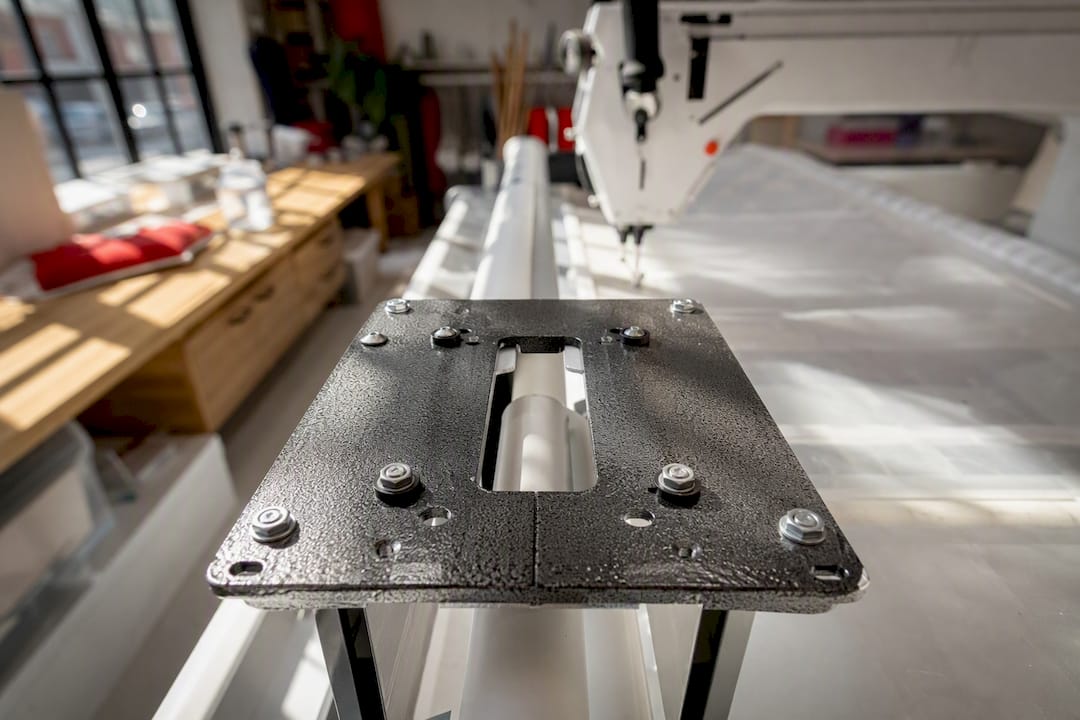
- Confirm the mounting plate type. Frames use different bracket systems, and not every plate fits every machine brand out of the box.
- Ask whether an adapter plate is available if your exact machine model isn’t listed as compatible.
- Look for frames with modular or adjustable carriages, since these accommodate a wider range of machine widths if you upgrade machines later.
- Note the carriage’s maximum quilting width, separate from the frame’s overall length, since this caps how wide a single pass can stitch.
Manufacturer resources consistently list weight limits, mounting plates, and track quality as the criteria to verify before purchase, and it’s worth treating that list as non-negotiable rather than optional homework. If you’re running or considering a heavier industrial-style machine, like a straight-stitch workhorse similar to the Juki DDL-8700, pay extra attention to weight limits since these machines run heavier than most domestic quilting setups. Future-proofing here is cheap insurance: a frame with a wider mounting range costs little more upfront and saves you from replacing the whole rig when you upgrade machines.
Which Quilt Frame Features Actually Matter?
Marketing copy loves to list features. Only a handful of them actually change how your quilts turn out or how your body feels after a three-hour session.
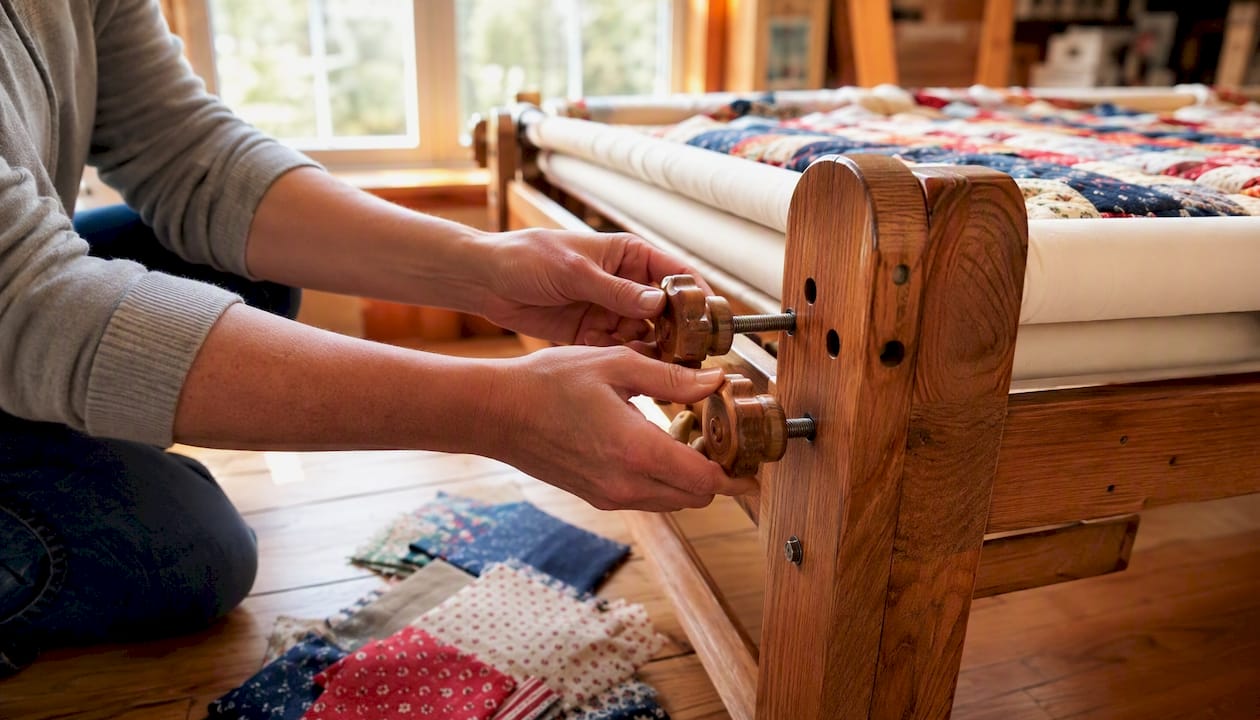
Tension is the one that matters most. Frames use roller or clamp-based tensioning systems to keep the quilt top, batting, and backing evenly taut while you stitch. Even tension prevents puckering and tucks, especially on quilts wider than about 60 inches, where uneven pull becomes visible fast. A frame with weak or inconsistent tension control will fight you on every large project regardless of how nice its rails look.
Rail and track quality determines how smoothly your machine carriage glides. Look for ball-bearing carriage systems and precision-milled rails rather than painted tube steel, since rough or warped rails translate directly into jerky stitching and skipped stitches at speed.
Ergonomics deserves more weight than most buyers give it. Working height should let your elbows rest close to a 90 degree angle, and OSHA’s ergonomics guidance on workstation design backs this up as a way to reduce repetitive strain during long sessions. NIOSH’s broader ergonomics research reinforces the same point: adjustable height and good posture support prevent the shoulder and wrist strain that shows up after months of hunching over a fixed-height frame, a concern echoed in CDC/NIOSH ergonomics resources. Sit/stand adjustability isn’t a luxury feature if you quilt for more than an hour at a stretch.
Portability is worth paying for only if you genuinely need to break the frame down regularly. A frame that folds flat in five minutes is worth a premium for an apartment quilter; it’s wasted complexity for someone with a dedicated permanent space.
- Prioritize tension system quality over cosmetic finish.
- Choose ball-bearing rails over basic tube tracks if your budget allows it.
- Get height adjustability if you’ll use the frame more than a few hours a week.
- Pay extra for fold-flat portability only if storage space genuinely demands it.
What Should You Budget for a Quilt Frame?
Price bands in quilt frames track pretty closely with frame length, build materials, and how much of the tension and carriage system is precision-engineered versus basic.
Hobby-entry tabletop and portable frames generally run under $500, sometimes well under, and get you a functional clamp system for lap quilts. Midrange sit-down and smaller floor frames land somewhere between $500 and $2,000, with better tension hardware and sturdier rails. Professional floor and longarm setups start above $2,000 and can climb into five figures once you add a dedicated longarm machine and extended rails.
Beyond the sticker price, budget for the extras that don’t always show up in the base listing:
- Mounting adapters if your machine isn’t a standard fit for the frame’s bracket system.
- Extension rails or additional take-up rollers for larger quilts than the base kit supports.
- Shipping, which can run heavy on floor and longarm frames given their size and weight.
- Assembly tools or professional setup help if the frame doesn’t ship with everything included.
- Leveling accessories like shims or a bubble level if the frame doesn’t include its own leveling feet.
A prioritized checklist helps you resist upsells that don’t matter for your quilting habits. Must-haves: confirmed weight and throat compatibility, adequate room clearance, and a tension system rated for your typical quilt width. Nice-to-haves: height adjustability, ball-bearing rails, and a modular carriage for future machine upgrades. Red flags: vague or missing weight limit specs, no listed mounting compatibility for major machine brands, and reviews mentioning warped rails or loose tension knobs.
What Does Setting Up and Maintaining a Quilt Frame Involve?
Most tabletop frames assemble in 15 to 30 minutes with basic hand tools and no help needed. Floor and longarm frames typically take one to two hours and go faster with a second set of hands, especially when lifting rail sections into place or squaring the frame against a wall.
- Assemble on a flat, level floor. An uneven floor throws off tension evenly across the quilt surface, so check level with a basic bubble level before tightening any fasteners.
- Square the frame by measuring diagonal corners; equal diagonals confirm the frame isn’t racked out of true.
- Test carriage travel by running the machine or take-up bar the full length of the rails before loading a quilt, checking for binding or uneven resistance.
- Tighten all fasteners to a snug, consistent torque, then recheck after the first few uses since new hardware tends to settle.
- Set a maintenance schedule: wipe down rails monthly, check bearing carriages for grit every few projects, and re-torque fasteners a couple of times a year.
For storage, frames that fold flat can lean against a wall or slide under a bed; floor and longarm frames benefit from casters so you can roll the whole assembly aside without disassembly.
Why Buy Your Quilt Frame From an Authorized Dealer?
A quilt frame is only as good as the support behind it, and this is where a specialty retailer earns its markup over a big-box impulse buy. Sewingmachinesplus, an authorized dealer with more than 50 years in the sewing and quilting industry, backs frame purchases with personalized consultations to confirm mounting compatibility before you buy, not after you’ve already unboxed a mismatched bracket.
That matters more than it sounds. A dealer who understands both the frame’s mounting plate and your machine’s actual weight and throat width can steer you away from an expensive mistake in a five-minute conversation. Sewingmachinesplus also offers financing options for larger floor and longarm setups, a price match guarantee so you’re not left wondering if you overpaid, and free shipping on orders over $49, which matters given how heavy frame shipments tend to run.
With over 175,000 positive customer reviews on record, the pattern that shows up most is buyers who needed setup guidance after the sale and got it, not just a shipping confirmation email.
What Are Some Recommended Frame and Machine Pairings?
Rather than chasing a single “best” frame, match the frame class to the machine and workload you already have or plan to buy. A domestic-weight machine on a tabletop clamp system is a fine pairing for lap quilts, since the lighter machine won’t strain a basic clamp’s tension.
For sit-down and floor frames, the pairing question shifts to weight and mounting plate compatibility rather than throat width alone, since these frames hold heavier midarm and longarm-style machines designed specifically for frame mounting. If you’re running or upgrading to an industrial-caliber machine, something in the weight class of a Juki DDL-8700, confirm the frame’s rated weight limit before assuming compatibility, since industrial machines often exceed the limits built into lighter consumer frames.
Quilters adding embroidery or specialty stitching to their workflow sometimes pair a frame setup with complementary software, such as Singer Quantum Futura cross-stitch software, to expand what a single machine can do beyond straight quilting passes. The frame and the machine are two separate purchase decisions that happen to need to agree with each other on weight, width, and mounting hardware.
Where Should You Buy a Quilt Frame?
Quilt frames show up in three main channels: big-box craft chains, marketplace listings, and specialty sewing and quilting dealers. Each comes with a different risk profile.
Big-box craft stores carry a narrow selection, usually limited to basic tabletop frames, and staff rarely have deep frame-specific expertise to answer mounting or weight questions. Marketplace listings offer the widest raw selection and often the lowest sticker price, but you’re on your own for compatibility checks, warranty claims, and setup troubleshooting.
Specialty online dealers split the difference: broader selection than big-box, plus staff who actually know frame and machine compatibility. Buying quilt frames online through a dealer like Sewingmachinesplus adds consultation support and financing that a marketplace listing simply doesn’t offer, which matters most on frames above the $1,000 mark where a mounting mistake gets expensive fast.
What Warranty and Support Should You Expect?
Warranty terms on quilt frames vary widely by manufacturer and frame class, so read the fine print rather than assuming coverage matches what you’d get on a sewing machine. Tabletop frames often carry shorter coverage, sometimes a year or less, given their lower price point and simpler mechanics. Floor and longarm frames from established manufacturers tend to carry longer structural warranties on the frame itself, though moving parts like carriage bearings may carry separate, shorter terms.
Support quality matters as much as the warranty length on paper. A frame that breaks down in month fourteen is only as useful as the dealer who picks up the phone and helps you diagnose it. This is where buying from an authorized dealer with a customer service track record, rather than a marketplace seller who disappears after the sale, pays off. Ask before you buy: what does the return window look like, does the dealer handle warranty claims directly with the manufacturer, and is phone or chat support available if you hit an assembly snag.
What Accessories Improve the Quilting Experience?
A base frame gets you started, but a handful of add-ons make daily use noticeably easier without inflating your budget much.
Basting clamps and leader cloth attachments speed up loading a new quilt top onto the frame. Extension rollers add capacity for wider quilts than your frame’s base kit was designed to hold. A frame-mounted thread stand keeps spools organized and prevents tangling during long sewing runs, and specialty presser feet, such as an invisible zipper foot or a button sewing foot, extend what your mounted machine can do beyond straight quilting passes.
For quilters working in tight quarters, a compact accessory kit like the SmartKit RX-24 foldable sewing kit keeps notions organized without eating into frame-adjacent storage. Quality thread also matters more on a frame than at a regular machine, since long continuous runs expose weak or inconsistent thread fast; a well-stocked embroidery thread set, like Madeira’s smart spool box, covers color range without repeat trips to restock mid-project.
None of these are must-haves on day one. They’re the upgrades most frame owners add within their first year once they know exactly where their workflow needs help.
A Space-First Way to Choose
The single heuristic worth remembering from all of this: your room decides your frame before your budget does. A gorgeous longarm setup is useless if it can’t clear your hallway or fit your ceiling height, and a modest tabletop frame that actually lives in your space beats an ambitious floor frame gathering dust in a closet because you never had room to leave it assembled.
If you’re still torn between two frame classes after measuring, reach out to a dealer for personalized guidance before you buy. A five-minute conversation about your machine, your room, and your typical quilt size will save you far more than it costs.
— Chris
Get Expert Help Choosing and Mounting Your Quilt Frame
You’ve measured the room, checked your machine’s weight, and narrowed down a frame class. The last mile, confirming your exact machine mounts correctly and getting financing that fits a bigger frame purchase, is where Sewingmachinesplus earns its keep as more than just a checkout page. As an authorized dealer with decades in the quilting industry, the team offers personalized consultations to verify mounting compatibility before you buy, a price match guarantee so you’re not left second-guessing the number, financing options for larger floor and longarm setups, and free shipping on orders over $49.
Visit the Sewingmachinesplus product catalog to compare frame-compatible machines, or request a consultation to confirm your exact mounting hardware before you place an order. That one conversation can save you a return shipment and a lot of frustration.
Where to Verify Your Measurements and Specs
Before you finalize any purchase, run your numbers past a few outside references rather than relying on gut estimates alone. The OSHA ergonomics guidance and complementary NIOSH ergonomics resources cover workstation height and posture recommendations that translate directly to frame setup. A long arm frame space calculator lets you plug in your room dimensions and get a fast read on whether a given frame length will actually fit with usable walking clearance. Finally, check the manufacturer’s own product page for your specific frame model to confirm current weight limits and mounting plate compatibility, since these specs occasionally change between production runs.
Sources
FAQ
What Is the 60/30/10 Rule for Quilting?
The 60/30/10 rule is a color balance guideline where 60% of a quilt uses a dominant color or print, 30% uses a secondary supporting color, and 10% is reserved for accent pops. It’s a design rule, not a frame specification, but it’s worth knowing since it affects how you plan fabric yardage before loading a project onto your frame.
What Is the Rule of 7 in Quilting?
Definitions of the “rule of 7” vary among quilters, but a common version suggests limiting a quilt’s color or print palette to around seven fabrics to keep the design cohesive without visual clutter. It’s a design heuristic rather than a fixed technical standard.
What Is Dirty Quilting?
“Dirty quilting” typically refers to a loose, less precise free-motion quilting style, often using looping or scribble-like stitch patterns instead of exact geometric designs. It’s a stylistic choice some quilters embrace for texture and speed rather than a technical defect.
What Is the Difference Between the Cutie Frame and the Cutie Breeze Quilting Frame?
Both are compact frame models aimed at smaller quilts, with the core difference typically coming down to size and portability features rather than tension performance; specific spec differences vary by manufacturer listing, so confirm current dimensions and weight limits directly on the product page before buying.
How Much Room Do I Actually Need for a Quilt Frame?
Most quilting frames need roughly 8 to 12 feet of length and 6 to 10 feet of width, with a 10 by 8 foot room comfortably fitting a mid-size setup including walking clearance.
