

For almost every beginner quilt, start with 100% quilting cotton and a simple tonal palette: one light, one medium, one dark. It cuts cleanly, presses flat, and behaves the same way every time you sew it, which is exactly what you want while you’re still learning how to choose fabric for quilting. Sewingmachinesplus stocks quilting cotton by the yard and in precut bundles at roughly 110 to 120 gsm, so you can build confidence before branching into batiks, linens, or flannel.
TL;DR:
- Quilting cotton weighs around 110 to 120 gsm with a plain weave and tight thread count, ensuring minimal stretch and predictable shrinkage.
- Precut bundles like fat quarters, jelly rolls, and charm packs simplify color coordination and cutting, but require matching print scale to block size for best results.
- Other fabrics like batik, flannel, linen, and linen blends add texture and interest but may require pretesting for colorfastness and adjustments for shrinkage or finishing.
- Avoid fabrics such as stretch knits, slippery silks, and pile fabrics, as they tend to distort, shift, or make piecing and pressing more difficult.
- Proper handling, including sharp rotary blades, pressing instead of ironing, nesting seams, and correct machine setup, is essential for accurate and durable quilting.
Table of Contents
- Understanding Quilting Fabric Types: Why Cotton Comes First
- Precut Fabric Formats: Fat Quarters, Jelly Rolls, and More
- Batik, Flannel, Linen, and Other Fabric Options
- Specialty Backings: Minky, Double Gauze, and Fleece
- Fabrics to Avoid for Traditional Patchwork
- How to Choose Quilting Fabric: A Buying Checklist
- Cutting, Pressing, and Machine Setup Tips
- How Sewingmachinesplus Helps You Choose the Right Fabric
- Fiber Content and What It Does to Your Finished Quilt
- Choosing Fabric With Sustainability in Mind
- Fabric Finishes That Change How a Fabric Sews and Wears
- Washing and Ironing Your Quilting Fabrics Correctly
- Find Your Fabric and Tools at Sewingmachinesplus
- A Personal Note on Fabric Experimentation
- Sources
- FAQ
Understanding Quilting Fabric Types: Why Cotton Comes First
When you walk into fabric selection without a plan, every bolt looks tempting and every print seems like it might work. Here’s the shortcut: quilting cotton is a plain weave, sometimes called a tabby weave, meaning the threads cross in a simple over-under pattern with no twill or satin structure to complicate things. That simplicity is precisely why it’s the standard fabric taught in nearly every beginner class and sold in nearly every quilt shop bundle.
Quilting cotton typically weighs around 110 to 120 gsm, a middle-weight range that holds a crease when pressed but doesn’t feel stiff or papery in your hands. Thread counts on quality quilting cotton usually land between 60 and 78 threads per inch, tight enough to resist fraying at the cut edge but loose enough to needle through easily on a home machine.
Here’s what that weight and weave combination gets you in practice:
- Minimal stretch along both the straight grain and cross grain, so pieced blocks stay true to their cut dimensions
- Crisp pressing that holds a seam line without springing back, which matters enormously when you’re nesting seams at intersections
- Predictable shrinkage, generally in the 1 to 3 percent range for cotton, so a prewash won’t wreck your carefully cut pieces
- Even dye absorption, which keeps colors consistent across a bolt instead of shifting from one end to the other
Quick fact: A fabric shrinking at the high end of that 1 to 3 percent range on a quilt top pieced from unwashed yardage can pull a finished block noticeably out of square once it hits the washing machine, which is why so many patterns specify prewashing before cutting.
Not all quilting cotton is created equal, and the price difference between budget and premium lines is not just marketing. Cheaper cottons, often found in big-box discount bins, tend to have looser weaves and inconsistent dye saturation, meaning they fray faster at the cut edge and can bleed color when washed. Premium lines from established fabric houses use tighter weaves and better-fixed dyes, so colors stay put and edges hold up through the handling that piecing requires. If you’re going to spend more on any single component of a quilt, spend it on the fabric touching the front of the quilt top rather than on backing or batting, where the difference matters less.
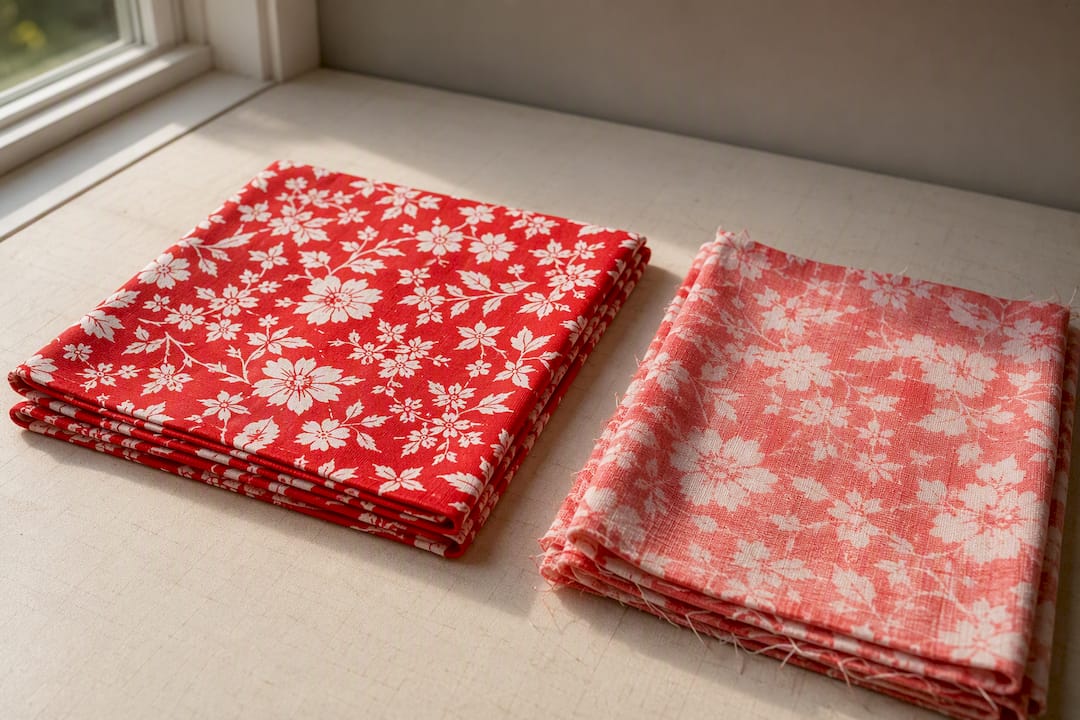
Stack-cutting similar-weight cottons together when you need multiples of the same shape reduces rotary blade drift and keeps every piece identical, a habit worth building early since it saves real time on larger quilts.
Precut Fabric Formats: Fat Quarters, Jelly Rolls, and More
Precut bundles solve a real problem for beginners: coordinating a whole palette of prints without buying and cutting yardage yourself. Almost all precuts are cut from 100% quilting cotton, so the fabric behavior stays the same. What changes is the size and the shopping strategy.
- Fat quarter — roughly 18 by 22 inches (sometimes 20 by 22), cut as a quarter-yard sliced the long way instead of the short way, giving you more usable width for template pieces.
- Fat eighth — half a fat quarter, ideal for small accent pieces or scrappy quilts where you need variety over quantity.
- Jelly roll — a bundle of strips about 2.5 inches by 44 inches, built for strip-piecing techniques like rail fence or string quilts where speed matters more than intricate cutting.
- Charm pack — a stack of 5-inch squares, perfect for simple patchwork blocks like disappearing nine-patch or postage-stamp quilts.
- Layer cake — 10-inch squares, sized for blocks that need more surface area, like large-scale patchwork or quilts with fewer, bigger pieces.
A bundle full of similar-value prints looks pretty in the package but produces a flat, muddy quilt top once it’s sewn together.
Batik, Flannel, Linen, and Other Fabric Options
Once you’ve sewn a few quilting-cotton projects, other fabric types start looking less intimidating and a lot more interesting.
- Batik is technically still 100% cotton, made through a resist-dye process that produces those vivid, mottled colors quilters love. The dye process tightens the weave, giving batik a slightly stiffer hand than standard quilting cotton, and it can occasionally bleed. Test a scrap in warm water before cutting to confirm colorfastness, especially with deep reds and blues.
- Flannel is brushed for softness and warmth, making it a favorite for baby quilts or whole-cloth backing. That brushing process also means flannel typically shrinks more than plain quilting cotton, so prewash it every time. Pay attention to nap direction when cutting, and press rather than iron aggressively to avoid stretching the fibers out of shape.
- Linen and linen blends bring texture that quilting cotton can’t match, but pure linen frays aggressively at cut edges and shifts more during piecing. A blend like 55% cotton and 45% linen behaves far closer to standard quilting cotton while still giving you that woven texture, which makes linen blends the easier entry point for a first experiment.
- Lawn and yarn-dyed wovens have a lighter hand and a subtler color depth than standard quilting cotton, often used once quilters are comfortable with a consistent quarter-inch seam. Prewash lawn, since its finer weave tends to shrink slightly more than midweight cotton; yarn-dyed wovens are generally stable enough to skip prewashing if you’re testing colorfastness on a scrap first.
Specialty Backings: Minky, Double Gauze, and Fleece
Backing fabric doesn’t have to match your quilt top’s fiber content, and sometimes it shouldn’t.
- Minky and other plush backings feel wonderful against skin but feed unevenly through a machine and stretch if handled roughly. Skip prewashing minky before cutting, since the nap and stretch can shift, and use a walking foot to keep layers moving together.
- Double gauze and voile suit lightweight summer quilts or swaddle-style projects where a thick batting isn’t wanted; both prewash well and soften further with each wash.
- Canvas and upholstery-weight fabrics work for bags, pouches, and decor pieces rather than bed quilts, but they demand a heavier needle and often a machine capable of stitching through multiple thick layers.
Fabrics to Avoid for Traditional Patchwork
Some fabrics simply fight against the mechanics of piecing, and knowing why saves you from a frustrating first project.
- Stretch knits distort under the pressure of a presser foot and rotary cutter, and they refuse to hold a crisp pressed seam, which is the backbone of accurate piecing.
- Slippery fabrics like silk charmeuse or synthetic satins shift during cutting and sewing, throwing off alignment even when you’re being careful.
- Pile fabrics such as velvet or corduroy make seam matching nearly impossible, since the nap compresses unevenly under a presser foot.
- Heavy upholstery fabric resists piercing by standard needles and often needs specialized hardware entirely.
- Mixed-fiber quilt tops shrink at different rates once washed, producing puckering along seams that no amount of pressing will fix.
How to Choose Quilting Fabric: A Buying Checklist
Once you know what quilting fabric types exist, the harder question is picking which ones actually belong together in a single quilt. This sequence works whether you’re buying yardage or shopping a precut bundle.
- Run the tonal test first. Lay your candidate fabrics side by side and squint. If you can’t tell which is light, medium, or dark, that fabric probably needs to move to a different pile. Quilters lean on this light/medium/dark grouping far more than exact color matching, because value contrast is what makes a block’s pattern actually readable from across a room.
- Check print scale against your block size. A large floral print can swallow a 3-inch finished block whole, while a tiny calico print can disappear entirely in a bold 12-inch block. Match scale to the size of the piece it’s filling, and reserve your biggest prints for borders or backing where they have room to breathe.
- Buy extra yardage than the pattern calls for. Add 10 to 15% beyond the stated requirement to cover cutting errors and, for directional or large-scale prints, pattern matching across seams. This matters even more with border fabric, where you’re often cutting long strips from a single length.
- Follow fabric-specific prewash rules. Prewash flannel and lawn every time, since they shrink noticeably more than quilting cotton. Test batik scraps for bleeding before deciding whether to prewash. Skip prewashing minky and other plush backings entirely, since it can distort the nap. For standard quilting cotton, prewashing is a personal preference rather than a requirement, since shrinkage sits in that predictable 1 to 3 percent range.
Pro Tip: Photograph your fabric pull in black and white on your phone before buying. Color tricks your eye, but a grayscale photo strips it away and shows you the true light/medium/dark values instantly.
Cutting, Pressing, and Machine Setup Tips
Good fabric choice only gets you halfway. The rest comes down to handling.
- Cut with sharp rotary blades and replace them at the first sign of skipped threads or fraying edges; a dull blade drags fabric instead of slicing it cleanly.
- Stack similar-weight fabrics when cutting multiples of the same shape, always following the fabric’s grain line to avoid bias distortion.
- Press, don’t iron. Pressing sets a seam with an up-and-down motion, while ironing’s back-and-forth glide can stretch bias edges out of shape.
- Nest your seams at intersections by alternating which direction you press adjoining seam allowances, which locks blocks together and reduces bulk.
- Keep your quarter-inch seam allowance consistent using a dedicated quarter-inch presser foot, since even a scant variation compounds across dozens of blocks.
Pro Tip: Swap to a fresh quilting needle, size 75/11 or 90/14 depending on fabric weight, every eight hours of sewing time. A dull needle punches instead of piercing, which shows up as tiny snags you won’t notice until you press.
A walking foot earns its keep on flannel, minky, and multi-layer piecing, since it feeds top and bottom layers evenly and prevents the shifting that causes puckered seams. Pair it with a quality thread, since a weak thread breaks under tension exactly when you least want it to.
How Sewingmachinesplus Helps You Choose the Right Fabric
Picking fabric is only half the equation. Sewingmachinesplus specializes in matching sewing and quilting machines to the fabrics you actually plan to use, backed by personalized consultations for crafters figuring out their first big project. With over 175,000 positive customer reviews, the retailer has built its reputation on helping novice quilters avoid expensive mistakes. Competitive pricing, financing options, free shipping on orders over $49, and a price match guarantee mean the fabric bundles, cutting tools, and quarter-inch feet recommended throughout this guide are easy to source in one place.
Fiber Content and What It Does to Your Finished Quilt
The fiber running through your fabric determines how your quilt feels, drapes, and ages, not just how it sews. Cotton breathes, softens with washing, and holds a crease, which is why it dominates quilting after generations of use. It also wears in gracefully, developing a slightly worn softness after repeated washes rather than degrading.
Polyester and poly-cotton blends resist wrinkling and hold color longer against sun exposure, but they don’t breathe the same way, so a poly-heavy quilt can feel warmer and slightly stiffer against skin. Blends also tend to pill over years of use, especially in high-friction spots like a folded edge draped over a couch arm. For a quilt meant to be used and washed for decades, cotton’s ability to soften rather than degrade generally wins out.
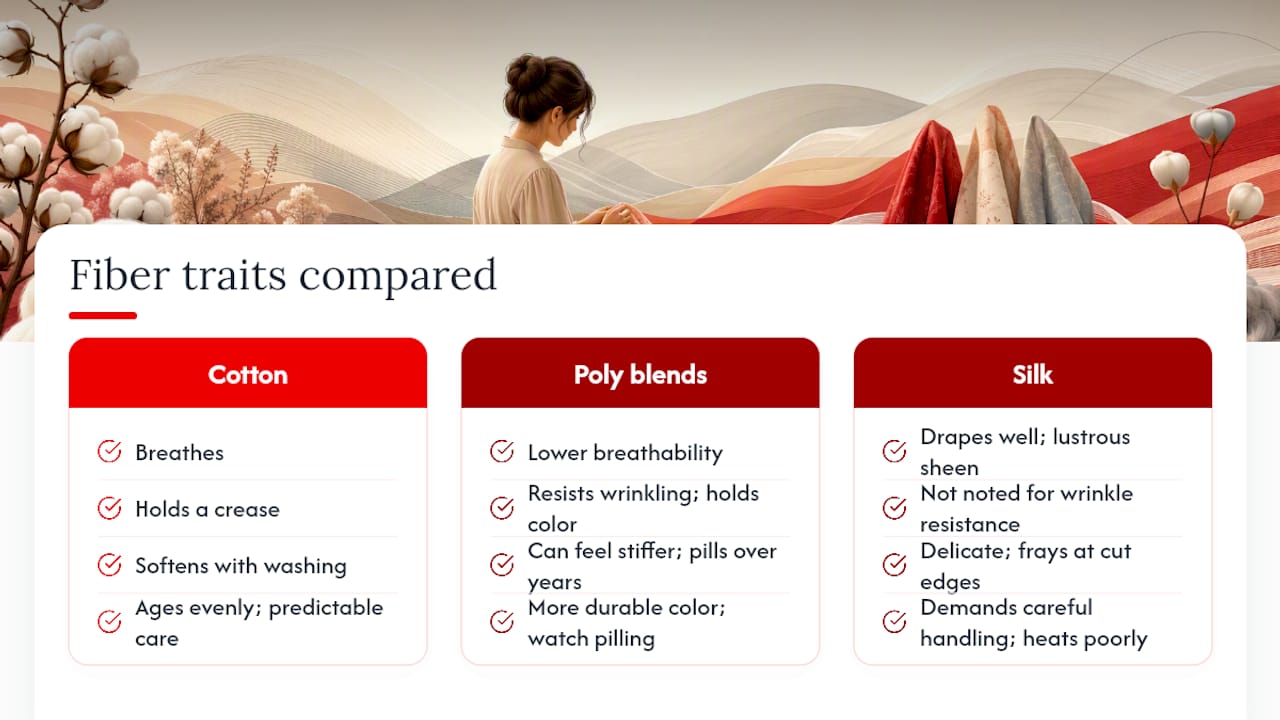
Silk shows up occasionally in art quilts or accent pieces, prized for its sheen and drape, but it frays badly at cut edges and demands careful handling that most beginners aren’t ready for. It also reacts differently to heat, scorching at iron temperatures that cotton handles without complaint.
Mixing fiber types within one quilt top isn’t forbidden, but it does raise the stakes on prewashing, since cotton, poly-blends, and silk each shrink and react to heat differently. A quilt built entirely from one fiber family, most often cotton, ages more evenly and predictably than one stitched from a patchwork of fiber types, even if the visual patchwork looks identical from across the room.
Choosing Fabric With Sustainability in Mind
Fabric sourcing has real environmental weight, and more quilters are factoring that into their fabric pulls. Organic cotton is grown without synthetic pesticides and often processed with lower-impact dyeing methods, though it typically costs more per yard than conventional quilting cotton and can have a slightly different hand depending on the mill.
Look for fabric lines that disclose their dye process, since low-impact or GOTS-certified dyes reduce the chemical runoff associated with textile production. Some fabric manufacturers now publish water-usage figures and certifications directly on bolt labels or product pages, giving you a way to compare options beyond price and print alone.
Buying precut bundles or exact yardage rather than habitually over-buying “just in case” also cuts down on textile waste, since leftover fabric scraps too small for future projects often end up discarded rather than reused. Scrap quilts, an old tradition born partly out of necessity, remain one of the most sustainable approaches available: they turn leftover strips and blocks from other projects into something new instead of adding to a fabric stash that never gets used.
None of this means abandoning affordable quilting cotton. It means reading labels, asking your local shop or supplier about sourcing when it matters to you, and treating fabric scraps as a resource rather than waste.
Fabric Finishes That Change How a Fabric Sews and Wears
Many fabrics arrive with finishes applied during manufacturing, and those finishes affect your needle, your iron, and your quilt’s longevity. A permanent-press or wrinkle-resistant finish, common on some blended fabrics, can make a fabric feel stiffer initially and slightly resistant to holding a crisp pressed seam, since the finish is designed to prevent creasing in general.
Mercerization, a common cotton treatment, strengthens fibers and improves dye absorption, giving quilting cotton its characteristic slight sheen and improved colorfastness compared to untreated cotton. It’s part of why quality quilting cotton takes dye so evenly across a bolt.
Water-repellent or stain-resistant finishes, occasionally found on canvas or outdoor-use fabrics, can make a fabric slippery under a presser foot and resistant to pressing entirely, since the coating is designed to repel exactly the kind of moisture that makes pressing effective. If you’re using treated canvas for a bag or outdoor project, expect to adjust pressure and consider a walking foot to compensate.
Sizing, a starch-like finish applied to keep fabric crisp on the bolt, washes out in the first laundering. That’s part of why a prewashed fabric can feel noticeably softer and slightly different in hand than the same fabric straight off the shelf, and why some quilters prefer working with unwashed fabric for the crisper edge it gives during cutting.
Washing and Ironing Your Quilting Fabrics Correctly
Care routines aren’t one-size-fits-all across quilting fabric types, and using the wrong method on the wrong fabric causes problems ranging from color bleed to permanent distortion.
Quilting cotton tolerates a normal machine wash on cold or warm with a color-catching sheet for the first wash, and it irons at a standard cotton setting without issue. Flannel needs the same gentle wash but benefits from an extra rinse cycle, since brushed fibers hold detergent residue more than smooth-woven cotton. Batik should be washed in cool water alone for its first cycle until you’ve confirmed the dye won’t bleed onto lighter fabrics nearby.
Linen and linen blends prefer a gentler cycle and should be steam-pressed rather than dry-ironed to avoid scorching the fiber, which reacts to heat differently than cotton. Minky and other plush backings should skip the washing machine before cutting entirely and, once quilted into a finished piece, wash on a gentle cycle with cold water to protect the nap.
Drying matters just as much as washing. Tumble drying on low heat is safe for cotton and flannel, but plush backings like minky do better air-dried or tumbled on the lowest heat setting to prevent nap flattening. Whatever the fabric, skip fabric softener on quilts, since it can leave a residue that interferes with future pressing and even affects how well future patches or repairs bond.
Find Your Fabric and Tools at Sewingmachinesplus
Once you know which quilting fabric types fit your project, the next step is sourcing them without guesswork. Sewingmachinesplus carries quilting cotton by the yard alongside precut bundles curated for solid tonal range, plus the cutting tools and machine feet this guide recommends, including rag quilting snips for trimming seams cleanly. Free shipping applies on orders over $49, and every purchase is backed by a price match guarantee, so you’re not stuck overpaying for the same bolt found cheaper elsewhere. If you’re unsure which weight of cotton or which machine foot suits your pattern, a personalized consultation can walk you through the decision before you buy. Start by browsing the fabric and precut bundle categories on the Sewingmachinesplus store landing page to see what’s currently in stock for your next project.
A Personal Note on Fabric Experimentation
I started every early project with plain quilting cotton, and I’d tell any beginner to do the same before reaching for batik or linen. Confidence with a predictable fabric builds the instincts you’ll need once you start mixing textures.
— Chris
Sources
- How to Choose Fabric for Quilting: A Beginner Guide
- 7 Fabric Types for Quilting — & How to Use Them Together Successfully
FAQ
What is the best fabric for a first quilting project?
100% quilting cotton is the standard recommendation for beginners because it cuts cleanly, presses flat, and shrinks predictably at about 1 to 3 percent.
Should I choose cotton or polyester for quilting?
Cotton breathes better, softens with age, and presses more crisply than polyester or poly-blends, which is why it remains the default choice for quilt tops meant to be washed and used for years.
Do I need to prewash quilting fabric before cutting?
Prewash flannel and lawn every time since they shrink more than standard cotton, test batik for colorfastness before deciding, and skip prewashing minky and other plush backings entirely.
What is a fat quarter and how is it different from a fat eighth?
A fat quarter measures roughly 18 by 22 inches, cut the long way instead of the short way for extra usable width, while a fat eighth is simply half that size.
Which fabrics should beginners avoid for pieced quilts?
Stretch knits, slippery silks, pile fabrics like velvet, and heavy upholstery fabric all cause alignment and pressing problems that make traditional patchwork much harder than it needs to be.
