

For most quilters, 50wt cotton is the right starting point. It lays flat in seams, works across most domestic machines, and won’t add bulk to your piecing. Here’s how that breaks down by task, so you can pick the right spool before you sit down to stitch:
-
Piecing: 50wt cotton on a standard 80/12 needle. It disappears into seams and holds firmly without stiffening the quilt.
-
Domestic machine quilting: 40wt cotton or cotton-wrapped polyester for visible stitch definition; 60wt if you want the quilting to recede.
-
Longarm quilting: 40wt on top, 60wt in the bobbin. This combination balances visibility with smooth tension across long runs.
-
Hand quilting: 12wt perle cotton or a dedicated hand-quilting thread with a slight wax or glaze finish to resist tangling.
-
Invisible/monofilament needs: Clear nylon or polyamide monofilament when you want the fabric pattern to read without visible stitching.
-
All-purpose beginner pick: Aurifil 50wt Mako cotton in a neutral (light gray or cream). One spool handles piecing, light machine quilting, and most domestic tasks.
Spool vs. cone: buy spools for domestic machines and cones for longarms. Cones carry significantly more yardage and are wound for continuous high-speed delivery.
Key Takeaways
For most quilters, the right thread comes down to matching weight and material to the specific task, then testing on a scrap before committing to the quilt top.
| Point | Details |
|---|---|
| 50wt for piecing | A 50wt cotton lays flat in seams, minimizes bulk, and works across most domestic machines. |
| 40wt for visible quilting | Use 40wt on top when you want the quilting pattern to read clearly on the finished quilt. |
| Longarm thread combo | 40wt on top and 60wt in the bobbin balances visibility with smooth tension on longarm machines. |
| Low-lint for high speed | Choose gassed, double-gassed, or polyester thread for longarms and high-speed machines to reduce cleaning. |
| Sewingmachinesplus for supplies | Sewingmachinesplus carries threads, needles, and accessories with free shipping over $49 and a price match guarantee. |
Table of Contents
-
What are the main thread types and when should you use each?
-
How do cotton, polyester, and finishes affect your quilting?
-
Working with specialty threads: metallics, variegated, perle, and monofilament
-
What experience at Sewingmachinesplus has taught us about thread
What are the main thread types and when should you use each?
Thread type shapes how your finished quilt looks, feels, and holds up in the wash. These are the materials you’ll encounter most often.
Cotton is the traditional choice for quilters working with cotton fabric. It breathes with the fabric, produces a matte finish, and pairs naturally with cotton’s hand and texture. It’s the go-to for piecing, hand quilting, and any project where you want the stitching to blend rather than shine. The trade-off is that cotton produces more lint than polyester, which means more frequent machine cleaning.
Polyester thread is stronger weight-for-weight than cotton, resists fading, and sheds far less lint. Those qualities make it a practical choice for bed quilts that see heavy washing and for longarm setups where lint accumulation is a real maintenance concern. The slight sheen is worth noting: on a matte cotton quilt, polyester can catch light in a way that reads as slightly synthetic.
Cotton-wrapped polyester gives you the look of cotton on the surface with a polyester core underneath. You get a more natural appearance in the finished stitch while keeping the strength and low-lint performance of polyester. It’s a solid middle-ground choice for quilters who want durability without sacrificing the matte finish.
Monofilament (clear nylon or polyamide) is the thread you reach for when you want the quilting texture without any visible thread color. It works well for stitch-in-the-ditch and for quilting over busy prints where any colored thread would compete. Use the lightest weight you can find and keep your tension on the looser side.
Silk thread is fine, strong, and produces a beautiful subtle sheen. It’s expensive, but for heirloom hand quilting or delicate appliqué work, nothing presses as flat or feels as smooth under the needle.
Metallic threads add sparkle to accent quilting and decorative borders. They require specific setup (covered in the specialty section below) and are not suited for everyday piecing.
Sashiko thread and embroidery floss belong in handwork. Sashiko thread is a thick, loosely twisted cotton designed for the running-stitch patterns of Japanese sashiko quilting. Embroidery floss works for decorative hand stitching on quilt labels and embellishments.
Pro Tip: For a baby quilt or any project that will be washed repeatedly, choose a colorfast 50wt cotton or a low-lint polyester. Avoid metallics and silk in anything that goes in a commercial dryer.
What do thread weight numbers actually mean?
The weight system is counterintuitive: a higher number means a finer thread. The number reflects how many meters of thread weigh one gram, so 100wt thread is much thinner than 12wt. Here’s how the common weights map to quilting tasks:
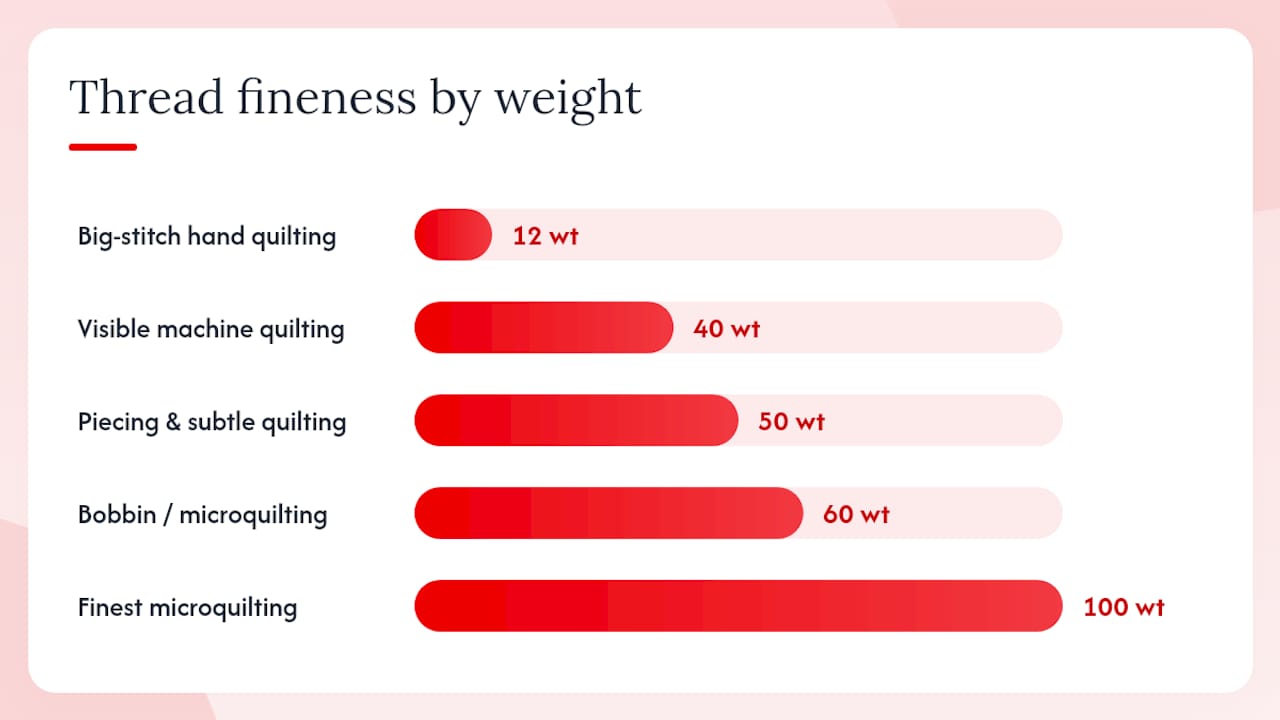
| Use | Common Weight | Typical Needle Size |
|---|---|---|
| Piecing | 50wt | 80/12 |
| Machine quilting (visible) | 40wt | 90/14 |
| Machine quilting (subtle) | 50wt | 80/12 |
| Longarm top thread | 40wt | 90/14–100/16 |
| Longarm bobbin | 60wt | Per machine spec |
| Microquilting / dense fills | 60–100wt | 70/10–80/12 |
| Big-stitch hand quilting | 12wt–8wt | Large-eye hand needle |
A few practical notes on these numbers:
-
50wt is the workhorse. It works for piecing and most machine quilting, and it’s the weight most domestic machines handle without tension adjustment.
-
40wt gives you more visible stitch definition. Use it when you want the quilting pattern to read clearly, especially on solid or low-contrast fabrics.
-
60–100wt threads are useful for dense microquilting or when you want the quilting texture to show while keeping the quilt soft and flexible.
-
12wt is thick enough to create a bold, hand-stitched look on a domestic machine or in big-stitch hand quilting. It reads almost like a running stitch done by hand.
A commonly used longarm combination is 40wt on top with a finer 60wt in the bobbin. The heavier top thread carries the design; the finer bobbin thread stays out of the way and keeps tension balanced.
How do cotton, polyester, and finishes affect your quilting?
Material and finish affect lint, sheen, shrinkage, and how your machine behaves. Getting this right matters more than most quilters expect.
Cotton with cotton fabric is a natural pairing. Cotton thread shrinks at roughly the same rate as cotton fabric, so the quilt ages consistently. It produces a matte, breathable finish that suits traditional and heirloom quilts. The downside is lint. Cotton thread, especially mercerized cotton, sheds fibers at every stitch, and that lint accumulates in your bobbin case and feed dogs.
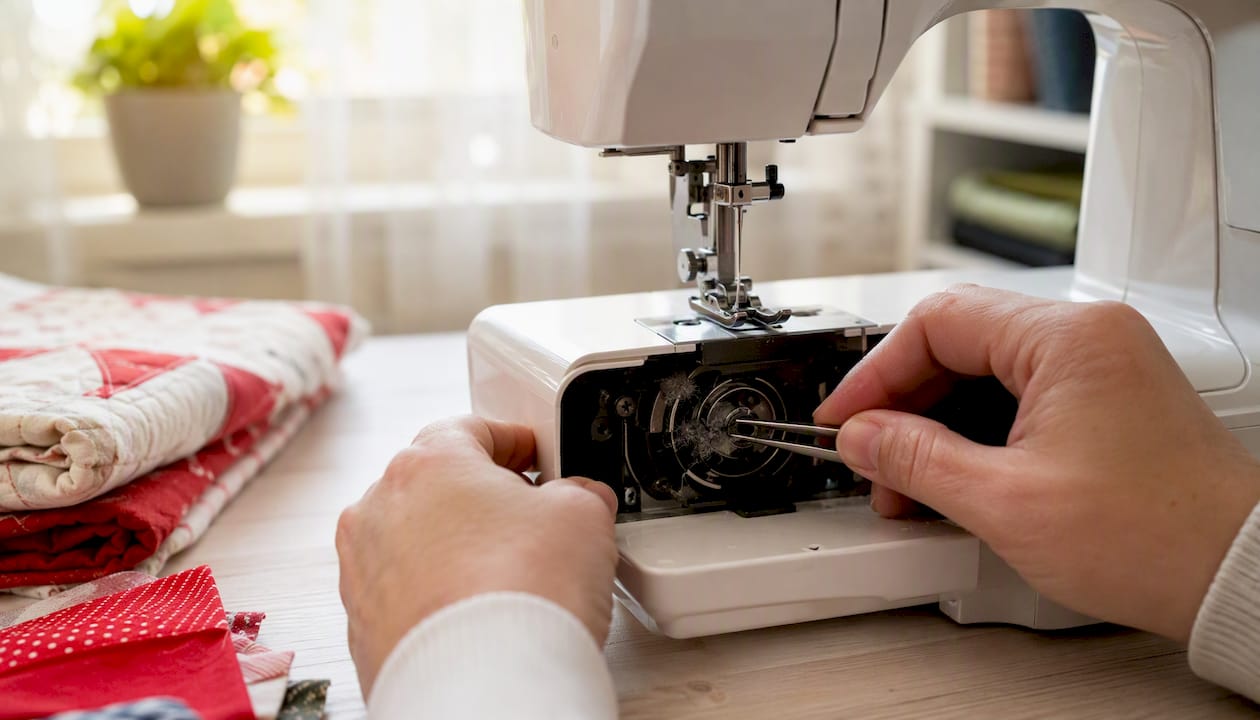
Polyester and cotton-wrapped polyester shed significantly less lint, which is why longarm specialists and high-speed machine quilters favor them. At longarm speeds, lint builds up fast. A low-lint thread can cut your cleaning intervals noticeably.
Mercerized cotton has been treated with sodium hydroxide to increase luster and dye uptake. It’s stronger than untreated cotton and takes color beautifully, which is why most premium quilting cottons are mercerized.
Gassed or double-gassed cotton goes one step further. The thread passes through a flame that burns off surface fibers, leaving a smoother, lower-lint strand. Double-gassed threads are among the cleanest-running cotton options for high-speed machines. If your machine’s manual recommends low-lint thread, gassed cotton is worth seeking out.
Pro Tip: If you’re switching from cotton to polyester thread mid-project, run a few test seams and check your tension. Polyester’s lower stretch and different surface texture can shift the balance between top and bobbin tension, even on the same machine.
How do you match needle size and tension to your thread?
Needle size and tension are where most thread problems start. The needle’s eye needs to be large enough to carry the thread without fraying it, and the tension needs to be balanced so neither the top nor the bobbin thread pulls to the wrong side.
Common needle pairings:
-
50wt thread: 80/12 universal or Schmetz Topstitch 80/12 for a clean path through the needle eye
-
40wt thread: 90/14 for machine quilting through a quilt sandwich
-
60–100wt thread: 70/10 to 80/12 depending on your machine’s sensitivity
-
12wt thread: 100/16 or a topstitch needle with a larger eye
-
Metallic thread: 90/14 Metallic or Topstitch needle with an elongated eye
When tension is off, the fix is usually sequential:
-
Start with the top tension at your machine’s default setting.
-
Sew a test seam on a scrap sandwich (top fabric, batting, backing) at the speed you’ll actually quilt.
-
Flip the sandwich and check the back. If you see loops of top thread on the back, loosen top tension. If you see bobbin thread on the top, tighten it slightly.
-
Adjust in small increments (half a number at a time) and test again before touching the bobbin.
-
Only adjust bobbin tension if top tension changes alone don’t resolve the problem.
Pro Tip: Always change your needle when you change thread weight significantly. A needle that worked perfectly with 50wt cotton may fray or skip stitches with 40wt polyester. Needles are inexpensive; seam ripping is not.
Testing on a fabric sandwich before starting your quilt top is the single fastest way to catch tension and appearance problems before they matter.
How do you choose thread color and manage your bobbin?
Color choice comes down to one question: do you want the quilting to show, or do you want it to recede?
Match the top thread to the top fabric when you want the stitching to blend. This works well for all-over quilting patterns on printed fabric, where the design carries the visual interest and the quilting adds texture without competing.
Use a contrasting thread when the quilting pattern itself is the point. A cream thread on a navy background, or a deep teal on a warm tan, makes every stitch visible. This approach works beautifully for feathers, custom designs, and any pattern you’ve spent time planning.
For the bobbin, the practical rule is simpler than most quilters think. If your backing is a solid dark color, a mismatched bobbin thread will show through. Match it, or use a neutral that reads as a close value. On a busy print backing, a neutral gray or cream bobbin thread disappears reliably without requiring you to swap bobbins every time the top thread changes.
Wind extra bobbins before you start a long project. Running out mid-quilt and re-threading mid-section creates a visible tension difference that’s hard to hide. For longarm quilting, pre-wound bobbins in the correct class for your machine save time and keep tension consistent.
Pro Tip: For longarm work, use the same brand and weight of thread in the bobbin as you do on top when possible. Mixing brands with different surface treatments can create subtle tension inconsistencies that are frustrating to diagnose.
For monofilament quilting, use a clear nylon or polyamide thread on top and a fine 60wt cotton or polyester in the bobbin. The bobbin thread won’t show, and the lighter weight keeps tension manageable. A set of pre-wound metal bobbins helps maintain consistent tension across a long project.
Working with specialty threads: metallics, variegated, perle, and monofilament
Specialty threads reward patience. Each type has a specific setup that makes the difference between a beautiful result and a frustrating afternoon.
Metallic threads are the most demanding. The metallic wrap around the core frays easily if the needle eye is too small or the speed is too high. Use a 90/14 metallic or topstitch needle with an elongated eye, slow your machine to about half its normal speed, and use a thread net over the spool to control delivery. Metallics work best as accent stitching on borders, sashing, or decorative motifs, not for all-over quilting.
-
Variegated threads shift color along the strand, creating a painterly effect without changing spools. The color transitions work best on larger-scale quilting patterns where the shifts have room to develop. On tight fills, the colors blend into a muddy middle tone.
-
Perle (pearl) cotton is a twisted, non-divisible thread used primarily for big-stitch hand quilting and decorative hand embroidery on quilt surfaces. It’s not designed for machine use.
-
Monofilament requires a lighter touch on tension and works best with a walking foot or free-motion foot. Keep it away from high heat in the dryer; nylon monofilament can soften and distort.
Pro Tip: After using metallic thread, clean your machine’s tension discs and bobbin area before switching back to cotton. Metallic threads leave fine metallic particles that can affect tension on subsequent projects.
Troubleshooting common thread problems
Most thread problems trace back to one of five causes: old thread, wrong needle, incorrect tension, a dirty machine, or a mismatch between thread and fabric weight.
Thread breakage is the most common complaint. Check these in order: Is the thread old or brittle? Is the needle the right size and recently changed? Is the top tension too tight? Is the thread path clear of snags (check the spool pin, thread guides, and tension discs)? A thread that breaks repeatedly at the needle is almost always a needle-size or threading-path problem.
Lint build-up slows your machine and throws off tension. For domestic machines, clean the bobbin area every 8–10 hours of sewing time. For longarms running at high speed with cotton thread, that interval shortens considerably. Switching to a low-lint or gassed thread reduces the frequency but doesn’t eliminate the need to clean.
Puckering usually means the tension is too tight, the needle is too large for the thread, or the stitch length is too short for the fabric weight. Loosen top tension first, then check needle size.
Skipped stitches point to a needle problem in most cases: the needle is dull, bent, or the wrong type for the thread. Replace the needle and retest.
Pro Tip: Keep a dedicated “test sandwich” (a few layers of scrap fabric and batting) near your machine. Before adjusting tension on your actual quilt, run the same thread and stitch pattern on the scrap. You’ll catch problems in 30 seconds instead of discovering them three inches into your border.
Vintage thread deserves a specific warning. Thread fibers weaken with age, and old thread can fail under machine stress even when it looks intact. Before using any thread that’s been sitting in a drawer for years, pull a length firmly between your hands. If it snaps with minimal force or shows discoloration and stiffness, replace it.
Where to buy quilting thread and which brands to trust
The U.S. market has several strong quilting thread brands, each with a distinct strength.
-
Aurifil (Italian-made, widely available in the U.S.) is the most-recommended 50wt Mako cotton for piecing. Its low-lint profile and consistent twist make it a reliable choice for domestic machines and longarms alike. Available in an extensive color range on small spools and large cones.
-
Mettler offers both cotton and polyester options, including their Metrosene line for general sewing and Silk-Finish Cotton for quilting. Consistent quality and good color selection make it a dependable everyday choice.
-
WonderFil specializes in low-lint and specialty threads designed for high-performance quilting. Their Konfetti and Fruitti lines are popular for machine quilting, and their Deco Bob is a go-to fine bobbin thread for longarm work.
-
Gütermann produces reliable cotton and polyester threads at accessible price points. Their Natural Cotton thread works well for piecing and hand quilting.
-
Madeira is known for embroidery and specialty threads, including their 80-color embroidery thread collections available at Sewingmachinesplus. Their quilting lines offer good colorfastness and consistent weight.
Buyer’s checklist before you purchase:
-
Spool for domestic machines; cone for longarms (cones hold 3,000–6,000 yards vs. 200–500 on a standard spool)
-
Check the weight label: 50wt for piecing, 40wt for visible machine quilting
-
Look for “low-lint,” “gassed,” or “mercerized” on the label if you’re running a longarm or high-speed machine
-
Order a color card from the brand before committing to a large cone purchase
-
Price-per-yard varies widely: budget threads often cost more in machine cleaning time than the savings justify
Sewingmachinesplus carries threads, needles, and accessories with free shipping on orders over $49 and a price match guarantee, so you’re not paying more than you need to.
How to store thread and avoid vintage-thread problems
Thread storage is simple but often neglected. The enemies are sunlight, heat, and humidity.
Store spools and cones in a cool, dry location away from direct light. UV exposure fades dyed threads and weakens fibers over time, even through a window. Airtight plastic bins or dedicated thread drawer organizers protect against dust and humidity while keeping colors visible. Clear-lidded bins let you see your inventory without opening every container.
Label your storage with purchase dates when you buy in bulk. Use older spools first. Thread doesn’t have a printed expiration date, but cotton and silk fibers do degrade, and a spool that’s been sitting for five or more years deserves a quick tensile test before you trust it in a quilt seam.
The test is simple: pull a 12-inch length firmly between both hands. Good thread stretches slightly and holds. Thread that snaps with light pressure, feels brittle, or shows yellowing or stiffness should be retired. It’s not worth the risk of a seam failure in a finished quilt.
Pro Tip: Store metallic and specialty threads in sealed bags inside your main storage bin. They’re more sensitive to humidity than cotton, and the metallic wrap can tarnish if exposed to moisture over time.
A retailer’s perspective on choosing thread
What experience at Sewingmachinesplus has taught us about thread
After more than 50 years helping quilters find the right equipment and supplies, the thread questions we hear most often come down to two things: “Why does my thread keep breaking?” and “Which thread should I use for my longarm?”
The breaking question almost always traces back to a needle that hasn’t been changed recently enough or a thread that’s older than the quilter realized. The longarm question usually resolves once quilters understand that the thread doing the visible work on top doesn’t have to be the same weight as the bobbin thread. A 40wt on top and a 60wt in the bobbin is a combination that works reliably across most longarm setups, and it’s the starting point we recommend most often.
What we’ve also seen repeatedly: quilters who invest in a quality thread from a trusted brand spend less time troubleshooting and more time quilting. The price difference between a budget spool and a quality 50wt cotton is small compared to the time saved on tension adjustments and machine cleaning.
If you have questions about thread compatibility with a specific machine, Sewingmachinesplus.com offers personalized consultations. Our team can help you match thread to machine, weight to task, and needle to both.
Thread and supplies available at Sewingmachinesplus.com
Sewingmachinesplus.com stocks the threads, needles, and accessories covered in this guide, with expert support available when you need it.
Whether you’re stocking up on 50wt cotton for a piecing project or looking for the right low-lint cone for your longarm, Sewingmachinesplus.com carries a curated selection of quilting supplies backed by over 175,000 positive customer reviews. Orders over $49 ship free, and a price match guarantee means you won’t find the same product cheaper elsewhere and pay more here. If you’re unsure which thread weight or brand fits your machine, reach out for a personalized consultation before you buy.
Sources
The resources below helped create this guide and provide details for those interested in specific thread topics. These include expert articles, reviews, and tips for beginners and experienced quilters. For example, “The Essential Guide to Quilt Thread” by Lo & Behold Stitchery explains thread types, usage, and troubleshooting. Madeira Quilting Thread’s “Guide to Sewing Threads for Quilting” covers materials like cotton, polyester, and silk, and recommends options for different styles. “Choosing the Right Thread for Longarm Quilting” by Handi Quilter offers tips on selecting strong threads, such as metallics for decoration. WonderFil Specialty Threads’ guide highlights options like variegated and metallic threads to enhance projects. The “Longarm Thread FAQ” addresses common questions about tension, breaking, and color matching, helping quilters troubleshoot and select the right threads.
FAQ
What kind of thread is best for quilting?
A 50wt cotton is the most versatile choice for piecing and general machine quilting. For visible quilting patterns, step up to 40wt; for longarm work, use 40wt on top and 60wt in the bobbin.
What is the difference between quilting thread and regular sewing thread?
Quilting thread is typically stronger, lower-lint, and more tightly twisted than standard sewing thread. Many quilting threads are also mercerized or gassed to reduce lint and improve performance at higher machine speeds.
What is the rule of 7 in quilting?
The rule of 7 refers to the recommended number of stitches per inch for hand quilting: a moderate number of stitches per inch is considered the standard for a balanced, even hand-quilted look. Some experienced hand quilters aim higher, but seven is the widely cited benchmark for quality hand quilting.
Is it better to quilt with cotton or polyester thread?
Cotton is the traditional choice for its natural finish and compatibility with cotton fabric. Polyester and cotton-wrapped polyester are better for bed quilts that see heavy washing and for longarm machines where low-lint performance reduces maintenance. The right answer depends on your project’s end use and your machine’s requirements.
