

A machine needle marked 90/14 tells you two things at once: 90 is the metric shaft diameter (0.9 mm) and 14 is the older U.S. size number for the same needle. The rule of thumb is simple: lighter fabrics need finer, lower numbers; heavier fabrics need thicker, higher numbers. But size alone won’t save a project. The needle’s point shape, whether it’s a ball point for knits or a wedge for leather, matters just as much as the number stamped on the package.
TL;DR:
- Needle size alone is not enough; matching point shape to fabric type is crucial for achieving clean stitches and avoiding damage.
- Household needle ranges from 60/8 to 120/19, with sizes specific to fabric weight, such as 70/10 for lightweight fabrics and 100/16 for heavy denim or upholstery.
- Thread weight and fabric thickness determine needle size, and testing on fabric scraps helps ensure proper fit before sewing the main project.
- Swapping to a ball point needle often resolves skipped stitches on knits more effectively than adjusting tension.
- Replacing needles every 6 to 8 hours of sewing prevents skipped stitches, fraying, puckering, and uneven stitches caused by dull or bent needles.
Table of Contents
- What Do Sewing Needle Sizes Actually Mean?
- Which Needle Point Matches Your Fabric?
- What Hand Needle Sizes Should You Keep on Hand?
- How Do You Choose the Right Needle Every Time?
- When Should You Replace a Sewing Machine Needle?
- Where Can You Get Needle Kits and Expert Advice?
- What Beginners Get Wrong About Needle Sizing
- Get the Right Needles Without the Guesswork
- Sources
- FAQ
What Do Sewing Needle Sizes Actually Mean?
Sewing needle sizes come from two overlapping systems that got printed on the same package to save everyone a headache. The metric NM system measures the needle shaft’s diameter in hundredths of a millimeter, so an NM 90 needle has a 0.9 mm shaft. The older U.S. system uses a separate number scale that doesn’t correspond numerically, which is why manufacturers print both together as 90/14 or 80/12 on nearly every pack sold today, according to Wikipedia’s technical breakdown of sewing machine needles.
Once you know that, matching size to fabric gets a lot less confusing. Here’s a working range for household machines:
- 60/8 (very fine): silk organza, chiffon, lingerie fabrics
- 70-80/10-12 (lightweight): quilting cotton, voile, rayon blouses
- 90/14 (medium): medium-weight cotton, wovens, most knit T-shirts
- 100/16 (heavy): denim, canvas, topstitching on thicker seams
- 110/18 and up (extra-heavy): upholstery fabric, multiple denim layers, heavy leather
Household needles generally run from 60/8 up to 120/19, which covers nearly every project a hobbyist takes on. If you’re piecing a quilt top from quilting cotton, a medium range needle size is standard. Switch to a pair of raw denim jeans with topstitching thread, and you’ll want a thicker needle to punch through those layers cleanly.
One shortcut worth knowing: some manufacturers, including SCHMETZ, color code the needle’s shank so you can identify the size range visually without squinting at tiny print. It’s a small detail, but it saves time when you’re digging through a needle case mid project.
Quick fact: a single needle package almost always lists both numbers together, precisely because sewers move between American and European machine brands, and the two size scales don’t translate directly without that dual label.
Which Needle Point Matches Your Fabric?
Size gets a needle into the fabric. Point shape determines whether it makes a clean stitch or a mess. SCHMETZ, one of the most recognized needle manufacturers, builds its entire lineup around matching point geometry to fabric structure, not just thickness, according to its guide on picking the correct sewing machine needle.
- Universal: a slightly rounded point that works on most woven fabrics; the default choice when you’re not sure what else to reach for.
- Ball point/stretch: rounded tips that slide between knit fibers instead of piercing them, which prevents the skipped stitches that plague knits sewn with a sharp point. Brother’s own fabric guidance recommends ball point needles in the 75/11 to 90/14 range for most knits.
- Denim/jeans: a stiffer shaft and reinforced, slim point built to punch through multiple layers without deflecting or breaking.
- Wedge (leather): a cutting point shaped like a tiny blade, made for leather and vinyl where a round point would tear instead of piercing.
- Quilting: a tapered point designed to glide through pieced seams and multiple cotton layers without shredding thread.
- Embroidery/metallic: a larger eye and a specialized scarf that reduce friction on decorative and metallic threads, cutting down on shredding.
- Twin and triple needles: two or three needles on one shank for parallel stitching lines, requiring two spools of thread and a wider stitch plate opening.
Pro Tip: If you’re getting skipped stitches on a knit and you’ve already checked tension, swap to a ball point before you touch a single dial. Point shape solves more knit problems than tension ever will.
What Hand Needle Sizes Should You Keep on Hand?
Hand needles use their own numbering logic, and it runs backward from what you’d expect: the higher the number, the finer and shorter the needle, with a smaller eye to match. A size 12 Sharp is noticeably finer than a size 5.
The American Sewing Guild’s needle guidance breaks the major types down clearly:
- Sharps: medium-length, all-purpose needles for general hand sewing and mending, typically sized 1 through 12.
- Betweens: shorter than Sharps with a small, rounded eye, favored by quilters for tight, even hand stitches.
- Embroidery (crewel): similar length to Sharps but with a longer eye that accommodates embroidery floss without fraying it.
- Tapestry: blunt tips designed to pass between woven threads rather than pierce them, ideal for cross-stitch and needlepoint.
- Darners: long needles with a large eye, built for repairing worn fabric or working with yarn.
- Beading: extremely fine and long, made to pass through tiny bead holes that a standard needle can’t fit.
A dedicated hand-needle set actually speeds up repair work and reduces fabric damage compared to grabbing whatever needle is closest. For hand quilting, reach for a Between in size 9 or 10. Appliqué calls for a fine Sharp, around size 10 or 11. Mending denim needs a sturdier Sharp in size 6 or 7 to push through the tight weave. Beading work requires an actual beading needle, since even a fine Sharp is usually too thick for seed beads.
How Do You Choose the Right Needle Every Time?
Run through this before you sew a single stitch:
- Identify the fabric. Is it a knit, a woven, denim, or leather? That determines point type before size even enters the conversation.
- Match size to thread weight. Fine thread pairs with a smaller needle; heavier topstitching or upholstery thread needs a larger eye to avoid shredding.
- Test on a scrap. Use the same number of layers and the same stitch you plan to sew, not a single flat piece of fabric.
- Adjust if needed. Puckering or skipped stitches on your test scrap mean it’s time to size up, size down, or switch point type entirely.
- Check machine settings for specialty needles. Twin needles need a wider stitch plate opening and two threaded spools; embroidery needles often pair best with a slightly loosened top tension.
Pro Tip: Keep your test scrap folded to match your actual seam. A single layer test can lie to you. A folded, multi-layer test tells the truth.
When Should You Replace a Sewing Machine Needle?
Skipped stitches, frayed thread, visible puckering, and uneven stitch length are the four clearest signs a needle has gone dull or bent. None of these problems require a new machine or a tension overhaul first. They usually just require a new needle.
- Skipped stitches: often a dull tip or the wrong point type for the fabric.
- Frayed or shredding thread: usually a burr on the needle or a scarf mismatched to the thread type.
- Puckered seams: can mean a needle too large for the fabric weight, or one that’s bent and dragging the fibers.
- Uneven stitches: frequently traced back to a needle that’s slightly bent, even when it looks straight to the eye.
Martha Stewart’s sewing guidance recommends starting every new project with a fresh needle, since dull or bent needles are a common, avoidable cause of stitch trouble. As a general cadence, plan to swap needles after roughly 6 to 8 hours of stitching time, or sooner at the first hint of skipped stitches. If a quick needle swap doesn’t fix it, check our guide to fixing skipped stitches for the next troubleshooting step.
Where Can You Get Needle Kits and Expert Advice?
Common needle sizes are generally kept in stock to avoid mid-project delays. The 5 Needle Starter Kit for Knit Sewing covers the 70/10 through 90/14 range most home sewers reach for on knit projects, and it’s a practical starting point if you’re building your first needle case.
Some providers offer personalized consultations to help you determine which size or point type fits your machine and fabric. Free shipping and price match guarantees are sometimes offered to enhance customer satisfaction. Browse the full needles and accessories selection to find the right pack for your next project.
What Beginners Get Wrong About Needle Sizing
Most beginners treat needle size like the whole decision, and it isn’t. The number on the package tells you thickness, nothing more. Point geometry is what actually determines whether your stitches hold or your fabric puckers, and that’s the piece most sizing charts bury below the numbers instead of leading with it.
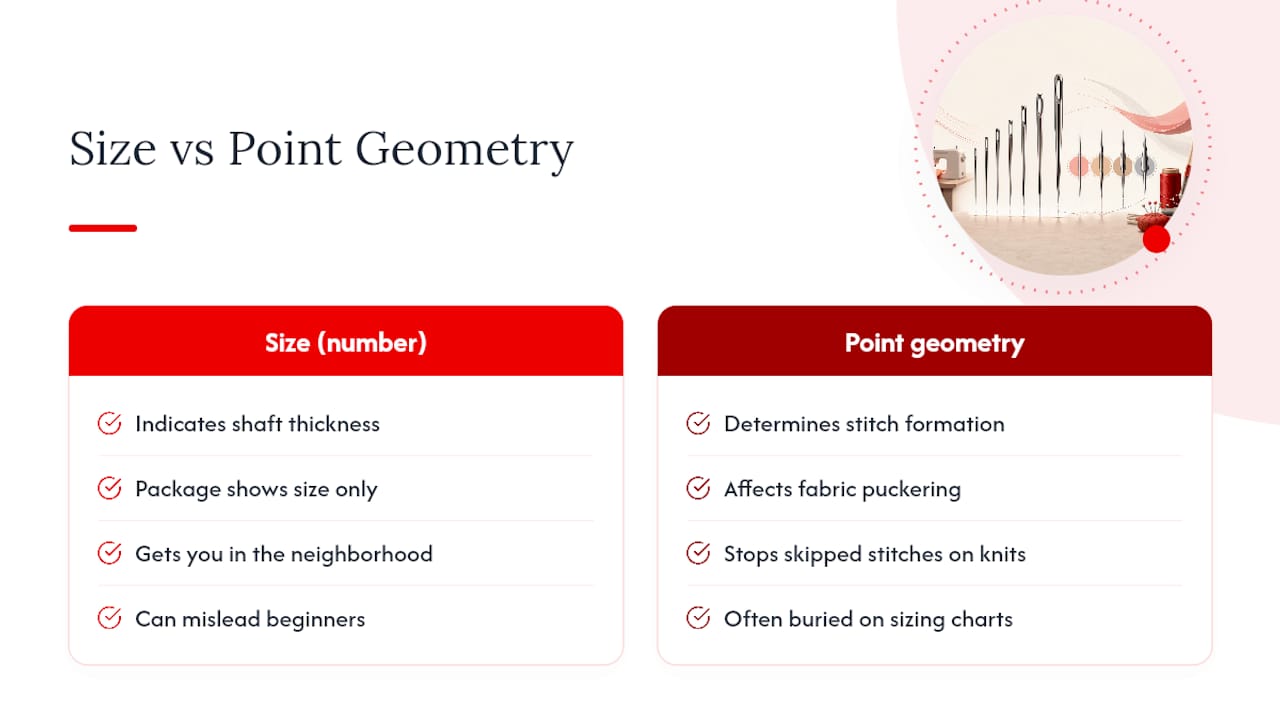
The conventional advice to “just use a universal needle” isn’t wrong exactly, but it’s incomplete. A universal needle on a rayon knit will often skip stitches that a $3 ball point would have prevented entirely. That’s not a tension problem or a machine problem. It’s a five-minute fix that a lot of sewers never learn because the packaging makes size look like the main event.
If you take one thing from a sizing chart, take this: buy a small range of sizes in universal, ball point, and denim points before your next project, not after you’ve already fought through one. Testing on scrap fabric first isn’t optional caution, it’s the fastest way to skip an entire afternoon of frustration. The size number gets you in the neighborhood. The point type gets you the finished seam.
— Chris
Get the Right Needles Without the Guesswork
Retailers often stock needle sizes and point types across many common project categories, from lightweight knits to heavy denim, providing more options than a typical local store. That matters more than it sounds like, because the wrong point type on hand is often the reason a project stalls out entirely. Beyond inventory, some sellers offer personalized consultations and value-added customer service like price match guarantees and free shipping on qualifying orders. If you’re outfitting a needle case for the first time, start with the 5 Needle Starter Kit for Knit Sewing and build out from there as your projects change.
Sources
- Guide to sewing machine needles and how to use them | Martha Stewart
- Sewing basics: hand sewing needles | American Sewing Guild
- Needle — Wikipedia
FAQ
How do you know what size sewing needle to use?
Match the needle size to your fabric’s weight: lighter fabrics like chiffon or quilting cotton need smaller needles (60/8 to 80/12), while denim and canvas need larger ones (100/16 and up). Always confirm the point type, ball point, universal, or denim, matches the fabric structure too.
What does needle size 90/14 mean?
The number 90 is the metric measurement of the needle’s shaft diameter in hundredths of a millimeter (0.9 mm), and 14 is the corresponding U.S. size number for that same needle. Manufacturers print both because both sizing systems remain in common use.
Which needle is bigger, 14 or 16?
A size 16 needle (100/16) is thicker than a size 14 needle (90/14). Higher numbers in the U.S. and metric machine-needle systems mean a larger diameter, suited for heavier fabrics.
Which needle is smaller, 10 or 12?
A size 10 needle (70/10) is finer than a size 12 needle (80/12). Lower numbers correspond to thinner needles built for lightweight fabrics like voile or lingerie fabric.
