

Start with a ballpoint or jersey needle for most knit fabric, and switch to a stretch needle when you’re sewing anything with real spandex or elastane. For everyday T-shirt jersey, an 80/12 is your workhorse size. Drop to a 70/10 for very fine, lightweight knits, and go up to a 90/14 when you’re working with heavier knits like sweatshirt fleece or ponte, or sewing over bulky, layered seams.
TL;DR:
- Using the correct needle type, such as ballpoint for lightweight knits or stretch for highly elastic fabrics, reduces skipped stitches and fabric damage.
- Needle sizes like 80/12 suit most T-shirt knits, while 70/10 is best for delicate fabrics and 90/14 for heavy or layered knits.
- Dull, bent, or improperly matched needles are the most common cause of sewing issues, and they should be replaced every six to eight hours of sewing.
- Testing on scrap fabric before starting helps verify needle and thread compatibility and prevents damage to the final garment.
- A well-stocked needle kit should include multiple sizes and types in labeled cases for quick access when sewing diverse knit projects.
Table of Contents
- Needles for Knit Fabric: Ballpoint, Stretch, or Universal?
- Reading Needle Sizes: What 80/12 and 90/14 Actually Mean
- Matching Needle, Thread, and Stitch for Clean Results
- Fixing Skipped Stitches, Holes, and Tension Problems
- Your Testing Routine and a Ready-to-Use Needle Kit
- How Sewing Machines Plus Helps You Stock the Right Needles
- Steel vs. Nickel-Plated Needles: Does Material Matter?
- Storing Needles So They Last Longer
- Spotting a Dull or Damaged Needle Before It Ruins Your Fabric
- What Happens When You Use the Wrong Needle Type on Knits
- Recommended Needle Brands and Types for Knit Sewing
- The Truth About Needle Guidance Most Sewers Never Hear
- Get Your Knit Sewing Needle Kit From Sewingmachinesplus
- Sources
- FAQ
Needles for Knit Fabric: Ballpoint, Stretch, or Universal?
Three needle types show up in almost every knit sewing conversation, and knowing what separates them saves you a lot of frustration at the machine.
A ballpoint needle (often labeled “jersey”) has a rounded tip instead of a sharp point. That rounded tip slides between the loops of knit fabric rather than piercing straight through them, which is exactly what you want. Sharp needles cut fibers; ballpoint needles nudge them aside. This makes ballpoint your default choice for cotton jersey, interlock, sweater knits, and most stable knit fabrics you’ll find at a fabric counter.
A stretch needle looks similar but has a different eye and a deeper scarf (the indentation above the eye), a design change created specifically to reduce skipped stitches on highly elastic fabric containing spandex or Lycra. If you’re sewing swimwear, activewear, or heavily ribbed knits and your machine keeps skipping stitches with a ballpoint needle, a stretch needle is usually the fix.
Universal needles, despite the name, aren’t actually universal. They’re built for woven fabric, with a point that sits somewhere between sharp and ballpoint. On stable knits they might get away with it, but on finer or stretchier knits, universal needles are a common source of avoidable snags, runs, and skipped stitches you didn’t need to deal with.
Quick decision rules:
- Stable cotton knit, sweater knit, French terry: ballpoint/jersey.
- Swimwear, activewear, rib knit with high stretch recovery: stretch needle.
- Not sure, and no ballpoint or stretch on hand: universal will sew, but expect more skipped stitches and small snags on delicate knits.
Pro Tip: If your machine starts skipping stitches mid-project, don’t assume it’s the machine. Nine times out of ten, it’s the needle fighting the fabric, not the tension settings.
Reading Needle Sizes: What 80/12 and 90/14 Actually Mean
Every sewing machine needle carries two numbers, like 80/12 or 90/14, and once you understand the system, sizing stops being a guessing game. The first number is the metric measurement, the needle’s diameter in hundredths of a millimeter. The second is the corresponding American size. So a 90/14 needle is 0.9 mm thick, an 80/12 is 0.8 mm, and a 75/11 is 0.75 mm. Bigger number, thicker needle, more capacity for handling dense or layered fabric.
For knit projects, size recommendations break down fairly cleanly by fabric weight:
- 70/10: very fine, lightweight jerseys, like a thin modal or rayon blend.
- 80/12: the everyday size for T-shirt jersey, interlock, and most cotton knits you’ll sew.
- 90/14: ponte knits, sweatshirt fleece, and any spot where you’re stitching through multiple layers or a bulky seam.
Two situations call for sizing up or down from your usual choice. Sewing several layers or topstitching over a thick seam is a case for going up to a 90/14 rather than forcing a finer needle through fabric it wasn’t built to handle. Do that with a 70/10, and you risk needle flex or an outright break. On the flip side, an ultra sheer, lightweight knit sewn with too heavy a needle will show visible holes at every stitch, so size down to 70/10 for anything gauzy or delicate.
Matching Needle, Thread, and Stitch for Clean Results
A needle only performs as well as the thread running through it. The eye of the needle has to be wide enough for thread to pass without dragging, and when it’s too tight, you get skipped stitches, thread shredding, or outright breakage. This is one reason stretch and ballpoint needles come with slightly larger eyes than a standard sharp needle of the same size.
For most knit projects, an all-purpose polyester thread or a polyester core spun thread does the job. Polyester has some natural give, which matters when it’s sewn into fabric that’s going to stretch every time someone wears it. Switch to a lightweight thread on sheer or delicate knits, where a heavier thread would show through or pucker the seam.
Stitch choice matters just as much as needle choice. A straight stitch has zero give, so it will pop the first time the seam gets stretched. Use a narrow zigzag, a lightning stitch, or your machine’s built in stretch stitch instead, all of which allow the seam to flex with the fabric. A twin needle is worth setting up for hems, since it lays two parallel lines of stitching with a bit of give built into the zigzag underneath.
Before you sew your actual garment, run through this checklist:
- Needle matches fabric weight (ballpoint or stretch, correctly sized).
- Thread passes through the eye smoothly, no visible drag.
- Stitch selected has stretch built in, not a rigid straight stitch.
Fixing Skipped Stitches, Holes, and Tension Problems
Most knit sewing problems trace back to one of three culprits: the wrong needle, a dull needle, or a stitch setting with no stretch. Work through them in this order before you touch anything else on the machine.
- Confirm needle type and size. If you’re using a universal needle on stretchy fabric, swap to a ballpoint first.
- Try a fresh needle of the same type. A needle that’s been through a few projects can dull faster than it looks, and a fresh one alone often clears up skipped stitches.
- Move up to a stretch needle if the ballpoint still skips, particularly on anything with spandex or Lycra.
- Recheck your thread. Thread that’s too thick for the needle eye causes the same skipping symptoms as a bad needle.
- Confirm your stitch setting has give. A straight stitch on knit fabric can mimic a needle problem when the real issue is the stitch itself.
If you’re seeing actual holes or runs rather than skipped stitches, stop sewing immediately. Continuing to stitch with the wrong needle only widens the damage. Swap in a properly sized ballpoint or stretch needle and test again on a scrap of the same fabric before returning to your project. Skipped stitches on knits are also sometimes a presser foot or feed dog issue rather than a needle issue, so if you’ve already tried a correct needle, fresh needle, and stretch stitch and problems persist, check presser foot pressure and feed dog engagement before assuming your machine needs a repair.
Pro Tip: Keep a small swatch of every knit fabric you buy in a labeled envelope with the needle size and type that worked. Six months later, you’ll thank yourself when you’re stumped over a similar fabric.
Your Testing Routine and a Ready-to-Use Needle Kit
Testing on scrap fabric before committing to your real project isn’t optional busywork. It’s the fastest way to catch a needle mismatch before it ends up in a finished seam.
Run this quick routine on a folded scrap of your actual project fabric:
- Start with a ballpoint 80/12, sew a few inches of straight stitch and a few inches of zigzag or stretch stitch.
- Inspect the stitches. Even, flat stitches with no puckering or visible holes mean you’re set.
- If you see skipping or puckering, switch to a stretch needle in 75/11 for lighter knits or 90/14 for heavier ones, and repeat the test.
Needles wear out faster than most people expect, especially on knits where lint and fiber buildup accumulate around the eye. Plan to replace your needle after every six to eight hours of sewing, or sooner if you notice any drop in stitch quality.
A small, organized kit covers nearly every knit project you’ll take on. Keep ballpoint needles in 70/10, 80/12, and 90/14, plus stretch needles in 75/11 and 90/14, in a labeled case or organizer near your machine. That’s five needle types total, and it’s enough range to handle everything from a sheer rayon tee to a heavyweight ponte dress without a mid-project supply run.
How Sewing Machines Plus Helps You Stock the Right Needles
Finding the right size in the moment you need it is half the battle, and that’s where a wide inventory of needle types and sizes pays off. Sewingmachinesplus carries ballpoint and stretch options across the common sizes, including serger ballpoint needles for anyone finishing knit seams without a dedicated overlock stitch.
Sewingmachinesplus offers free shipping on orders over a certain amount and provides a price match guarantee, helping customers get a good deal when building a needle kit. The store has received a large number of positive customer reviews, and offers consultations to help with choosing needle types for tricky fabrics. Browse the needle assortments or reach out to customer service before your next knit project.
Steel vs. Nickel-Plated Needles: Does Material Matter?
Most sewing machine needles are made from one of two materials, and the difference shows up more in durability than in day-to-day stitch quality. Standard steel needles are strong, sharpen well during manufacturing, and handle most home sewing without issue. Nickel-plated needles add a thin coating over the steel core, which gives some resistance to corrosion and a slightly smoother glide through fabric, an advantage on delicate or silky knit blends where friction can leave marks.
Nickel plating also matters for sewers with nickel sensitivity, since direct, repeated skin contact with plated needles can occasionally cause irritation. If that’s a concern, uncoated steel needles or titanium coated options are worth seeking out.
For pure performance on knit fabric, the needle’s point type and size do far more work than the metal it’s made from. A dull steel needle will underperform a sharp nickel-plated one every time, and vice versa. Titanium coated needles, sometimes marketed for their extended lifespan, hold an edge longer under heavy use, which matters more if you’re sewing knits in volume for a small business than if you’re stitching an occasional T-shirt. For most hobbyist projects, a quality steel or nickel-plated ballpoint or stretch needle in the right size will outperform any material upgrade.
Storing Needles So They Last Longer
Loose needles rolling around in a drawer pick up nicks faster than you’d think, and a nicked needle behaves like a dull one from the first stitch. Keep needles in their original packaging or a dedicated needle case with labeled slots by type and size, so you’re not fishing through a jumble every time you switch fabric.
Moisture is the other quiet threat. A humid sewing room or a case stored near a window can introduce enough condensation to start light corrosion on steel needles, which then drags against thread and fabric. A dry, closed container solves this, and a small silica packet inside a needle case adds extra insurance in damp climates.
Handle needles by the shank, not the point, when inserting or removing them. It sounds minor, but repeatedly touching the tip with fingers or letting needles clatter against metal tools and scissors in a drawer is one of the more common ways a needle gets dulled before it’s ever used. Label used needles if you’re rotating them out for a break rather than discarding them, since a needle that’s done a few hours of work on stable wovens might still have life left for a quick knit repair, but a needle pulled mid-project because of skipping should go straight in the trash rather than back in the case.
Spotting a Dull or Damaged Needle Before It Ruins Your Fabric
A damaged needle rarely announces itself loudly. It shows up as small, frustrating symptoms that are easy to blame on the machine instead.
The clearest sign is a change in the sound of your stitching. A dull or bent needle often produces a faint popping or thudding noise as it forces its way through fabric instead of gliding through cleanly. Visually, hold the needle up at eye level and roll it slowly. A bent needle will show a visible wobble at the tip, and you’ll often catch a burr or flat spot on a needle that’s been sewing for a while.
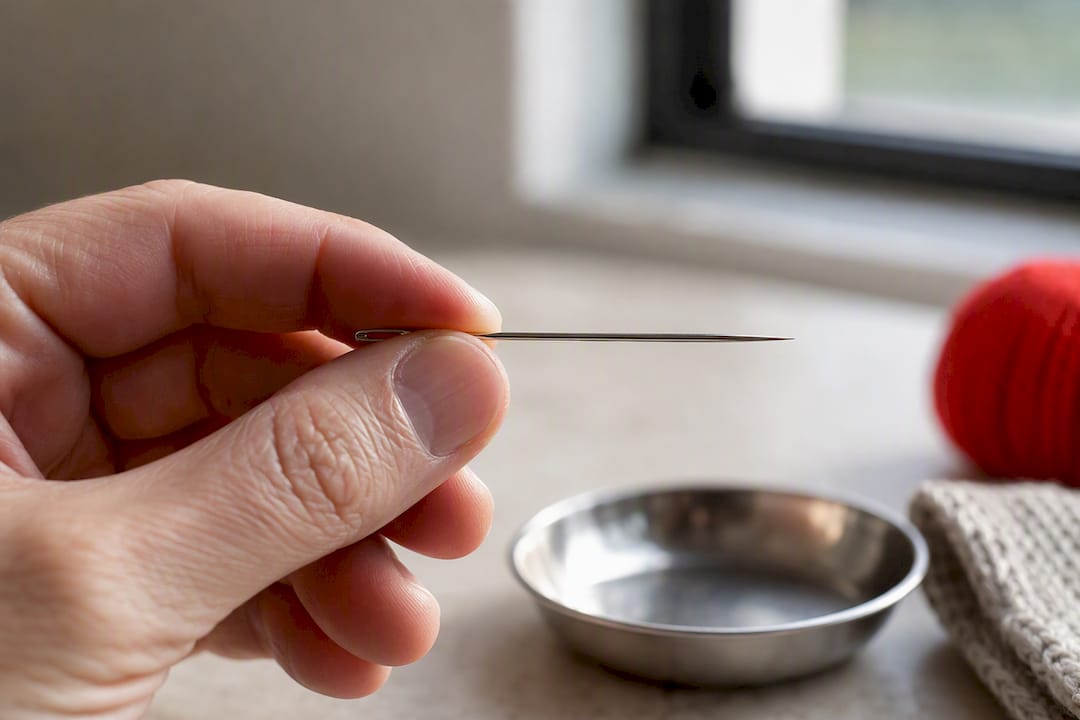
On the fabric itself, watch for small pulls, snags, or a fine line of tiny holes along your seam, all common indicators the needle’s point has dulled past the point of gently parting knit fibers. Needles left in service too long increase holes and uneven stitching, and the damage compounds the longer you keep sewing with the same one. If your machine starts skipping stitches after a run of smooth sewing with no changes to thread or fabric, a dull or damaged needle is the first thing to rule out, well before adjusting tension or presser foot pressure.
What Happens When You Use the Wrong Needle Type on Knits
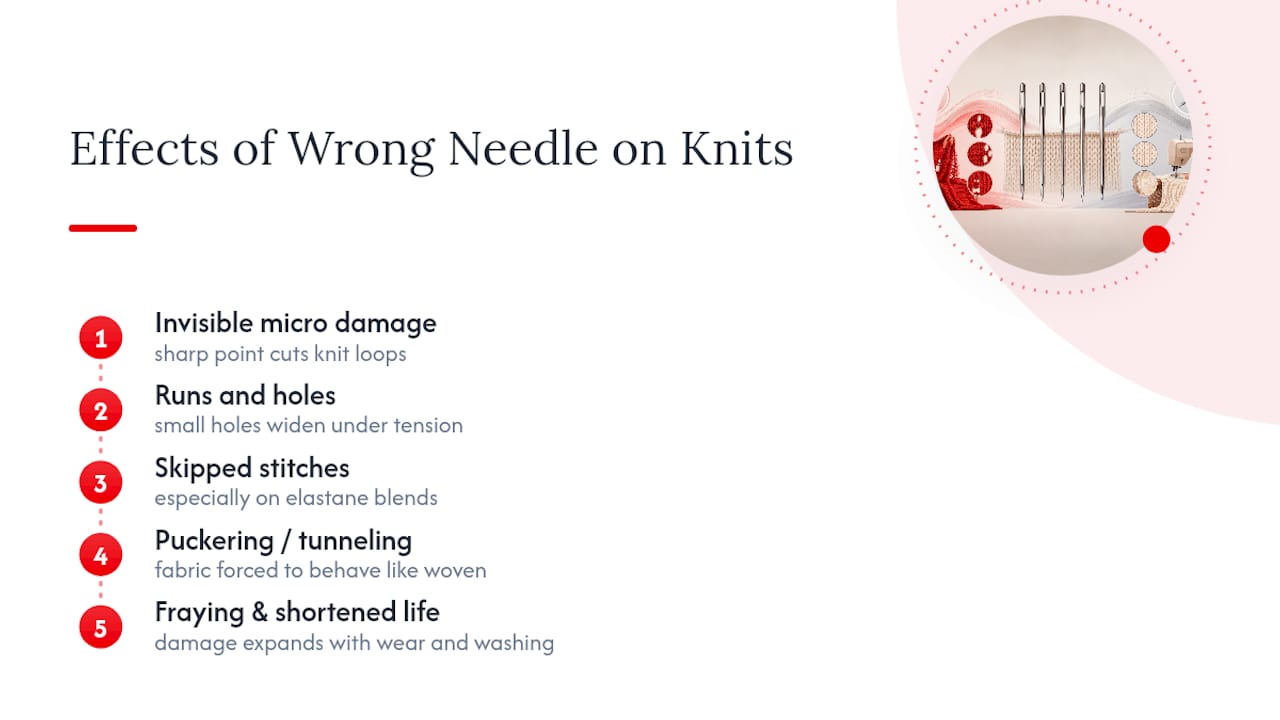
Sewing knit fabric with a sharp needle, the type built for wovens, produces damage that’s often invisible until the garment gets worn and washed a few times. A sharp point cuts straight through the loops that make up knit fabric instead of sliding between them, and those tiny cuts weaken the surrounding fibers.
The most immediate symptom is a run, similar to what happens in a stocking when a fiber snags and unravels along a line. Small holes appear at each stitch, and under any tension, that hole widens into a visible pull. Skipped stitches are the second common effect, particularly on fabric with elastane content, since a sharp or universal needle doesn’t have the eye and scarf design that stretch needles use to keep pace with fabric moving under the presser foot.
Seams sewn with the wrong needle also tend to pucker or tunnel, since a rigid needle forces knit fabric to behave like a stable woven during stitch formation, and the fabric fights back once it’s off the machine and back to its natural stretch. Over repeated wear and washing, garments sewn with a mismatched needle show more fraying at the seams and a shorter usable life overall, since the initial micro damage from a sharp needle only expands with movement and laundering. None of this is usually visible on the fabric fresh off the machine, which is exactly why testing on a scrap first, rather than trusting the seam to hold, catches the mismatch before it’s stitched into a finished garment.
Recommended Needle Brands and Types for Knit Sewing
A handful of needle brands show up consistently in recommendations for knit sewing, and the differences between them are smaller than the differences between needle types. What matters most is that the brand clearly labels ballpoint, jersey, or stretch on the packaging, and that the sizing matches the dual metric and American system.
Schmetz is one of the most widely recommended names for stretch and ballpoint needles, with clear labeling and consistent quality across sizes. Klasse and Singer both produce reliable ballpoint options as well, including serger specific ballpoint needles for anyone finishing knit seams on an overlock machine rather than a standard sewing machine. Organ is another name that turns up in recommendations, particularly for stretch needles in the smaller sizes suited to lightweight knits.
Rather than fixating on one brand, focus on stocking the right combination of point type and size for the projects you actually sew. A mid-range ballpoint needle from a reputable brand, replaced regularly and matched correctly to your fabric weight, will consistently outperform a premium needle used past its useful life or mismatched to the wrong knit.
The Truth About Needle Guidance Most Sewers Never Hear
Most needle advice online treats ballpoint versus stretch as a minor detail, buried after paragraphs about thread tension and stitch length. That ordering is backwards. Needle choice is the single biggest lever you control on a knit project, ahead of your machine’s brand, its price tag, or how many stitches it offers.
The conventional wisdom oversells universal needles as a safe default. They’re not dangerous, but they’re a compromise that shows up later as tiny holes and pulled fibers you won’t notice until the garment’s been worn and washed a few times. If you sew knits with any regularity, a small kit of ballpoint and stretch needles costs less than one skipped afternoon of frustration and a ruined cut of fabric.
Prioritize the scrap test every time, even when you’re confident about the fabric. Fiber content varies more between “the same” fabric types than most sewers assume, and thirty seconds of testing beats unpicking a finished seam. Buy needles in small multiples, not singles, since a bent or dulled needle mid-project shouldn’t mean a trip to the store before you can keep sewing.
— Chris
Get Your Knit Sewing Needle Kit From Sewingmachinesplus
Once you know the sizes and types you need, the next step is having them on hand before your next knit project, not halfway through it when a needle skips or bends. Sewingmachinesplus carries ballpoint and stretch needles across the sizes covered here, from fine 70/10s for sheer knits to heavier 90/14s for ponte and layered seams, along with serger ballpoint options for anyone finishing knit edges on an overlock machine.
Orders above a certain amount qualify for free shipping, and customer service is available to assist with needle and machine compatibility questions. The store is popular among customers and can be a convenient place to stock up on a needle kit rather than buying needles one at a time. Check the current needle assortments and build out your kit before your next knit project hits the machine.
Sources
For readers who want to check needle specifications directly against manufacturer standards, Singer’s guide to machine needle sizing breaks down the metric and American numbering system in detail. Threads magazine’s overview of sewing machine needles covers needle anatomy and point types more broadly. Always cross check needle system compatibility against your specific machine’s manual, since not every brand uses an identical needle system.
- Choosing the right Singer machine needles
- Guide to sewing machine needles for knits - The Last Stitch
- Stretch needles: When and why to use them | Fabric + Flow
- All about needles | Coats
FAQ
What Are the Main Needle Types Used for Sewing?
The three needle types most home sewers rely on are sharp needles for wovens, ballpoint or jersey needles for knits, and stretch needles for highly elastic fabric containing spandex or Lycra.
What Is a 90/14 Needle Used For?
A 90/14 needle measures 0.9 mm in diameter and works well for heavier knits like ponte or sweatshirt fleece, plus multiple fabric layers and bulky seams.
What Needle Do I Use for Stretchy Fabric?
Use a ballpoint or jersey needle for most stretchy knits, and switch to a stretch needle if you’re sewing swimwear, activewear, or rib knit with high elastane content and experience skipped stitches.
What Is the Best Way to Sew Knit Fabric Without a Serger?
Use a ballpoint or stretch needle with a narrow zigzag, lightning stitch, or your machine’s built in stretch stitch instead of a straight stitch, and finish raw edges with a zigzag or twin needle hem for a durable, stretch-friendly seam.
How Often Should I Replace My Knit Sewing Needle?
Replace needles after roughly six to eight hours of sewing, or immediately if you notice skipped stitches, small holes, or a popping sound while stitching.
