

A knee lifter is the better choice for quilters, garment makers, and anyone handling bulky or multi-layered projects, because it frees both hands to guide fabric while you pivot or chain-piece. A hand lifter works fine for casual, occasional sewing where budget and simplicity matter more than hands-free control. The trade-off comes down to this: one costs you a short learning curve for a real efficiency gain, the other costs nothing to learn but slows you down mid-seam. Here’s how the mechanics and the math actually break down.
TL;DR:
- A knee lifter provides proportional, adjustable lift control and keeps both hands free, making it ideal for quilting and handling bulky layers.
- Most machines require a compatible socket and may need additional accessories to support a knee lifter, which can be costly if retrofitting is needed.
- Casual sewists who only do occasional garment work typically find the hand lifter sufficient, as it requires no learning curve and works on every machine.
- Training with a knee lifter involves seat adjustment and consistent knee contact, with most users feeling comfortable after a few projects.
- Prioritize your project type and workflow habits when choosing, since complex quilting workflows greatly benefit from a knee lifter’s hands-free control.
Table of Contents
- Knee Lifter vs Hand Lifter: How Each One Actually Works
- Pros and Cons of Knee Lifters and Hand Lifters
- Does Your Machine Support a Knee Lifter?
- How to Use a Knee Lifter Without Straining Your Leg
- Should You Choose a Knee Lifter or a Hand Lifter?
- How Sewing Machines Plus Helps You Get the Right Setup
- What Actually Matters When You’re Choosing a Lifter
- Ready to Upgrade Your Setup?
- Where to Verify the Details
- Sources
- FAQ
Knee Lifter vs Hand Lifter: How Each One Actually Works
A knee lifter, sometimes called a Free-Hand System, is a detachable metal bar that slides into a socket on the lower right side of the machine. Push it sideways with your knee and it lifts the presser foot proportionally to how much pressure you apply, often lowering the feed dogs at the same time. Let go, and the foot drops back down on its own. Your hands never leave the fabric.
A hand lifter is the small lever behind or beside the needle on nearly every machine ever built. You reach up, flip it, and the foot rises a fixed amount. It works every time, on every machine, but it demands one hand while the other holds the work steady, which breaks your rhythm exactly when you don’t want it broken, mid pivot or mid chain.
The difference shows up fastest in real workflows. Quilters pivoting through a mitered corner need to lift, rotate the fabric, and drop the foot in one fluid motion. A knee lifter lets that happen without releasing pressure on the layers underneath, which matters when you’re wrangling batting and backing that want to shift. Chain-piecing benefits the same way. You feed one unit after another with zero gap, tapping your knee between pieces instead of stopping to reach for a lever.
Here’s how the two stack up across the factors that matter most:
- Best for: knee lifter suits quilting and heavy multi-layer work; hand lifter suits garment construction and occasional projects.
- Hands-free vs. hands-on: knee lifter keeps both hands on fabric; hand lifter requires one hand to release the work.
- Lift height: knee lifter offers proportional, adjustable clearance; hand lifter gives one fixed height per flip.
- Ergonomics: knee lifter reduces hand and wrist strain over long sessions; hand lifter adds repetitive reaching.
- Cost: knee lifter often requires a compatible machine or added accessory; hand lifter comes standard on virtually every machine.
Electronic foot controls and automatic lifters exist too, and they trade some of this granular control for convenience, but neither replaces the tactile feedback a knee bar gives an experienced quilter.
Pros and Cons of Knee Lifters and Hand Lifters
Weighing these two head to head gets easier once you see the trade-offs laid out plainly.
- Knee lifter pros: hands-free operation, better handling of bulky or multi-layered fabric, adjustable lift height that responds to how hard you press.
- Knee lifter cons: takes practice to get consistent, fit varies by machine and cabinet height, and adding one to a machine that lacks a socket usually costs extra.
- Hand lifter pros: works on every machine, costs nothing extra, and requires zero learning curve since most sewers already know how to use it.
- Hand lifter cons: pulls a hand away from the fabric at the worst moments, slows down repetitive tasks like chain-piecing, and offers only one fixed lift height.
Quilters and patchworkers tend to lean knee lifter once they’ve felt the difference on a real project. Casual sewers doing the occasional hem or tote bag rarely notice the hand lever’s limits, because they’re not pivoting or chaining pieces often enough for it to matter.
Does Your Machine Support a Knee Lifter?
Not every machine ships with a knee lifter socket, and not every machine can accept one after the fact. Some models include a Free-Hand System from the factory. Others have a compatible fitting but need the accessory bar purchased separately. Still others simply weren’t designed for it, which means retrofitting isn’t realistic no matter how badly you want the feature.
The lifter itself attaches to a socket on the lower right front of the machine, just below the free arm, and connects internally to the presser bar mechanism. Before you buy anything:
- Check your model’s manual for “knee lifter,” “Free-Hand System,” or “knee control” in the presser foot section.
- Contact the manufacturer or your dealer if the manual is unclear or missing.
- Compare the cost of a retrofit kit against upgrading to a machine with FHS built in, especially if you’re already due for a machine change.
Pro Tip: If you’re shopping for a new machine specifically for quilting, ask about knee lifter compatibility before you fall in love with a price tag. It’s a much cheaper decision to make upfront than to retrofit later.
How to Use a Knee Lifter Without Straining Your Leg
Getting comfortable with a knee lifter is mostly about seat height and consistent contact. Sit so your knee naturally rests against the bar without stretching or hunching, and keep that position consistent across sessions so muscle memory builds faster.
Lift height responds to pressure, so a light nudge gives a small clearance for turning a corner, while a firmer push gives full clearance for pulling out pins or repositioning thick layers. Practice on scrap fabric first: sew a few inches, tap the knee bar, pivot 90 degrees, and continue. Repeat until the motion feels automatic.
- Time your knee tap right before you need to pivot or reposition, not after you’ve already stopped the needle.
- Use a lighter touch for quick adjustments and a firmer one when clearing bulky seams.
- Switch to the hand lever for fine, one-off adjustments like trimming a thread tail, where hands-free control adds no real benefit.
Pro Tip: Most sewists report the knee lifter feels awkward for the first hour and second nature by the end of a full quilt top. Give it a real project before deciding it isn’t for you.
Should You Choose a Knee Lifter or a Hand Lifter?
Run through these signals before deciding:
- Project type: Quilting, free-motion work, or multi-layer garment sewing points toward a knee lifter. Occasional mending or simple garment sewing works fine with a hand lifter.
- Workflow habits: If you chain-piece often or pivot constantly through curves and corners, hands-free control saves real time over a full project.
- Budget and machine fit: If your current machine has no knee lifter socket, weigh the cost of a compatible replacement machine against sticking with the hand lever you already have.
- Body mechanics: Hand or wrist strain, or long sewing sessions that leave your hand sore from repeated lever flips, both favor switching to knee control.
Quilters and garment makers working on large or complex pieces get the most out of a knee lifter, according to guidance from Practical Textile, while casual hobbyists rarely need to upgrade past the standard hand lever.
How Sewing Machines Plus Helps You Get the Right Setup
There are many machines and accessories available for quilters, from entry-level models to long-arm setups built for heavier work, and options include some models with a Free-Hand System and others that require an add-on kit. If you’re unsure whether your current machine supports a retrofit, a quick consultation saves you from buying the wrong part.
Financing options may be available to help move up to a knee-lifter-equipped machine without paying the full cost upfront, and some sellers offer price match guarantees to help avoid overpaying. Many online retailers offer free shipping on orders over a certain amount, which can cover most lifter accessories and presser feet outright. Browse presser feet and accessories to see what pairs well with your current setup.
What Actually Matters When You’re Choosing a Lifter
Most advice on this topic treats the knee lifter like a luxury upgrade, something you add once you’ve “graduated” to serious quilting. That framing undersells it. The knee lifter isn’t a reward for skill level. It’s a workflow tool that pays off the moment your projects involve repeated pivoting or layered fabric, regardless of how long you’ve been sewing.
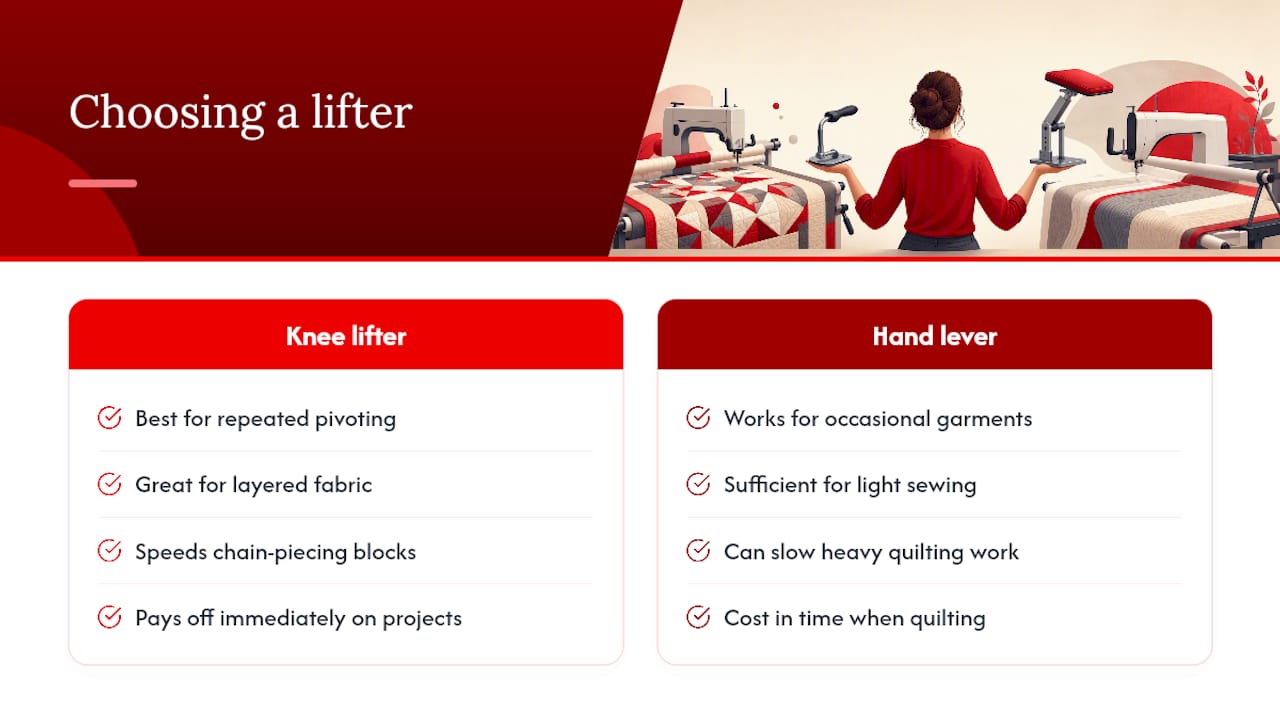
Where the conventional advice falls short is compatibility. Plenty of guides describe the benefits without mentioning that a large share of machines simply can’t accept one without a proper socket, so readers get excited about a feature their machine will never support. Check compatibility first, want the feature second.
If you’re on the fence, prioritize an honest look at your actual projects over what sounds impressive. Someone sewing occasional garments doesn’t need to chase a knee lifter just because quilters swear by it. But if you’re chain-piecing blocks or wrestling with quilt sandwiches every weekend, the hand lever is quietly costing you time you’d never notice until it’s gone.
— Chris
Ready to Upgrade Your Setup?
If you’ve decided a knee lifter fits your workflow, the next move is confirming your machine can support one, and consulting with a knowledgeable dealer can help. Some retailers carry machines with Free-Hand Systems built in alongside compatible accessories, and may offer price match guarantees, financing options, and free shipping on qualifying orders.
Call our sales team to ask about knee-lifter-compatible machines, or browse our full selection of sewing and quilting machines to compare options directly. If you already own a machine and just need the right accessories, request a fit check before ordering so you’re not stuck with a part that won’t work.
Where to Verify the Details
For technical specifics on presser-foot lifting mechanisms, see Jukky’s service page. For a plain-language breakdown of knee lifter operation, read SewingTrip’s explainer. For compatibility questions, check EHarrisGallery’s guide.
Sources
- Presser Foot Lifting Systems - Service - Jukky
- What is a Knee Lifter on a Sewing Machine? Game-Changing Sewing Hack! - SewingTrip
- What Is Knee Lifter On Sewing Machine: How Does It Work? - EHarrisGallery
FAQ
Is a Knee Lifter a Real Thing?
Yes, it’s a standard accessory on many mid-range and higher-end sewing machines, not a niche or discontinued feature. It’s officially called a Free-Hand System on many machines and functions as a detachable bar that raises the presser foot using knee pressure.
What Is the Purpose of a Knee Lifter on a Sewing Machine?
Its purpose is to let you raise and lower the presser foot without using your hands, so you can keep fabric positioned while pivoting, chain-piecing, or handling bulky layers. It often lowers the feed dogs at the same time, which helps with repositioning thick or multi-layer work.
How Much Does a Knee Lifter Cost?
Pricing varies by machine brand and whether the accessory is sold separately or built into the model, so current prices are best confirmed on the Sewingmachinesplus site or through a quick consultation with our sales team. Cost often depends on whether your machine already has a compatible socket or requires a different model entirely.
Can I Add a Knee Lifter to My Current Machine?
It depends on your model. Some machines have a socket that accepts a knee lifter accessory, while others aren’t built to support one at all, so checking your manual or contacting the manufacturer before buying anything is the safest first step.
Do I Need a Knee Lifter If I Only Sew Casually?
Not necessarily. A standard hand lifter handles occasional garment sewing and light projects just fine, and the knee lifter’s real advantage shows up mainly during quilting, chain-piecing, or frequent pivoting where hands-free control saves meaningful time.
Recommended
- High-Quality 1/4in. Quilting and Patchwork Foot with Guide (SA185) (XC6800251) (ESG-QGF) Fits Baby Lock, Brother, Elna, Janome, Singer
- Ditch Quilting Foot P60494 - Janome / New Home, Kenmore
- Quilting Ruler Types: A Practical Guide for Every Quilter
- Avoid Returns: Pick a Quilt Frame That Fits Your Room, Machine, and Do
