

The most reliable thread storage system mixes two things: protected, visible storage for your master stash and a portable setup for whatever you’re working on right now. Compartment boxes or drawers handle long-term protection. Peg racks, dowel rods, and small project kits handle daily grabbing. Keep threads out of direct sunlight and away from humidity swings, and either option works.
TL;DR:
- Use partitioned plastic boxes for large collections, ensuring all spools are visible but protected from dust and sunlight.
- Label every bobbin with brand, color number, and fiber type to prevent confusion during selection and reordering.
- Store cones upright in enclosed drawers or cabinets to prevent crushing and reduce exposure to dust and light damage.
- Keep a separate portable kit with pre-wound bobbins and labeled rings for current projects to minimize handling of the entire stash.
- Protect stored thread from light, humidity, and dust by using closed containers with silica gel and rotating stock to avoid aging or color fading.
Table of Contents
- Thread Storage Ideas for a Large Mixed Collection
- Wall-Mounted Thread Display Ideas That Save Counter Space
- Drawer and Cabinet Storage for Cones and Bulky Spools
- Portable Thread Storage for Projects and Travel
- DIY Thread Organizer Ideas on a Budget
- How Light, Humidity, and Fiber Type Affect Thread Life
- Labeling and Inventory Systems That Actually Get Used
- Choosing the Right Thread Storage System for Your Space
- Embroidery Floss vs. Spool and Bobbin Storage
- Keeping Thread Storage Safe Around Kids and Pets
- Why Preservation Beats Perfection
- Where to Find Bobbins, Boxes, and Storage Accessories
- Sources
- FAQ
Thread Storage Ideas for a Large Mixed Collection
If your stash has grown past a shoebox, partitioned plastic boxes are the workhorse solution. They let you see every spool at a glance, stack neatly on a shelf, and keep dust off your thread without sacrificing organize-thread-spools access.
Swap cardboard bobbins for plastic ones wherever you can. Plastic bobbins resist bending, water damage, and label loss far better than cardboard, which matters once you’re managing hundreds of colors over several years.
- Label every bobbin with brand, color number, and fiber type. This one habit prevents more wasted time than any storage container you’ll buy.
- Tuck loose tails before boxing thread to stop tangles.
- Slip a spool net over cones and larger spools. Thread nets stop the unwind pooling that turns a tidy cone into a tangled mess.
Wall-Mounted Thread Display Ideas That Save Counter Space
Wall storage turns your thread collection into part of the room instead of clutter on the cutting table. Pegboard with removable dowels gives you flexibility to rearrange as your stash grows. A dedicated dowel rack is faster to build and holds up better under daily use, but it’s fixed once installed.
- Mount the rack away from windows and heat vents. Direct light and warm air both accelerate fiber breakdown over time.
- Space dowels at roughly 1 to 1.25 inches on center using 1/4 to 3/8 inch rods. That spacing fits most mini spools and floss bundles without crowding.
- Group spools by color family or fiber type so your eye finds the right shade in seconds rather than scanning the whole wall.
- In a small room, use a narrow strip of dowels behind a door or on the inside of a closet panel. You lose no floor space and still get full visibility.
Pro Tip: Label each peg row with a small tag by color family. It sounds unnecessary until you’re standing at the rack trying to remember whether “medium blue” lives on row three or row five.
Drawer and Cabinet Storage for Cones and Bulky Spools
Large cones and industrial spools don’t belong on open display. They’re heavy, they collect dust fast, and direct light does more damage to them simply because they sit exposed longer. Shallow drawers or a small cabinet keep them concealed and protected while still giving you organized access.
- Use drawer inserts or shallow trays to separate bobbins from small tools like scissors and seam rippers.
- A rolling cart works well if your sewing space doubles as a dining table or guest room. Everything tucks away between sessions.
- Store cones upright on dedicated holders rather than stacking them on their sides. Stacking crushes the core and can distort the wind, which throws off tension later.
Portable Thread Storage for Projects and Travel
Your master stash should stay put. Your current project shouldn’t have to. Building a small, portable kit for whatever you’re stitching right now saves you from digging through the full collection every session, and it protects the rest of your thread from unnecessary handling.
- Floss drops work faster for grab-and-go color changes; pre-wound bobbins save setup time if you’re using a machine on location.
- Pack a compact case with a labeled binder ring for the colors in your current pattern, plus a silica gel packet to control moisture.
- A small tackle box style case, roughly 8 by 6 inches with adjustable compartments, holds a full project’s worth of embroidery thread storage without adding bulk to a travel bag.
- Keeping a separate project kit means your main stash gets opened less often, which cuts down on dust exposure and accidental snags.
DIY Thread Organizer Ideas on a Budget
You don’t need a full workshop to build solid thread storage. A basic dowel rack takes an afternoon: cut a board, drill holes at your chosen spacing, insert dowels, and mount to the wall. Pegboard conversions are even faster since the holes are already there.
- Repurpose mason jars for floss bundles sorted by color. They’re airtight enough to slow dust buildup and look good on an open shelf.
- Jewelry trays with small compartments make surprisingly good bobbin organizers, especially the kind with a clear lid.
- Spice racks mounted on a wall or inside a cabinet door hold spools upright in rows, which is ideal for a narrow craft closet.
- Old card-catalog drawers, if you can find one secondhand, are practically built for floss cards and take on a nice vintage look.
Pro Tip: Open shelving looks great in photos, but it trades UV and dust protection for visibility. If you go this route, keep it out of direct sun and dust the shelves weekly.
How Light, Humidity, and Fiber Type Affect Thread Life
Preservation comes down to four enemies: light, humidity, dust, and time. Sunlight weakens thread fibers significantly, and stable conditions, roughly 60 to 75°F with 35 to 60% relative humidity depending on fiber, slow that breakdown considerably.
Dust is the sneakier problem. Grit from dusty thread works into tension discs and needle eyes, which is why a machine that suddenly develops tension trouble often has a thread problem, not a mechanical one.
Fiber type changes the stakes. Polyester holds up for decades when stored properly, while rayon, silk, and metallic threads need closer attention. Metallic threads in particular are prone to foil delamination if humidity swings too much.
- Use opaque, closed boxes instead of open bins for anything you’re not actively using.
- Add silica gel packets to sealed containers in humid climates.
- Cap cones between projects to keep dust off the outer wraps.
- Rotate stock first in, first out so older spools don’t sit exposed at the bottom of a bin for years.
Labeling and Inventory Systems That Actually Get Used
A system only works if you keep up with it, so keep labeling simple. Write brand, color number, and fiber type on every spool and bobbin, no exceptions. That third detail matters more than people expect. Choosing thread for quilting versus embroidery depends heavily on fiber, so mixing them without a label creates real confusion later.
- A photo grid or basic spreadsheet prevents duplicate purchases and helps you track discontinued shades before they’re gone.
- Sorting by color family speeds up retrieval if you shop by eye; numeric sorting works better if you follow pattern codes closely.
- Re-tuck tails and cap cones after every session.
- Keep your five or six most-used colors within arm’s reach instead of buried in the main stash.
Choosing the Right Thread Storage System for Your Space
Match your system to how you actually work, not to what looks best online. Answer three questions first: how big is your stash, how much space do you have, and how often do you travel with projects.
- Small stash, tight space: A single compartment box plus a narrow dowel strip covers most starter collections.
- Steady hobbyist, dedicated corner: A wall rack for daily colors, a drawer unit for cones, and one portable project case.
- Large collection or shared studio: Multiple partitioned boxes or a small cabinet, a full wall rack system, and separate project kits per active piece.
Once you know your profile, work through it in order: declutter what’s tangled or expired, sort by fiber and color, pick one system from above, then label everything as you put it away. Most people can finish this in a single evening.
| Your profile | Best starting system | Add later |
|---|---|---|
| Starter (small collection) | One compartment box | Small dowel strip |
| Steady hobbyist | Wall rack + drawer unit | Portable project case |
| Collector or studio | Multiple boxes + cabinet | Full wall system |
Embroidery Floss vs. Spool and Bobbin Storage
Floss and spooled thread behave differently, so they need different systems. Plastic or cardboard bobbins in partitioned boxes work best for large floss collections you plan to keep long term, since each bobbin holds a single color in a fixed, labeled unit that stacks cleanly. Printable floss cards in a three-ring binder are the better call if you want fast flip-through browsing, especially for cross-stitch where you’re matching colors against a chart constantly.
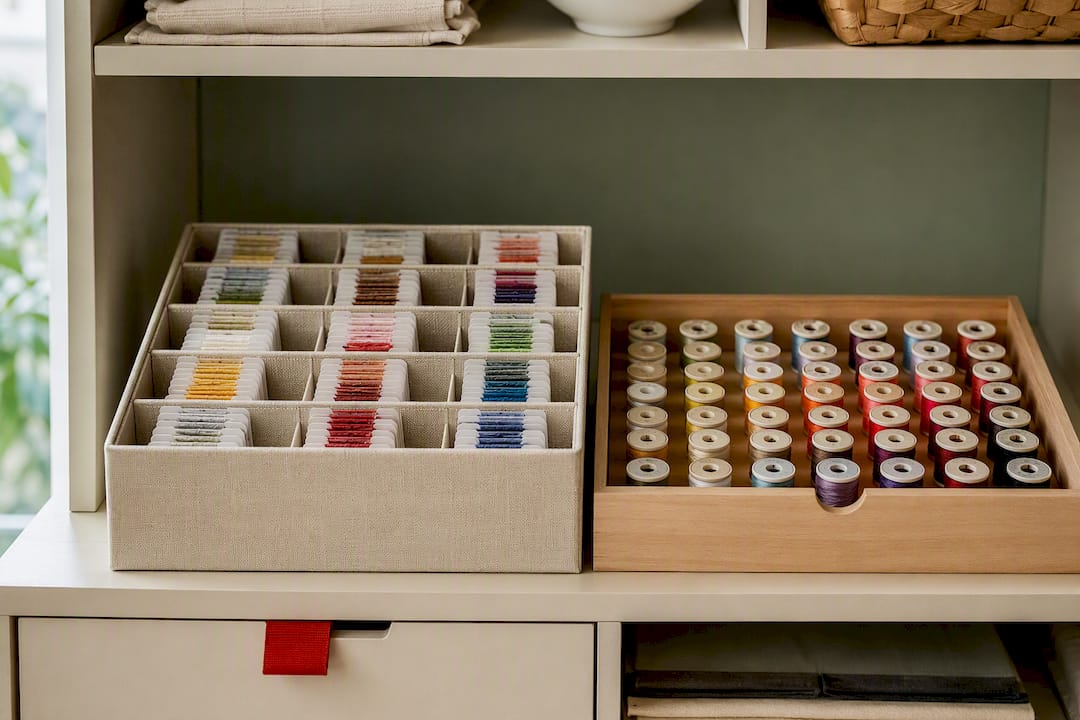
Spool and bobbin thread for machine sewing works on a different rhythm. You’re not browsing dozens of shades per project the way you might with floss. Instead, you’re usually running one or two colors for an extended stretch, which makes wall racks or drawer units more practical than binder-based systems. Bobbin type also depends on your machine, so keep bobbins for different machines in separate labeled sections if you own more than one.
The two systems can share a shelf without competing. A common setup keeps floss bobbins in one partitioned box, sewing thread spools on an adjacent wall rack, and a shared drawer below for empty bobbins and winding tools. What matters is that you’re not forcing floss card storage to double as spool storage or vice versa. Each format was built around how that thread type actually gets used. Trying to make one container do both jobs usually ends with floss cards jammed sideways into a box meant for round spools, or spools rattling loose in a binder pocket that was never sized for them.
Keeping Thread Storage Safe Around Kids and Pets
Thread looks harmless, but small spools, loose floss bundles, and pins that often live in the same storage area create real hazards for young children and curious pets. A dropped spool can become a choking risk, and a tangle of loose floss is exactly the kind of thing a cat or a toddler finds irresistible.
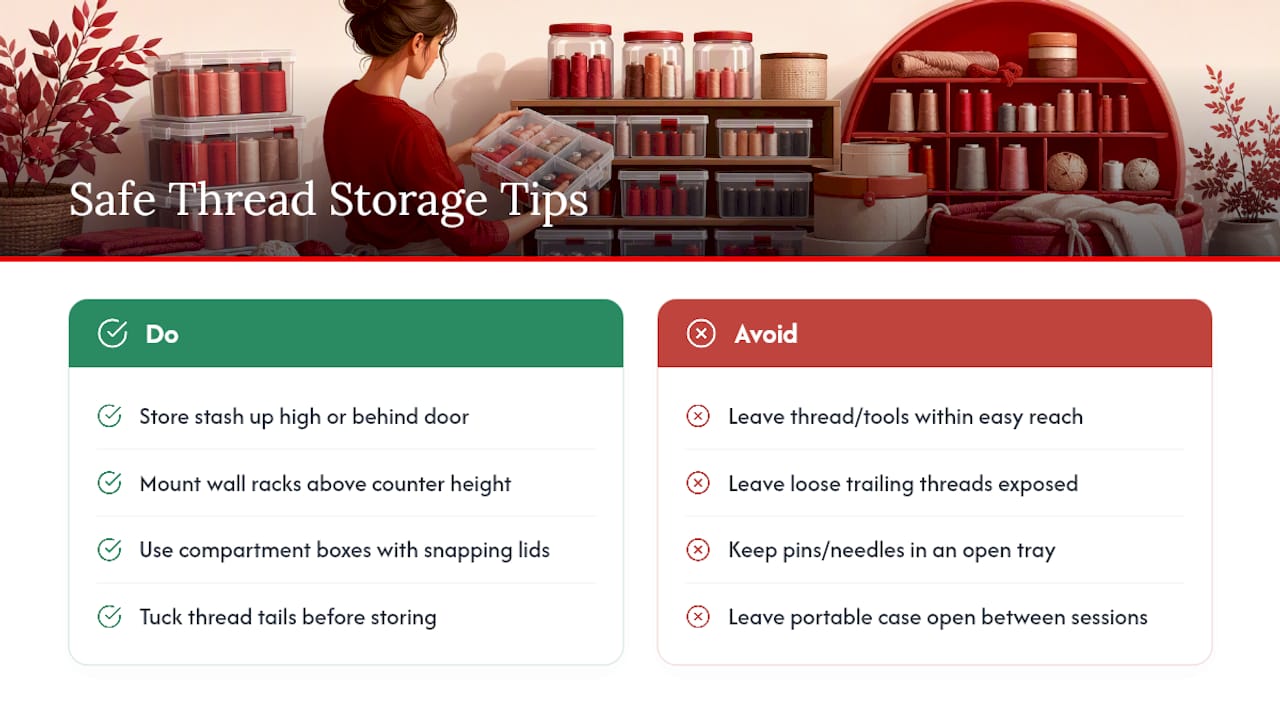
Store your main stash up high or behind a closed door if children or pets have regular access to your sewing space. Wall racks mounted above counter height keep spools visible without putting them within easy reach. Compartment boxes with secure, snapping lids do double duty here: they protect thread from dust and also keep small pieces contained if a box gets knocked to the floor.
Loose thread tails are a tangling hazard in their own right, for pets especially. A trailing thread can wrap around a paw or, in rare but serious cases, get swallowed. Tucking tails before storage isn’t just tidy housekeeping, it removes a genuine snag point. If you keep pins, needles, or seam rippers in the same drawer as your thread, use a separate lidded compartment rather than an open tray, since those tools carry more risk than the thread itself.
Portable project cases deserve the same caution when you’re stitching somewhere shared with kids, like a living room or kitchen table. Close the case fully between sessions rather than leaving it open on a side table, and choose a case with a secure latch if pets tend to investigate anything left out.
Why Preservation Beats Perfection
Most articles on thread storage focus on what looks good, and honestly, a wall of color-sorted spools does look great in a photo. But the crafters who keep thread usable for years, not just months, are the ones who treat storage as protection first and display second. A gorgeous open shelf that sits under a sunny window will cost you thread strength faster than a boring closed drawer ever will.
The other thing worth saying plainly: you don’t need one perfect system. The hybrid approach, a protected master stash plus a separate portable kit, works because it matches how sewing actually happens. You don’t dig through your entire collection every time you sit down to stitch, so stop building storage that assumes you do. Build one system to protect what you’re not using and another to serve what’s in front of you right now. That split does more for your workflow than any single container ever will.
— Chris
Where to Find Bobbins, Boxes, and Storage Accessories
Once you’ve picked a system, the right accessories make it stick. Sewingmachinesplus carries partitioned storage boxes, clear bobbins in multiple sizes, and compact project kits like the foldable sewing kit with accessories for anyone building a portable setup. Shipping is free on orders over a certain amount, and purchases are backed by a price match guarantee to help ensure competitive pricing. Financing options may be offered for larger purchases to assist customers acquiring multiple items at once. If you’re not sure which bobbin size fits your machine, a quick look at bobbin types by brand will save you a return trip. Browse the full accessories selection to start building your system today, or reach out for a personalized consultation if you want help matching storage to your specific collection.
Sources
- Embroidery thread storage and shelf life – SignWarehouse
- How to store sewing thread properly — SewingTrip
FAQ
What is the best way to store sewing threads?
A mixed system works best: partitioned boxes or drawers for your main stash, plus a wall rack or portable case for threads you use often. Keep everything away from direct sunlight and humidity swings to protect fiber strength.
What are some ways to store thread?
Common options include partitioned plastic boxes, pegboard or dowel wall racks, shallow drawer units for cones, rolling carts, and portable project cases for active work. The right choice depends on your stash size and how often you travel with projects.
How can I make a DIY thread organizer?
Build a simple dowel rack by drilling holes spaced 1 to 1.25 inches apart using 1/4 to 3/8 inch dowels, then mount it to a wall away from windows. Repurposed mason jars, jewelry trays, and spice racks also work well for smaller collections.
What should I do with a lot of embroidery floss?
Wind floss onto plastic bobbins and store them in a partitioned box for long-term protection, or use printable floss cards in a binder for quick color browsing. Keep a small labeled ring of floss drops separate for your current project so you’re not digging through the full stash.
How do I keep thread from tangling in storage?
Use spool nets on cones and larger spools, tuck loose tails before boxing thread, and cap cones between uses. These small habits prevent the unwind pooling that leads to tangled, unusable thread.
