

Piecing calls for a fine 50wt to 60wt thread that disappears into the seam, while quilting usually looks best with a heavier 40wt thread that shows off your stitches. If you’d rather keep one spool loaded for both jobs, a 50wt cotton thread is the reliable middle ground most quilters reach for.
TL;DR:
- Using 50wt cotton thread for both piecing and quilting provides a reliable middle ground that balances invisibility in seams and stitch visibility on the quilt surface.
- Finer 60wt to 80wt threads are ideal for piecing to keep seams flat, while heavier 40wt threads are better suited for visible quilting and longarm stitches that require durability.
- Cotton, polyester, and rayon fibers each behave differently, with cotton favored for piecing due to low stretch, while polyester offers strength and low lint for longarm quilting.
- Proper machine setup, including matching needle size to thread weight and maintaining tension, is crucial to prevent issues like skipped stitches and lint buildup.
- Dedicated thread choices depend on the task, but a high-quality 50wt cotton thread is a versatile option for most quilting projects unless maximum stitch definition or longarm durability is needed.
Table of Contents
- Piecing Thread vs Quilting Thread: The Quick Comparison
- What Does Thread Weight Actually Mean?
- Cotton, Polyester, Rayon, Silk, or Monofilament: Which Fiber Fits?
- How Do You Set Up Your Machine for Each Thread?
- Can One Thread Handle Both Piecing and Quilting?
- A Quick Troubleshooting and Selection Checklist
- Why Does Thread Strength Matter Differently for Each Job?
- Does Thread Color Actually Stay Put Over Time?
- How Does Thread Twist Change the Way It Stitches?
- What Should You Expect to Pay for Each Type?
- Which Brands and Standards Do Quilters Rely On?
- Why Trust This Thread Guidance?
- Get the Right Thread, Needles, and Advice for Your Next Quilt
- Sources
- FAQ
Piecing Thread vs Quilting Thread: The Quick Comparison
The core difference between piecing and quilting thread comes down to what each seam has to do. Piecing joins two pieces of fabric together and needs to vanish inside that seam allowance. Quilting stitches through three layers, top fabric, batting, and backing, and often gets seen and admired.
That single distinction drives everything else: weight, visibility, and even how your machine handles the thread.
- Job: Piecing joins patchwork seams; quilting secures the quilt sandwich (top, batting, backing).
- Typical weight: Piecing runs 50wt to 60wt; quilting commonly uses 40wt.
- Visibility: Piecing thread should be nearly invisible; quilting thread is often chosen specifically to show.
- Seam bulk: Finer piecing thread keeps intersections flat, especially on scrappy or busy blocks.
- Lint output: Heavier and looser threads shed more lint, a bigger deal on longarm machines running at speed.
- Longarm factor: Commercial quilters lean toward low-lint 40wt polyester for durability during long, continuous runs.
None of this is arbitrary. A 60wt thread in a dense pieced block keeps your seams from turning into little ridges, while a 40wt thread on a quilted feather motif actually reads as a design element instead of disappearing into the fabric.
What Does Thread Weight Actually Mean?
Thread weight numbers work backward from what you’d expect. The higher the number, the finer the thread, so a 60wt is thinner than a 40wt, and a 40wt is thinner than a 30wt. This trips up a lot of new quilters who assume “bigger number equals bigger thread.”
A 50/3 label tells you two things at once: the weight (50) and the number of plies twisted together (3). More plies generally mean more strength, but also slightly more bulk, so a 50/3 cotton is a workhorse for piecing because it balances both.
In seams, a 50wt or 60wt thread sinks into the fabric and adds almost no thickness where seams cross, which matters enormously once you’re pressing dozens of intersecting points on a sampler quilt. On the quilt top, a 40wt thread sits a little higher and catches light differently, which is exactly why it reads as visible stitch definition rather than a flat, ghost-like line.
For pairing, a finer 60wt to 80wt top thread usually runs best with a 75/11 or 80/12 needle, while a 40wt thread wants a 90/14 topstitch or quilting needle to open a large enough hole in the fabric. Go too fine a needle with too heavy a thread and you’ll hear it before you see it: skipped stitches and thread shredding.
Cotton, Polyester, Rayon, Silk, or Monofilament: Which Fiber Fits?
Fiber choice changes how thread behaves under tension, how much it sheds, and how it looks once the quilting is done. Here’s how the main options stack up for piecing and quilting work.
Cotton has minimal stretch and a matte finish, which is why it’s the default for piecing. Long-staple, gassed cotton in particular reduces lint that would otherwise build up in your machine’s tension assembly.
Polyester brings more strength and elasticity than cotton, plus better colorfastness, making it a favorite for quilting where the stitching needs to survive years of washing and use.
Rayon has a noticeable sheen and looks gorgeous on decorative quilting, but it’s weaker than cotton or polyester and better suited to top stitching than structural piecing seams.
Silk is fine, strong, and nearly invisible in seams, appealing for hand piecing and appliqué, though it costs considerably more than cotton or polyester.
Monofilament (clear or smoke nylon or polyester) hides completely on quilting tops with busy prints, but it can be finicky with heat and tension, so it’s rarely used for piecing.
Most quilters settle on cotton for piecing and switch to polyester, especially trilobal polyester, for longarm or high-speed machine quilting where strength and low lint matter more than anything else. Our cotton versus polyester breakdown digs deeper into how each fiber wears over time.
How Do You Set Up Your Machine for Each Thread?
Needle size should track thread weight, not the other way around. A 60wt or 50wt piecing thread pairs naturally with a 75/11 sewing needle, while a 40wt quilting thread wants at least a 90/14, sometimes larger for dense free-motion work.
Bobbin thread strategy depends on the job. For piecing, matching your top thread in the bobbin, 50wt cotton on top and in the bobbin, gives even tension and flat seams. For machine quilting, many quilters switch to a finer 60wt or 80wt bobbin thread even when the top thread is heavier, which reduces bulk on the back of the quilt without sacrificing how the top looks.
Lint management deserves real attention, especially with cotton threads and older machines. Here’s what tends to help during machine consultations:
- Clean the bobbin case and tension disks after every bobbin change, not just once a project.
- Avoid hand-quilting thread in a machine; its glaze or wax coating can gum up tension disks and require professional cleaning to remove.
- Loosen top tension slightly when switching from a thin piecing thread to a heavier quilting thread.
- Test stitch quality on scrap fabric before starting the actual seam or quilting line.
If your machine starts skipping stitches or bird-nesting under the fabric, tension is almost always the first thing to check, and our tension troubleshooting guide walks through the most common fixes.
Can One Thread Handle Both Piecing and Quilting?
Yes, in most cases, and here’s how to decide fast.
- Default to 50wt cotton if you want one spool for the whole project. It’s fine enough to keep piecing seams flat and still gives decent stitch definition when quilting.
- Switch to 40wt when you’re doing heavily visible machine quilting, longarm work, or want stitches that stand out as a design feature.
- Make exceptions for big-stitch hand quilting (which uses much heavier thread on purpose), decorative or metallic threads, and fine appliqué work, where a lighter 60wt to 80wt thread disappears better.
Pro Tip: Before committing thread to a whole quilt top, stitch a test line on a scrap quilt sandwich with the same batting and backing you’re using. It takes two minutes and saves you from picking out stitches on a finished top.
The 50wt cotton rule works because it’s a compromise, not a perfect fit for either job. If you’re chasing crisp stitch definition on a show quilt or running a longarm at full speed, dedicated thread for each task still wins.
A Quick Troubleshooting and Selection Checklist
Before threading up, run through fabric weight, desired visibility, machine type, needle size, bobbin thread, and a quick tension test on scrap. That sequence catches most problems before they show up in your seams.
When something does go wrong, the fix is usually one of these:
- Thread breaking repeatedly: check for a burred needle, incorrect needle size for the thread weight, or old thread that’s lost strength.
- Puckering seams or quilting lines: usually a weight mismatch between top and bobbin thread, or tension set for a different weight than you’re currently using.
- Excess lint inside the machine: switch away from a low-quality or glazed thread, and clean the bobbin area more often.
- Visible thread nests on the back: almost always a tension issue, not a thread problem, so adjust settings before blaming the spool.
Color choice matters more than most beginners expect. For piecing, a neutral gray or beige thread blends into almost any fabric combination and saves you from constantly rethreading. For quilting, contrast thread or variegated cotton can turn your stitching into a visible design element, especially on solid-color backgrounds where every stitch shows.
Why Does Thread Strength Matter Differently for Each Job?
Piecing seams get pulled, pressed, and handled constantly during construction, but they’re also protected once the quilt is assembled and the seam allowance is enclosed. Quilting stitches, on the other hand, stay exposed to decades of washing, folding, and use, so durability carries more long-term weight there.
A practical rule worth following: choose piecing thread that’s no stronger than the fabric itself. Thread that’s tougher than the surrounding cotton can actually cut into fabric fibers over years of stress on a seam, causing wear right at the stitch line rather than in the open fabric. This is one reason all-cotton piecing thread has stayed popular. It’s strong enough for construction without overpowering quilting-weight cotton fabric.
Quilting thread faces a different kind of stress test. It has to survive needle punctures through three layers, repeated motion during free-motion work, and then years of laundering afterward. Polyester earns its reputation here because it resists abrasion and doesn’t weaken as quickly with repeated washing compared to cotton.
The practical takeaway: don’t assume “stronger is always better.” Match strength to the job. Overly strong piecing thread against soft quilting cotton is a mismatch that shows up as premature wear, not extra durability.
Does Thread Color Actually Stay Put Over Time?
Colorfastness deserves more attention than most quilters give it, especially on projects meant to be washed repeatedly or displayed for years. Cheap thread, cotton or polyester, can bleed dye into surrounding fabric during a hot wash, leaving faint color streaks along every seam and quilting line.
Polyester generally holds dye more reliably than cotton across repeated washings, which is part of why it’s favored for quilts that will see heavy use, baby quilts, everyday bedding, and anything that gets tossed in the wash often. Cotton thread from reputable manufacturers still performs well, but budget cotton threads are more prone to fading or slight bleeding over time.
For piecing, colorfastness matters less because the thread stays buried inside the seam and out of direct light and abrasion. For quilting, where stitches sit exposed on both the front and back of the finished piece, dye stability affects how the quilt looks years down the road, not just how it performs on day one.
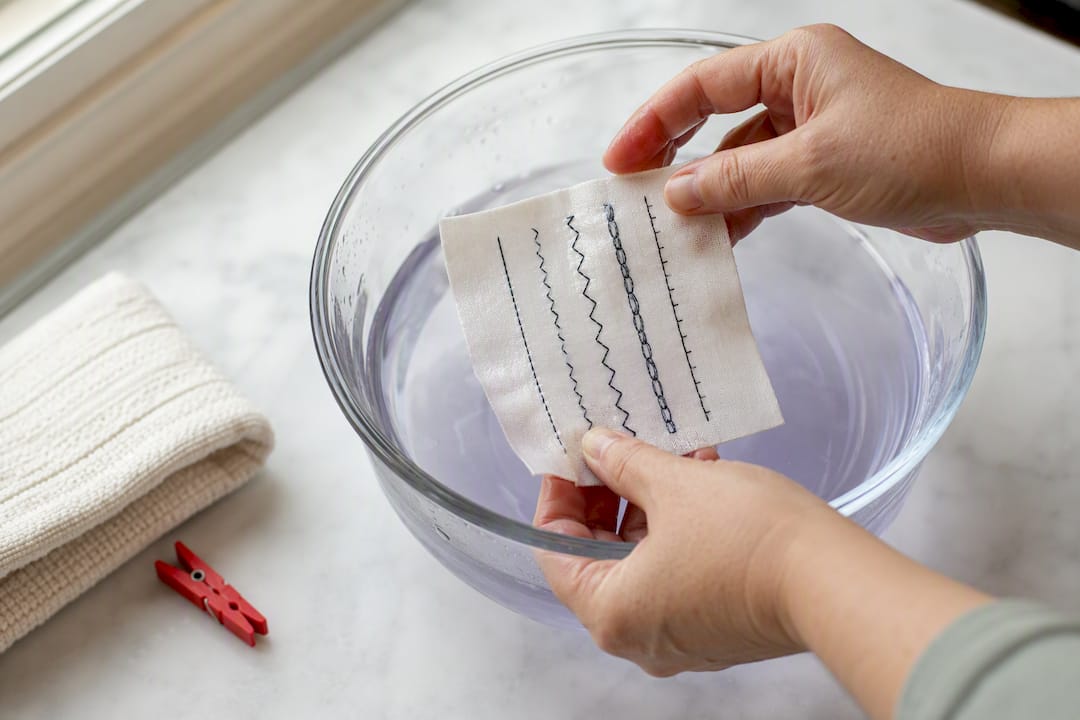
If you’re working with high-contrast fabric combinations, dark thread against white background, or bright variegated thread on pastel fabric, test a small stitched sample and wash it before committing to the whole project. A quick test avoids discovering dye bleed after you’ve already quilted an entire top.
How Does Thread Twist Change the Way It Stitches?
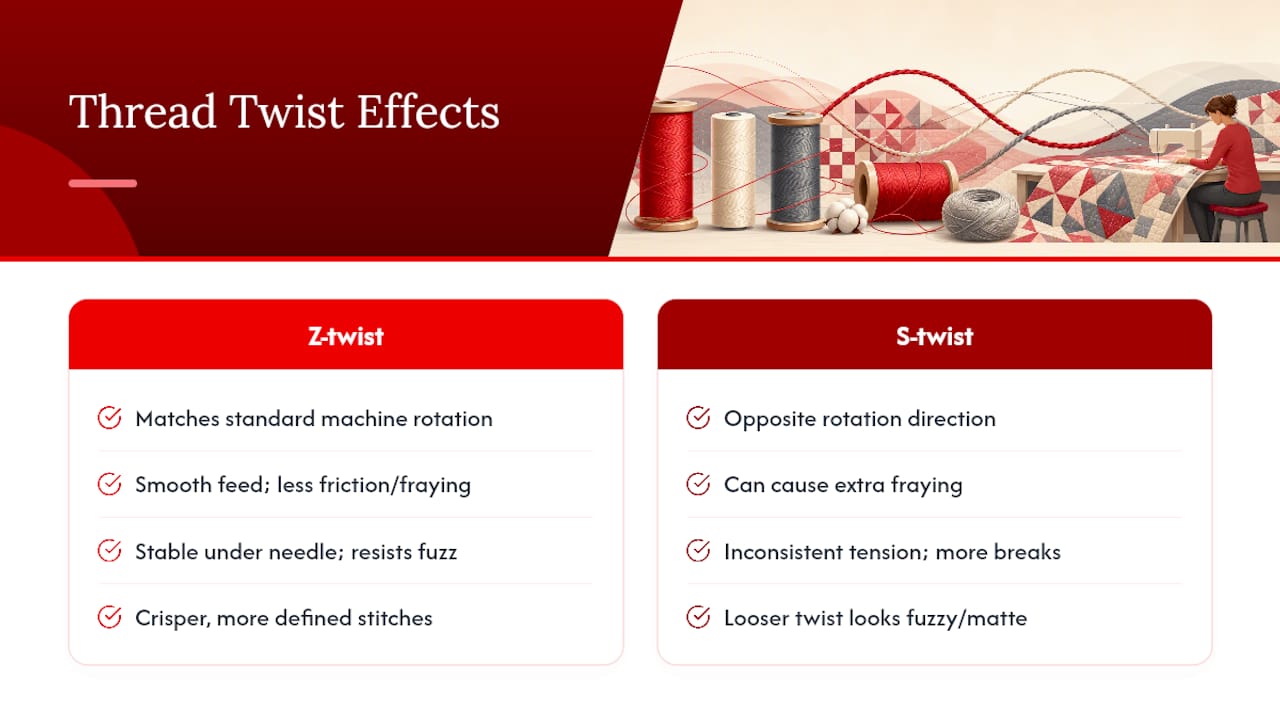
Most machine thread is spun with a Z-twist, meaning the fibers twist in a direction that matches how home sewing machines rotate their needle and hook mechanism. This isn’t a minor manufacturing detail. Z-twist thread feeds more smoothly through standard machines, reducing the friction and fraying that happens when twist direction fights against needle rotation.
S-twist thread, twisted the opposite direction, is less common in general piecing and quilting but shows up in some specialty and hand-sewing threads. Using S-twist thread in a machine built around Z-twist expectations can cause extra fraying, inconsistent tension, and more frequent thread breaks, particularly at higher sewing speeds.
For piecing, twist direction affects how cleanly the thread sinks into a tight seam allowance. A properly twisted Z-twist cotton thread holds its shape under the needle and resists the fuzzing that leads to lint buildup. For quilting, twist affects stitch appearance almost as much as weight does. Tightly twisted thread produces a crisper, more defined line, while loosely twisted thread can look slightly fuzzy or matte once stitched.
The practical guidance here is simple: stick with reputable, machine-rated thread built for standard Z-twist rotation unless a specialty technique specifically calls for something else. Most quilting and piecing thread sold for machine use already accounts for this, so it’s rarely something you need to check on the label, just something to know if a spool behaves oddly.
What Should You Expect to Pay for Each Type?
Piecing thread and quilting thread occupy roughly the same price range, but the format you buy often changes the math. A small spool of quality 50wt cotton piecing thread typically costs a few dollars, while the same brand in a large cone built for continuous piecing sessions costs more upfront but works out cheaper per yard.
Quilting thread, especially 40wt polyester sold on cones for longarm machines, tends to run a bit higher per spool because of the added strength engineering and low-lint coatings manufacturers build in for high-speed use. Specialty threads, rayon, silk, metallic, or variegated cotton, cost noticeably more than standard cotton or polyester, sometimes double or triple, because of dye complexity and lower production volume.
Buying cones instead of small spools saves money for anyone piecing or quilting regularly, since cost per yard drops substantially at that volume. For occasional projects, small spools make more sense even at a higher per-yard price, since you’re not committing to hundreds of yards of a single color you may not reuse.
The real cost consideration isn’t just price per spool. Cheap thread that breaks constantly, sheds excess lint, or fades after a few washes ends up costing more in frustration and rework than a mid-range spool from a reliable manufacturer. Budgeting slightly more for thread on a quilt that took weeks to piece is a small price relative to the time already invested.
Which Brands and Standards Do Quilters Rely On?
Thread weight numbering (the wt system) is the closest thing the industry has to a universal standard, and it’s what lets you compare a spool from one manufacturer against another regardless of brand. A 50wt cotton from one company should behave similarly to a 50wt cotton from another, even if the exact fiber processing differs slightly.
Beyond the numbering system, certain thread categories have earned a strong reputation among quilters for specific tasks. Long-staple, gassed cotton threads are widely recommended for piecing because they shed less lint and hold up under repeated seam stress. For longarm and high-speed machine quilting, low-lint polyester cones are the standard recommendation because they’re built to resist breaking during continuous, uninterrupted quilting runs.
Rather than chasing a single “best” brand, look for threads explicitly labeled for piecing versus quilting or longarm use. Manufacturers design these differently on purpose, adjusting ply count, finish, and tensile strength for the specific stress each job puts on the thread. Our task by task thread guide breaks down which weight and fiber combination fits specific quilting techniques if you want a more granular starting point than fiber and weight alone.
Why Trust This Thread Guidance?
This guidance comes from Chris on the Sewingmachinesplus blog, drawing on patterns that show up constantly during machine consultations with quilters at every skill level. Customers bring in tension problems, thread breakage, and lint complaints far more often than they realize thread choice is the actual culprit, not their machine.
This guidance comes from hands-on troubleshooting experience, supported by extensive customer feedback and years of fitting the right thread, needle, and machine setup to real projects. The recommendations here reflect what actually solves problems at the sewing table, not just what sounds correct on paper.
— Chris
Get the Right Thread, Needles, and Advice for Your Next Quilt
Choosing between piecing thread and quilting thread gets a lot easier once you have the right needles, feet, and a machine that handles tension consistently. Personalized consultations on weight, fiber, and needle pairing can help before you buy thread, and looking for a good price and shipping options is worth considering.
If your seams are puckering or your bobbin keeps jamming, our quarter-inch quilting and patchwork foot is a practical upgrade worth pairing with the right thread for more accurate piecing. Browse the full Sewingmachinesplus catalog for thread, needles, and quilting feet, or reach out for a consultation before your next project so you’re threading the machine correctly the first time.
Sources
- Understanding quilting thread weight: simple rules for perfect pairing
- Choose threads for patchwork and quilting
- What is the Best Quilting Thread? Our Experts Have the Answers
- A Quilter’s Guide to Choosing the Best Quilting Thread
FAQ
Can I Use Quilting Thread for Normal Sewing?
Yes, 40wt quilting thread works fine for general sewing, though it can add slightly more bulk to seams than a finer 50wt or 60wt thread built for piecing.
What Is the Difference Between Piecing and Quilting?
Piecing joins fabric pieces into blocks and a quilt top, while quilting stitches through the top, batting, and backing together to hold the whole quilt sandwich in place.
What Thread Should I Use for Piecing a Quilt?
A 50wt to 60wt cotton thread is the standard choice for piecing because it minimizes seam bulk and keeps intersections flat.
Is There a Difference Between Sewing Thread and Quilting Thread?
General sewing thread is often a mid-weight all-purpose thread, while dedicated quilting thread is engineered for either fine piecing seams or visible, durable stitching depending on its weight and fiber.
