

For most hobbyist sewists, a standard sewing machine should be your first purchase. A serger is a complementary tool that speeds up seam finishing and does beautiful work on knits, but it does not replace a sewing machine’s ability to install zippers, sew buttonholes, or handle general construction. Once you know how these two machines split the workload, the decision checklist below will tell you exactly when a serger earns its spot on your table.
TL;DR:
- Sergers use multiple threads to create stretchy, fray-proof overlock stitches that finish edges quickly, but they cannot sew buttonholes or install zippers.
- They are ideal for repetitive seam finishing on knit garments or when producing multiple identical items like t-shirts or leggings.
- Cost varies from affordable basic models to high-end machines but requires more maintenance, including frequent blade replacements and lint cleanup.
- Threading a serger is more complex due to multiple thread paths and tension management, requiring practice with contrasting threads and scrap fabric.
- Most hobbyists should start with a sewing machine for general construction, adding a serger later when seam finishing slows workflow or projects involve knits.
Table of Contents
- Serger vs Sewing Machine: The Core Mechanical Differences
- Do I Need a Serger, and When Should I Buy One?
- What Sergers and Sewing Machines Actually Cost to Own
- Why Sergers Have a Steeper Learning Curve
- What Chris at Sewing Machines Plus Tells Buyers
- Get Serger-Style Finishes on a Sewing Machine Right Now
- Buy the Machine That Fixes Your Actual Bottleneck
- Get Matched With the Right Machine Setup
- Sources
- FAQ
Serger vs Sewing Machine: The Core Mechanical Differences
The gap between these two machines starts with the stitch itself. A sewing machine forms a lockstitch using one top thread and one bobbin thread locked together inside the fabric. A serger, by contrast, uses 3 to 5 threads fed through loopers that wrap and interlock around the raw edge as it sews, a process explained well in this overview of overlocking machines. That thread count difference is the whole story: more threads mean more stretch, more coverage, and a finished edge that won’t fray, but also a much fussier setup when something goes wrong.
Sergers come with a built-in cutting knife that trims the seam allowance in the same pass that sews it, plus a differential feed that lets you stretch or ease fabric as it moves under the needle. That combination is why knits behave so well on a serger. A detailed comparison of the two machine types confirms the split: sergers finish and trim edges in one motion, while sewing machines rely on a separate bobbin and top thread system built for structural, load-bearing seams.
Here’s what each machine can and cannot do:
- A serger cannot sew buttonholes. No looper configuration replaces the buttonhole stitch a sewing machine produces.
- A serger cannot install a zipper. Zipper feet, precise straight stitching, and reverse-stitch tacking are sewing machine territory.
- A serger struggles with heavy, multi-layer quilting. Its knife and narrow stitch bed aren’t built for bulky sandwiches of batting and backing.
- A sewing machine can approximate an overlock stitch with a zigzag or overcasting foot, but it won’t trim as it sews.
- A sewing machine handles topstitching and reinforcement that a serger’s stitch formation isn’t designed to replicate.
Think of it this way: a sewing machine builds the garment, and a serger cleans up and reinforces the seams once they’re built.
Do I Need a Serger, and When Should I Buy One?
The honest answer depends on what’s sitting in your project pile right now, not on how advanced you feel as a sewist. Most hobbyists start with a sewing machine, and a serger gets added later, once knit garment work or repetitive seam finishing becomes the actual bottleneck slowing them down, according to guidance on when to add a serger to your setup. If your projects are mostly quilts, home decor, mending, or anything involving zippers and buttonholes, a sewing machine covers essentially everything you’ll need.
Use this simple flow to sort yourself:
- If most of your projects are wovens, repairs, or require zippers and buttonholes, buy a sewing machine first, full stop.
- If you’re sewing knit garments weekly and finishing seams by hand or with slow zigzag workarounds, a serger will save real time.
- If you’re producing multiples of the same garment, like a run of t-shirts or leggings, a serger can cut your finishing time roughly in half compared to finishing each seam on a sewing machine.
- If your sewing space is tight or you rarely sew knits, hold off. A second machine that sits idle isn’t saving you anything.
Frequency matters more than ambition here. Occasional sewists rarely get their money’s worth from a serger, while quilters and bag-makers, in particular, tend to see limited return since the Craftsy guide to choosing a serger points out that project type, not skill level, should drive the purchase.
Pro Tip: Before buying a serger, track your projects for a month. If knit seams and rolled hems show up more than twice a week, that’s your signal.
What Sergers and Sewing Machines Actually Cost to Own
Entry-level sewing machines typically run in the low hundreds of dollars, midrange models with more stitch options and automatic features land in the mid-hundreds, and high-end machines with embroidery or quilting extras climb well beyond that. Sergers follow a similar spread. Basic 3 or 4 thread models sit at the affordable end, while 5-thread sergers and coverstitch-capable machines cost significantly more because they’re built for specialized finishes rather than everyday overlocking, a distinction the Spruce Crafts guide to serger types lays out clearly.
Ownership costs diverge fast, though. A sewing machine mostly needs occasional needle changes and cleaning. A serger demands more upkeep:
- Multiple thread cones instead of one, since most sergers run 3 to 5 spools at once.
- Replacement knife blades as they dull with use.
- More frequent lint cleanup around the loopers, where fabric trimmings collect.
- Occasional professional servicing to keep tension and timing accurate.
If cost is a concern, look at bundled starter kits, refurbished machines, or retailers offering financing and price-match guarantees so you’re not paying full retail while you’re still deciding whether a serger fits your workflow. A maintenance guide is worth bookmarking regardless of which machine you buy.
Why Sergers Have a Steeper Learning Curve
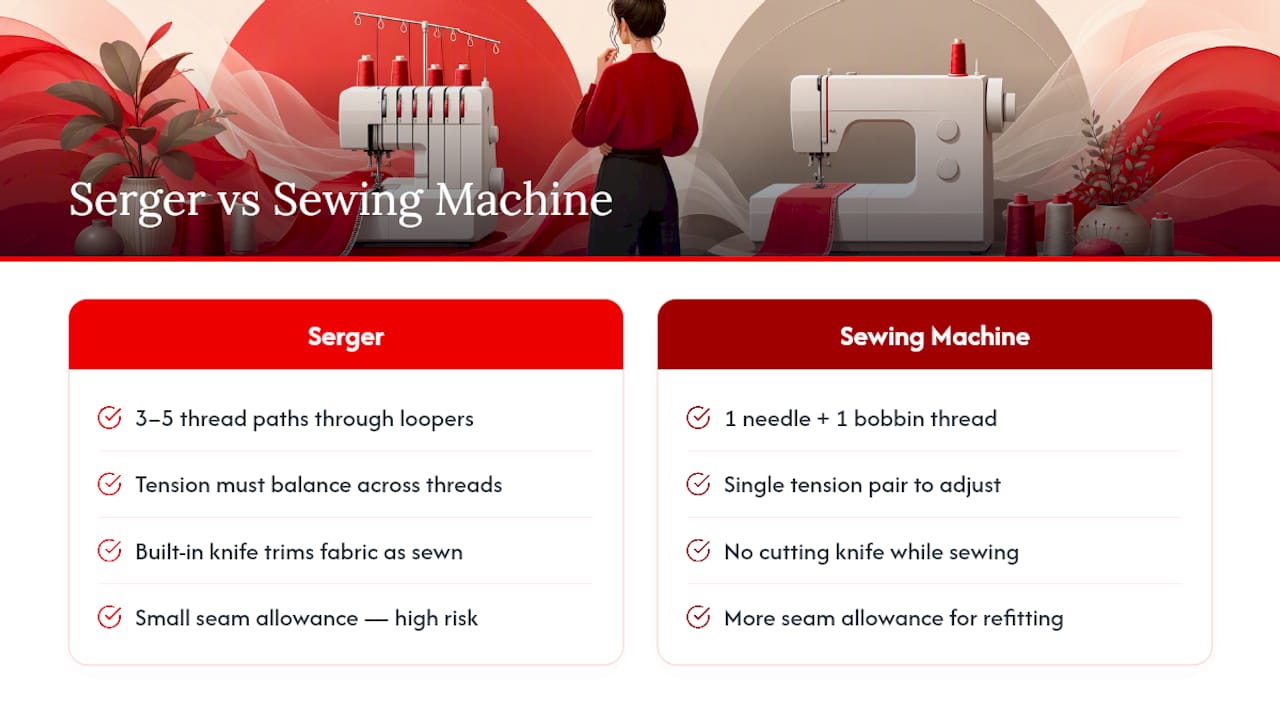
Threading a serger is genuinely harder than threading a sewing machine, and that’s not a knock on your skills. You’re managing 3 to 5 thread paths through loopers instead of one bobbin and one needle thread, and tension has to balance across all of them simultaneously. Get one dial wrong and you’ll see loose loops or puckered seams instead of a clean overlock.
The knife adds its own risk. Because a serger trims fabric as it sews, there’s very little seam allowance margin to work with, which makes it a poor tool for the kind of iterative fitting where you sew, try on, and re-sew, according to sewing community discussion on serger seam allowance limitations. One miscalculated seam and the fabric piece is gone.
Newer sergers ease this with color-coded threading paths, air-threading systems, and automatic tension. Even with those features, threading guidance from sewing librarians still recommends practicing with contrasting thread colors on scrap fabric before touching a real project, so you can actually see where each thread travels and reset tension to a known baseline when things go sideways.
What Chris at Sewing Machines Plus Tells Buyers
Chris’s advice to buyers cuts straight through the hype: buy the machine that solves the seam you fight every week. If that’s zippers, hems, or general construction, a sewing machine comes first. If knit garment seams are eating your time, a serger earns its place next. Sewing Machines Plus has spent over 50 years as an authorized dealer, backed by more than 175,000 positive customer reviews, and offers free consultations plus financing so you can build a starter setup, sewing machine and serger together, without guessing at compatibility or overspending upfront.
Get Serger-Style Finishes on a Sewing Machine Right Now
You don’t need a serger to clean up raw edges today. A narrow zigzag or mock safety stitch on your sewing machine mimics an overlock reasonably well on lighter knits, and switching to a rolled-hem or overcasting foot tightens up the finish further. Press seams open and trim close with sharp shears before stitching, and the edge will look far more professional than a straight seam left raw.
If you want to test whether a serger fits your workflow before buying one:
- Borrow one from a friend or sewing group for a weekend project.
- Take a beginner serger class at a local fabric shop.
- Check whether a nearby maker space rents machine time by the hour.
Buy the Machine That Fixes Your Actual Bottleneck
The gadget trap in sewing is real: it’s easy to buy a serger because it looks impressive, then let it collect dust because your actual projects never needed one. Pair any serger purchase with a real threading lesson, not just the manual, because a machine you’re afraid to thread is a machine you won’t use. The verdict stands: get a sewing machine first, add a serger only when knit seams or repetitive finishing start slowing you down.
— Chris
Get Matched With the Right Machine Setup
Choosing between a sewing machine and a serger doesn’t have to be a solo guessing game. Sewing Machines Plus offers free personalized consultations to match your project mix, whether that’s garment sewing, quilting, or repair work, with the right machine or combination of machines. You’ll also get access to financing options, a price-match guarantee, and free shipping on orders over $49, so building out a starter setup doesn’t mean paying full price twice while you figure out what you actually need. Start by browsing sewing machines and sergers to compare current models, or use the buyer’s checklist to narrow down features before you book a consultation.
Sources
- When to Use a Serger vs Sewing Machine: Complete Guide
- Understanding serger or overlocking sewing machine - The Spruce Crafts
- Sewing Machine vs. Serger: What Is the Difference? - Spindle and Spoon Homestead
FAQ
Can You Use a Serger as a Normal Sewing Machine?
No. A serger can’t sew buttonholes, install zippers, or handle the precise construction stitching a sewing machine performs, since it’s built to trim and finish edges, not build garments from scratch.
What Can a Serger Do That a Sewing Machine Can’t?
A serger trims and encloses a seam edge in a single pass using 3 to 5 threads, producing a stretchy, frayproof finish on knits that a standard lockstitch sewing machine can only approximate with a zigzag.
Does a Beginner Need a Serger?
Most beginners don’t need one right away. A sewing machine covers the bulk of early projects, and a serger becomes worthwhile once knit garments or repeated seam finishing become a regular part of your sewing routine.
Can a Normal Sewing Machine Do Overlocking?
Not exactly, but you can get close. A narrow zigzag, mock safety stitch, or an overcasting foot on a sewing machine will finish an edge reasonably well, though it won’t trim the fabric or stretch as cleanly as a true overlock stitch.
