

Most beginners and hobbyist quilters can start on a quality domestic sewing machine paired with the right accessories, and skip the quilting machine question entirely for now. You only need a dedicated quilting machine, whether a domestic quilting model, mid-arm, or longarm, if you regularly make large or bulky quilts, or you want the speed and comfort of a bigger workspace. Before buying anything, check throat space, walking foot or dual feed, motor strength, and how much workspace you actually have.
TL;DR:
- Most hobbyist quilters can meet their needs with a domestic sewing machine equipped with a walking foot and extension table, without needing a dedicated quilting machine.
- Throat space and feed system features, such as a walking foot or dual feed, are crucial for handling large, layered quilts and preventing puckering or shifting during quilting.
- Machines with at least 9 inches of throat space suit small and lap quilts, while mid-arm and longarm models, with throats of 15 inches or more, are necessary for larger projects and volume quilting.
- A stronger motor and features like needle up/down controls, variable speed, and large bobbins significantly improve quilting comfort and consistency on any machine.
- For most hobbyists, upgrading accessories like walking feet and extension tables is often sufficient, reserving longarm use for volume or professional quilting projects.
Table of Contents
- Quilting Machine vs. Sewing Machine: Key Differences at a Glance
- Why Throat Space, Feed, Motor, and Controls Matter
- Domestic, Mid-Arm, and Longarm: Which Class Fits You?
- How to Quilt on a Regular Sewing Machine
- Choosing the Right Machine for Your Quilting Goals
- Author Perspective and Publisher Proof Points
- Who Benefits Most From Each Machine Type
- How Sewingmachinesplus Can Help
- Sources
- FAQ
Quilting Machine vs. Sewing Machine: Key Differences at a Glance
The gap between a domestic sewing machine and a dedicated quilting machine comes down to four things: how much fabric fits under the arm, how the layers feed through, how hard the motor works, and what it costs you in dollars and floor space.
Domestic machines typically offer throat spaces under 9 inches, while mid-arm and longarm machines stretch to 12 to 30 inches or more. That extra room changes how you physically wrestle a queen-size quilt sandwich through the machine. Feed systems matter just as much. A machine without a walking foot or dual feed tends to let the top layer creep ahead of the backing, which causes puckering and shifted seams by the time you reach the far edge of a quilt. Motor strength shows up when you are punching a needle through batting, backing, and top fabric all at once, especially on dense stipple quilting.
- Throat space: under 9 inches on most domestic machines; 12 inches or more on mid-arm and longarm setups
- Feed system: standard feed dogs on entry machines; walking foot or built-in dual feed on quilting-focused models
- Speed: domestic free-motion quilting often runs 100 to 300 stitches per minute, longarm systems run much faster
- Cost and space: domestic machines fit on a craft table; longarms need a dedicated frame and room
Budget and square footage often decide this before features do. A longarm setup is a serious commitment. A domestic machine with the right foot attached is not.
Why Throat Space, Feed, Motor, and Controls Matter
Throat space is the single feature quilters underestimate until they are fighting a king-size quilt through a 6-inch gap at 11 PM. Buying guides for quilters consistently rank throat space as the top priority for good reason: a wider harp area means less bunching, fewer stalls, and less strain on your shoulders as you shove yardage through the machine. Domestic machines generally sit under 9 inches. Domestic quilting-capable models push that closer to 11 or 12 inches, which is often enough to handle a lap quilt or throw without a fight.
Feed is the second lever. A walking foot or integrated dual feed grips the top and bottom layers evenly as they move through the machine, which is exactly what stops the shifting and puckering that ruins an otherwise good quilt top. Free-motion or darning feet serve a different purpose. They drop the feed dogs entirely so you can steer the fabric by hand for stippling, feathers, or custom motifs.
Motor power rarely gets mentioned in spec sheets, but it decides whether your stitches stay consistent through eight layers of cotton batting or bog down and skip. A stronger motor also protects your needle from bending mid-seam.
Beyond torque, a few controls make quilting sessions noticeably less frustrating:
- Needle up/down positioning lets you pivot precisely without hand-cranking the wheel
- Variable speed control slows things down for tight curves and speeds up for straight lines
- Automatic thread cutters save time on projects with dozens of starts and stops
- Large-capacity bobbins mean fewer mid-seam interruptions on big projects
Pro Tip: Match your top thread and bobbin thread type and weight when quilting through thick sandwiches. Mismatched tension between the two is one of the most common causes of skipped stitches and thread breaks on dense quilting.
Domestic, Mid-Arm, and Longarm: Which Class Fits You?
Machine categories map almost directly to project size, and picking the wrong category is how people end up either underpowered or overpaying.
- Domestic sewing machines handle piecing, small quilts, and table runners well. Their limited throat space and standard feed dogs start working against you once you get past lap-quilt size.
- Domestic quilting-capable machines offer a larger throat, roughly 10 to 12 inches, and a sturdier motor built for hobbyists who regularly finish bed-size quilts without going pro.
- Mid-arm machines trade portability for throat space, often 15 to 20 inches, but they are usually quilting-only tools. Expect a higher price tag and a permanent spot on a frame in your sewing room.
- Longarm machines are the fastest option, often quoted at 1,500 to 3,000 stitches per minute, but they demand real square footage and a serious budget, which usually only makes sense for volume quilters or small businesses.
If none of those fit your life right now, renting time on a shop’s longarm, or sending a finished top out to a longarm service, is often the smartest move. Plenty of hobbyists piece their quilt tops at home and hand off the actual quilting to a longarm operator for the final pass, which sidesteps the biggest expense entirely.
How to Quilt on a Regular Sewing Machine
You can quilt on a standard domestic machine, and most quilters actually start this way. A short accessory list closes most of the functional gap before you ever need to shop for something bigger.
Start with a walking foot. It is the single accessory most likely to fix shifting and puckering on layered fabric. Add an extension table to give your quilt sandwich something flat to rest on instead of sagging off the edge of your machine bed. A 1/4-inch piecing foot keeps your seams consistent during the piecing stage, and a darning or free-motion foot opens up stippling and custom quilting once you’re past straight-line work. Quilting needles, sized for the thicker layers, round out the list.
- Chain piece blocks to save thread and time before you ever start quilting
- Baste your sandwich with pins or spray adhesive so layers don’t crawl mid-seam
- Trim and press seams flat before layering, since bulky seams jam under a regular foot
- Lengthen your stitch for quilting (roughly 2.5 to 3.0mm) versus piecing (around 2.0 to 2.5mm)
- Slow your speed for free-motion curves and let the walking foot run faster on straight lines
Pro Tip: If you keep breaking needles, fighting tension on every third seam, or your shoulders ache from wrestling a quilt through a narrow harp, those are the real signals your current machine has hit its limit, not the calendar or somebody else’s opinion.
Choosing the Right Machine for Your Quilting Goals
Buying decisions get easier once you separate “what I want” from “what I actually make.” Answer these honestly before you spend a dollar.
- How big are your typical projects? Table runners and baby quilts rarely justify anything beyond a domestic machine with a walking foot. Bed-size quilts made several times a year start justifying a domestic quilting-capable model.
- How often do you quilt? Occasional hobbyists get more value from a $200 to $600 domestic machine plus accessories than from stretching for a machine they’ll use twice a year.
- What’s your realistic budget? Hobbyist domestic quilting machines commonly run $600 to $2,500, a range worth checking against current dealer pricing before you commit.
- How much floor space do you have? A mid-arm or longarm needs a permanent, dedicated footprint, not a table you clear off once a month.
For a fast reference, keep this checklist handy: throat space of at least 9 to 10 inches, a walking foot or dual feed, a motor that doesn’t bog down on four or more layers, needle up/down control, and a bobbin sized for long, uninterrupted seams. Those five items decide more about your quilting experience than any decorative stitch count ever will.
Author Perspective and Publisher Proof Points
Choosing between a quilting machine and a sewing machine is easier with hands-on comparison, not just spec sheets. Some retailers offer personalized consultations and showroom demos where you can test throat space and feed handling before buying, backed by financing options and price match guarantees. With many customer reviews available, experienced sellers have seen the full range of quilters, from beginners piecing their first lap quilt to hobbyists sizing up a domestic quilting-capable upgrade, and can help you match a machine to your actual projects.
— Chris
Who Benefits Most From Each Machine Type
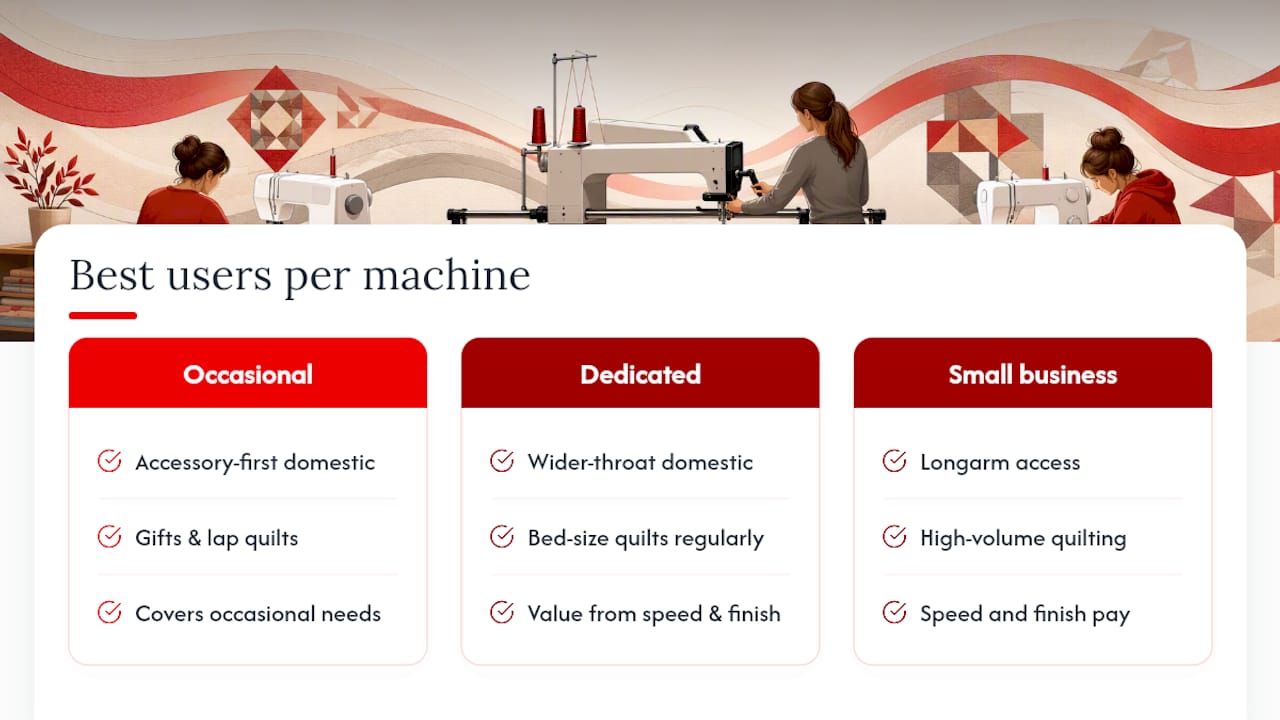
If you make gifts or occasional lap quilts, an accessory-first approach on a domestic machine covers you completely. Dedicated hobbyists finishing bed-size quilts regularly get real value from a domestic quilting-capable machine or a higher-tier domestic model with a wider throat. Small-business quilters and anyone quilting for others in volume should be looking at longarm access, whether owned or rented, since that’s where speed and finish quality actually pay for themselves.
How Sewingmachinesplus Can Help
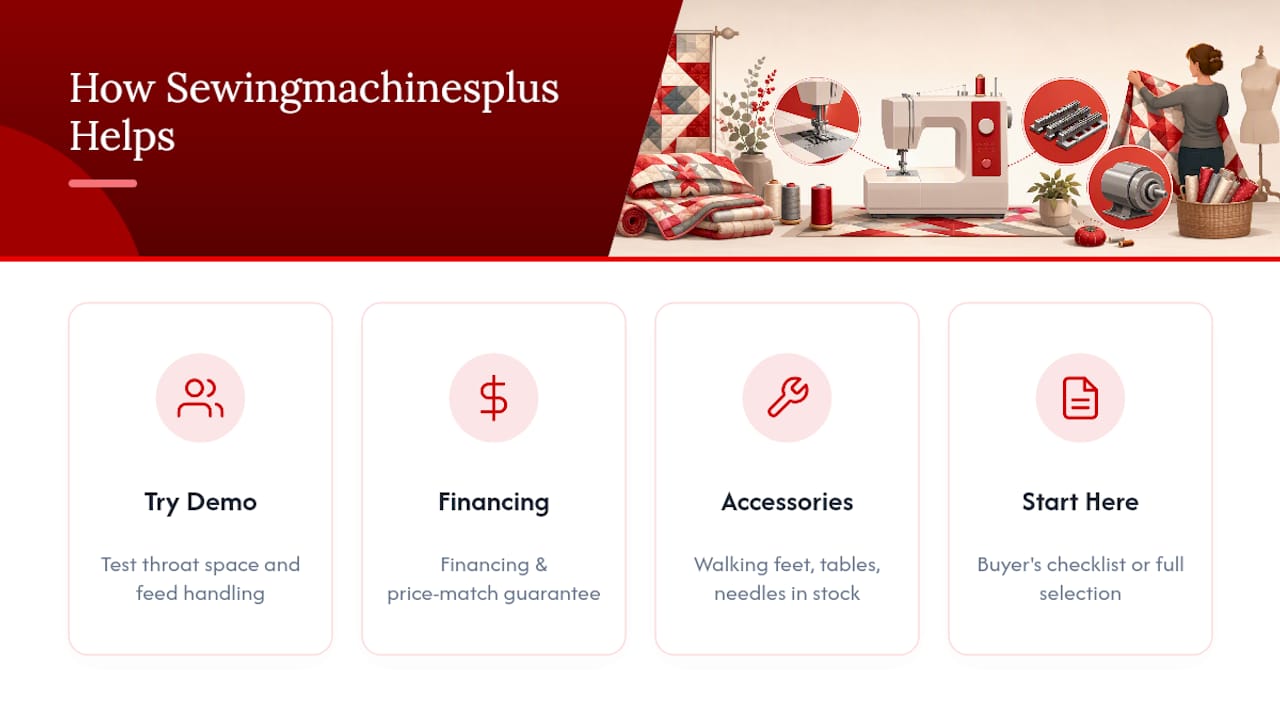
Reading specs online only gets you so far when the real question is how a machine feels under your hands with a heavy quilt sandwich in motion. Sewingmachinesplus lets you book a consultation or showroom demo to test throat space and feed handling before you commit, backed by financing options and a price match guarantee so a bigger machine fits your actual budget instead of straining it. If you’re not ready to upgrade the machine itself, the accessories that close most of the gap, walking feet, extension tables, and quilting needles, are all in stock and ready to ship. Start with a buyer’s checklist or head straight to the full machine and accessory selection to see what fits your next quilt.
Sources
- The Ultimate Sewing Machine Buying Guide for Quilters and Sewists
- Domestic vs. Longarm Quilting: Which is Best?
- Tips for machine quilting with a walking foot
FAQ
Can I Use a Regular Sewing Machine for Quilting?
Yes. A domestic sewing machine with a walking foot, extension table, and quilting needles handles most lap-size and bed-size quilting projects without trouble. Many quilters start this way and only upgrade once project size or frequency outgrows the machine.
What Does “Dirty Quilting” Mean?
“Dirty quilting” typically refers to using mismatched or contrasting thread colors on purpose, letting stitching show as a visible design element rather than blending in. It is a style choice, not a defect, and it has nothing to do with the machine you use.
Can You Quilt Without a Regular Sewing Machine?
Yes, hand quilting is a long-standing tradition that predates any machine, and it remains popular for heirloom-quality work. Outside of hand stitching, some quilters skip owning a machine entirely and send finished tops to a longarm service instead.
What Can You Do With a Quilting Machine?
A dedicated quilting machine, whether a domestic quilting model, mid-arm, or longarm, lets you finish larger quilts faster with less physical strain thanks to a wider throat and stronger motor. Longarm systems in particular add speed and professional-grade stitch consistency that’s hard to match on a standard domestic machine.
