

If you finish fewer than six quilts a year and love the hands-on control of guiding fabric yourself, a domestic quilting machine will serve you well. If you routinely finish large quilts, quilt for other people, or want to cut hours off every project, a longarm earns its space and cost. Everything else in this decision comes down to volume, size, and how much floor space you’re willing to give up.
TL;DR:
- Longarms provide significantly larger throat space, with 15 to 30 inches, making large quilt handling faster and less physically taxing than domestic machines.
- For finishing more than six quilts per year or large projects regularly, a longarm can justify its higher cost through time savings and improved stitch consistency.
- Domestic machines are more affordable, occupy less space, and are better suited for detailed free-motion work, but they slow down with large quilts due to limited throat space.
- Initial longarm costs start in the low thousands and include ongoing maintenance, while domestic machines cost a few hundred to a couple of thousand dollars with lower upkeep.
- For occasional quilting or smaller volumes, renting longarm time or buying used frames often offers a more economical and practical solution than full ownership.
Table of Contents
- Domestic Vs. Longarm Quilting: What Actually Moves?
- Pros And Cons: The Real Tradeoffs
- How Do You Decide Which Machine To Buy?
- What Do Costs And Maintenance Really Look Like?
- Can You Combine Both Approaches?
- Where Can You Get Expert Guidance On Either System?
- What Surprises Most New Quilters About This Choice?
- Ready To Try Before You Buy?
- Sources
- FAQ
Domestic Vs. Longarm Quilting: What Actually Moves?
The single biggest mechanical difference between these two systems is which part moves. On a domestic machine, you push and guide the quilt under a stationary needle. On a longarm system, the machine itself travels over a quilt mounted on a frame, or rides along a table mounted rail. That single distinction shapes almost everything else about how each machine behaves.
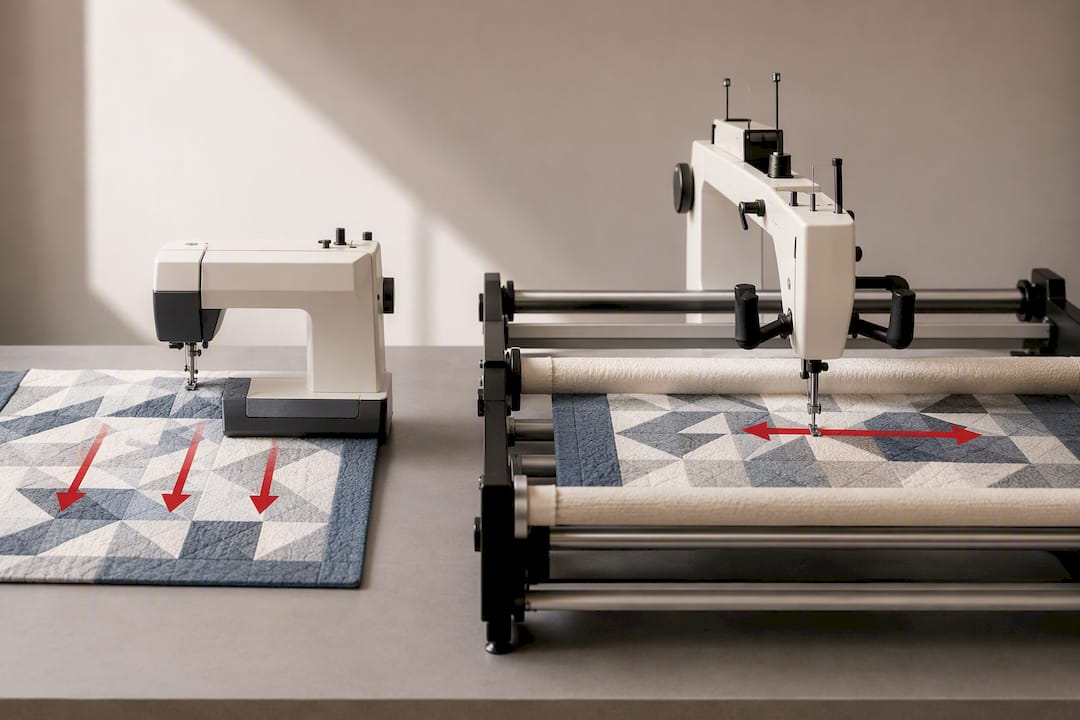
Throat space, sometimes called harp space, tells you how much room you have between the needle and the machine body. Domestic machines typically offer under 9 to 12 inches of throat space, which is plenty for lap quilts and table runners but tight once you’re wrestling a king-size quilt through the machine. Longarms offer 15 to 30 inches or more, letting you maneuver large sections without bunching or shifting the fabric.
You’ll also run into the term “midarm” while shopping. Treat it carefully. Experts generally recommend judging a machine by its actual specs, throat size, feed dog presence, frame compatibility, rather than trusting a marketing label that different brands define differently.
Stitch regulation and computerized pattern systems appear on both types of machines now, but they matter more on longarms, where consistent tension across a large mounted quilt is harder to achieve by feel alone. These systems reduce fatigue on long sessions and lock in even stitch length, though they add real complexity, including the need for calibration and occasional software updates.
The workflow differences show up clearly in design choices:
- Longarms handle pantographs and digitized repeating patterns easily because the machine head glides horizontally across a stationary quilt, tracing a pattern beneath the frame.
- Domestic machines excel at free-motion detail work, thread painting, and custom stippling, where you want direct tactile control over every curve.
- Longarm frame setups (sit-down, table-mounted, or full floor frame) determine how much of the quilting process is automated versus manual.
- A walking foot on a domestic machine closes some of the gap for straight-line and grid quilting, even without a frame.
Pros And Cons: The Real Tradeoffs
Domestic machines win on flexibility and price. You can piece, appliqué, and quilt on the same machine, store it in a closet, and take it to a class. The tradeoff shows up on big projects: limited throat space slows you down, and rolling a queen or king quilt through repeatedly puts real strain on your back and shoulders.
Longarms win on speed and consistency. Once you’ve built the skill, a longarm can cut the time to quilt a queen-size quilt to a fraction of what the same project takes on a domestic machine, thanks to higher stitch rates and a frame that keeps tension even across the whole surface. The tradeoff is upfront cost, a dedicated room or corner, and a maintenance routine that’s less forgiving than a home machine’s.
Domestic machine pros:
- Lower cost and no dedicated space required
- Portable enough for classes or a sewing room
- Better suited to detailed, artistic free-motion work
Domestic machine cons:
- Limited throat space slows large quilts
- Physical strain from repeatedly repositioning heavy fabric
- Slower stitch speed overall
Longarm pros:
- Much faster finishing time on large quilts
- Consistent tension and professional-looking stitch quality
- Pantograph and computerized options for repeatable patterns
Longarm cons:
- High purchase price and setup cost
- Requires dedicated floor space
- Steeper learning curve and more frequent maintenance
Stitch speed check: Longarm systems generally run at higher stitch rates than domestic machines, which is the main reason experienced longarm quilters finish large projects in a fraction of the time a domestic machine requires for the same quilt, according to Sewvanta’s comparison of the two systems.
How Do You Decide Which Machine To Buy?
The clearest signal isn’t your budget. It’s how many quilts you finish each year and how big they typically run. Quilters who make six or more quilts annually, or who regularly finish large quilts, tend to see a longarm pay for itself in saved time and reduced physical wear. Below that threshold, a domestic machine with a good walking foot usually covers your needs without the added cost and space commitment.
Space matters just as much as volume. A full longarm frame setup typically needs a dedicated room or a permanent corner, roughly 6 by 12 feet at minimum for a mid-length frame, plus good overhead lighting and enough electrical capacity for the motor and any computerized controls. Domestic setups need only a sturdy table and an outlet.
Budget ranges vary widely. Entry-level longarm systems start in the low thousands of dollars, while full computerized frame setups run considerably higher once you add tables and accessories. Renting time on a longarm at a local shop, or buying a used frame secondhand, is a reasonable middle step before committing to a full purchase.
Before you buy, answer these questions:
- How many quilts did you finish last year, and how many do you expect to finish next year?
- What’s the largest quilt size you typically make: throw, queen, or king?
- Do you have a dedicated 6-by-12-foot space with good lighting and power access?
- Would renting longarm time a few times a year cost less than owning one?
- Are you quilting for yourself, or do you want to take in quilts for others?
Pro Tip: If you’re on the fence, rent longarm time for one full quilt before you buy anything. It’s the fastest way to know whether the workflow actually suits how you like to work.
What Do Costs And Maintenance Really Look Like?
Entry-level longarm setups can run several thousand dollars, and full computerized systems with tables and frames run significantly higher from there. Domestic quilting machines cost far less upfront, ranging from a few hundred dollars for a capable home machine to a couple thousand for a heavy-duty model built for quilting.
Ongoing costs differ too. Longarms need regular servicing, timing checks, and occasional part replacement, especially if you’re running them hard for production work. Domestic machines need routine cleaning and the occasional tension adjustment, which most quilters can handle themselves.
Time investment tells the real story:
- A queen-size quilt on a domestic machine, done with free-motion or walking-foot technique, often takes 8 to 15 hours depending on design complexity.
- The same quilt on a longarm, once you’ve built basic skill, frequently finishes significantly faster thanks to higher stitch speed and full-surface access.
- Learning curve for a longarm typically runs several months of regular practice before you’re quilting confidently at speed.
Cost callout: Higher longarm speed is real, but it comes after an investment period. Sewvanta’s comparison notes the time savings show up “once the quilter has developed skill,” not on day one.
Storage matters too. Longarms need a stable, climate-controlled space since temperature swings can affect frame alignment and thread performance. Domestic machines tolerate more variation and store easily in a cabinet or closet between projects.
Can You Combine Both Approaches?
Most hobbyists don’t choose one system forever. A common workflow is piecing and detail work on a domestic machine, then finishing large quilts by renting time on a longarm at a local shop or through a longarm quilting service. This keeps your upfront cost low while still giving you access to frame speed when a project genuinely needs it.
If a full floor frame won’t fit your space, a sit-down or table-mounted longarm offers a middle ground, giving you more throat room than a domestic machine without the footprint of a full frame system.
A rough year-one comparison: renting longarm time for four or five large quilts typically costs a few hundred dollars total, while buying an entry-level longarm outright means several thousand dollars before you’ve finished a single quilt. For occasional big projects, renting almost always wins on cost. For frequent production work, ownership catches up fast.
To map out which path fits your habits:
- Track your quilt count and sizes for one full year before deciding.
- Price out local longarm rental rates and compare against a realistic purchase budget.
- Test a sit-down longarm at a shop demo if floor space is your main constraint.
Where Can You Get Expert Guidance On Either System?
Buying either type of machine is a real investment, and getting hands-on advice before you commit matters. Sewingmachinesplus has operated as an authorized dealer for more than 50 years, backed by over 175,000 positive customer reviews.
What that means for you:
- Personalized consultations to match a machine to your actual quilt volume and space
- Financing options to help spread out the cost of a longarm purchase
- A price-match guarantee and shipping offers on qualifying orders
- Demo scheduling to test throat space and frame handling before buying
A dealer consultation typically covers space planning, frame fit, and basic training expectations, which reduces the risk of buying equipment that doesn’t match your room or your skill level.
What Surprises Most New Quilters About This Choice?
Most beginners underestimate how much space a longarm frame actually needs, or buy a frame larger than their quilt sizes justify. The smarter path is usually sequential: learn free-motion technique on a domestic machine, rent longarm time for a few big projects, then buy only once your quilt count genuinely supports it. Don’t let waiting for “the right machine” keep you from quilting in the meantime.
— Chris
Ready To Try Before You Buy?
You don’t have to guess your way into a longarm purchase. Personalized consultations can help match a machine to your quilt volume, and financing options are available to spread out the cost of a frame system, along with a price-match guarantee to ensure competitive pricing. Whether you’re outfitting a first domestic setup or comparing longarm frames, browse the full lineup of machines and accessories to see what fits your space and budget. If you’re still weighing throat size against your typical quilt dimensions, reach out for a consultation before you commit. It’s the same groundwork a dealer would walk you through in person, just without the pressure of standing in a showroom.
Sources
- Quilting on a Home Machine Versus Longarm Machine
- Prairie Woman Arts — longarm investment guidance
- Domestic vs. Longarm Quilting: Which is Best? - Sewvanta
- Should you buy a long-arm machine? - AllPeopleQuilt
FAQ
What Is The Best Quilting Machine For Home Quilters?
For most hobbyists finishing under six quilts a year, a heavy-duty domestic machine with a good walking foot is the best fit, since it handles piecing, detail work, and moderate quilt sizes at a lower cost. Quilters finishing larger or more frequent projects typically see better value from a longarm.
Can You Quilt A Whole Quilt Without A Longarm Machine?
Yes. Domestic machines can quilt any size project using free-motion or walking-foot techniques, though larger quilts take longer and require more repositioning due to smaller throat space. Many quilters finish queen and king-size quilts entirely on a domestic machine.
What Is “Dirty Quilting”?
“Dirty quilting” generally refers to a loose, informal free-motion style that prioritizes movement and texture over precise, uniform stitching, often used for filler designs rather than showcase patterns. Definitions vary among quilters, so treat it as a style descriptor rather than a fixed technique.
What Is The 60/30/10 Rule In Quilting?
The 60/30/10 rule is a color-balancing guideline, not a machine or stitching rule, suggesting a quilt design use roughly 60% dominant color, 30% secondary color, and 10% accent color. It’s a design planning tool, unrelated to whether you quilt on a domestic or longarm machine.
How Much Does A Longarm Machine Cost Compared To A Domestic Machine?
Entry-level longarm setups typically start in the low thousands of dollars, while full computerized frame systems run considerably higher. Domestic quilting machines range from a few hundred dollars to around two thousand for a heavy-duty model, making them the lower-cost entry point for most hobbyists.
